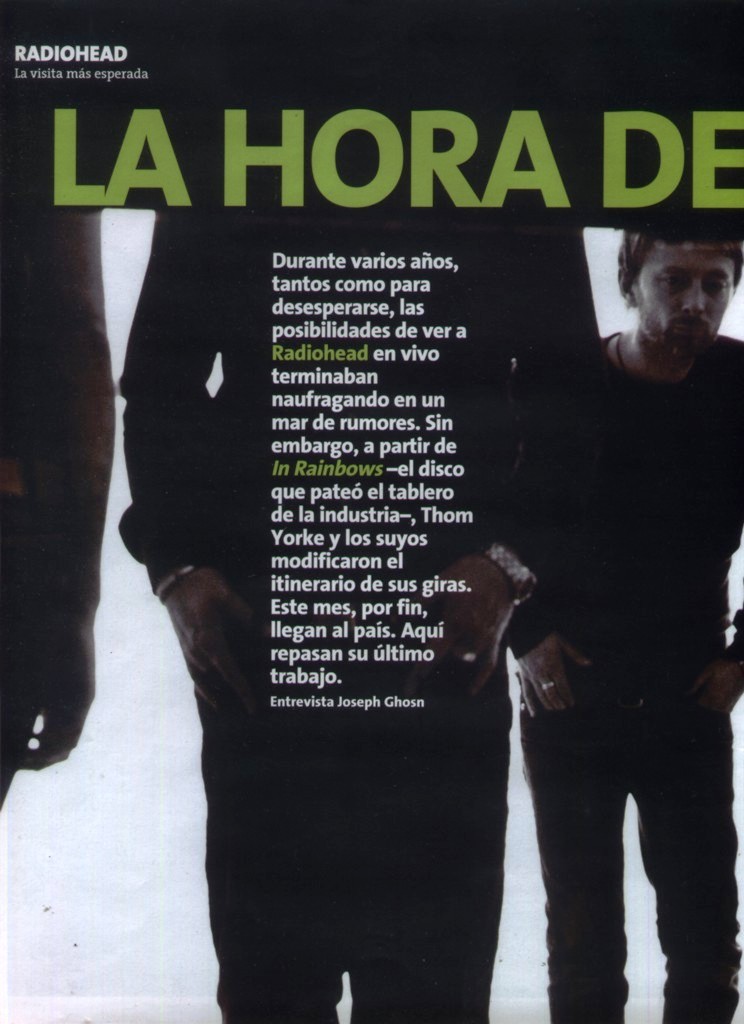
LA HORA DE LA VERDAD
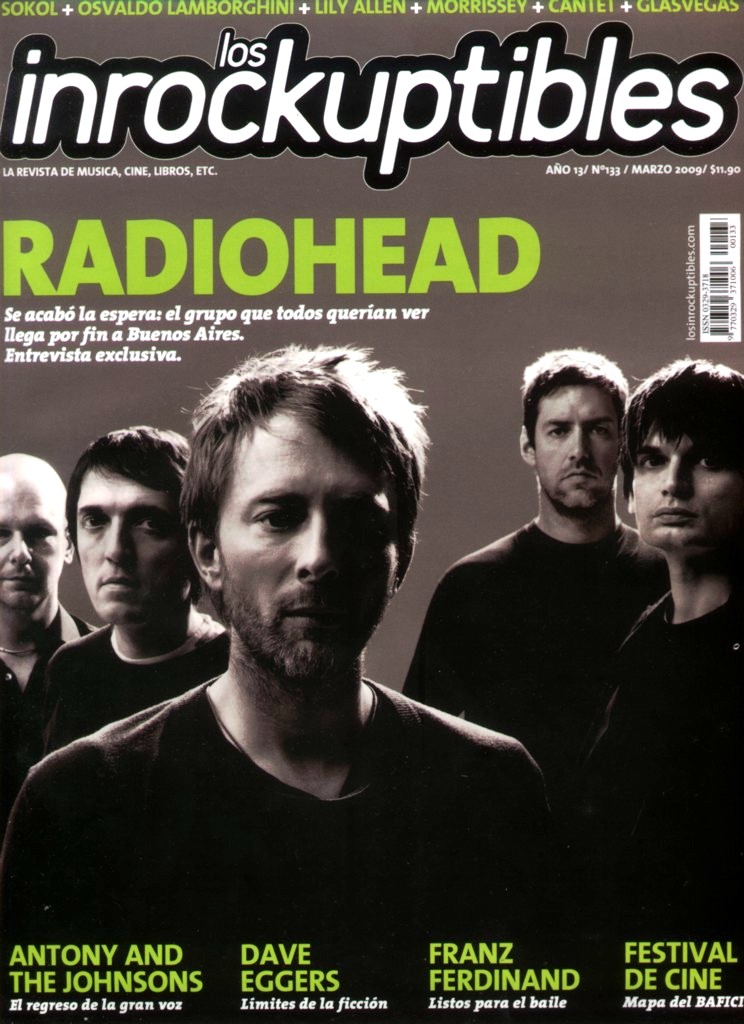
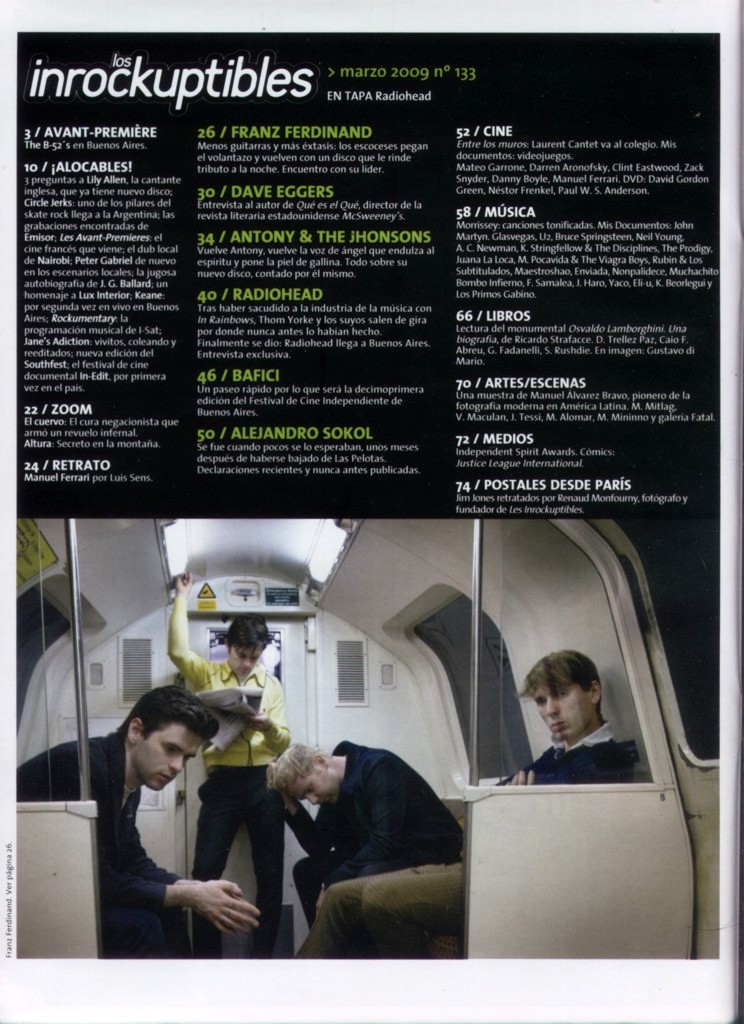
Los Inrockuptibles #133, march 2009
[Click images for full size. The article is a Spanish translation of a French feature that originally appeared in the december 18th 2007 edition of Les Inrockuptibles.]
ENGLISH TRANSLATION
THE HOUR OF TRUTH
For several years, enough for anyone to become desperate, the chances to see Radiohead live shipwrecked in a sea of rumours. However, with 'In Rainbows' - the album that changed the ways of the industry - Thom Yorke and his bandmates changed their tour itinerary. This month, at last, they visit our country. Here they analyse their last album.
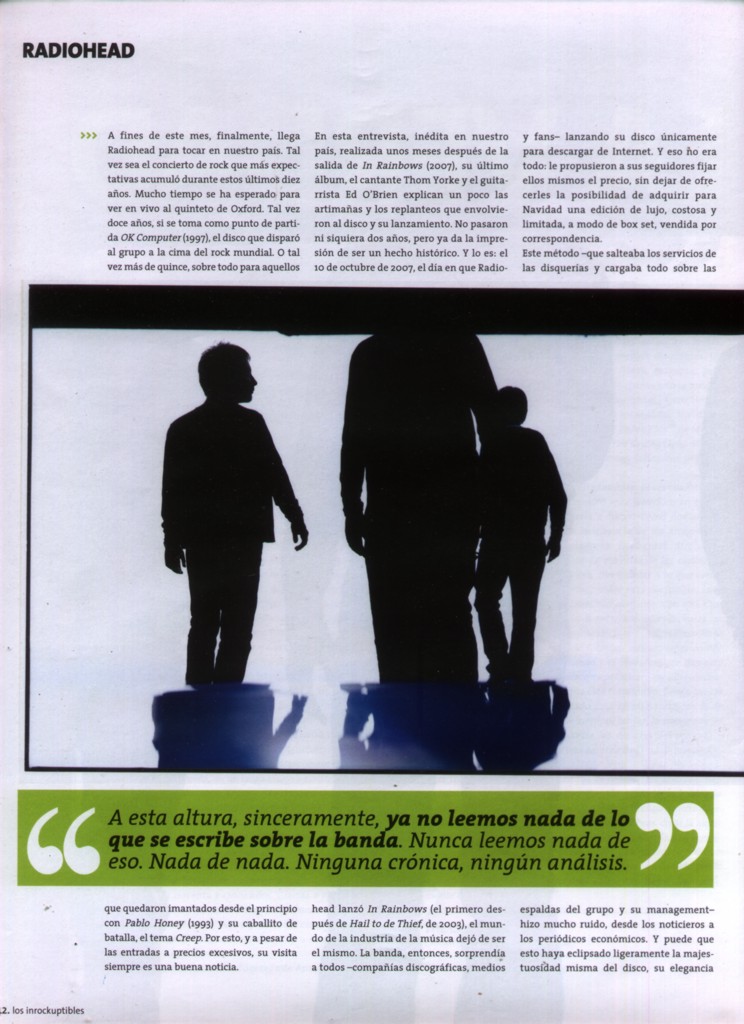
Finally, at the end of this month, Radiohead will visit our country to play live. It may well be the most expected rock show of the last 10 years. We have waited a very long time to see the Oxford quintet live. Maybe 12 years, if you start counting from 'OK Computer' (1997), the album that rocketed the band to the top of the rock world. Or maybe more than 15 years, especially those who stuck to the band from 'Pablo Honey' (1993) and its hobby horse, 'Creep. Because of this, and even though the overpriced tickets, their coming is always good news.
In this interview, unreleased in our country, done a few months after the release of 'In Rainbows' (2007), their last album, singer Thom Yorke and guitar amn Ed O'Brien comment upon the struggle and the things they've reconsidered while making the album and releasing it. Not even two years have gone by, but this seems to be an historical event. And it is: on October 10th 2007, the day Radiohead released 'In Rainbows' (their first album after 'Hail to the Thief' (2003), the music industry changed for ever. The band shocked everyone - record labels, media and fans - by releasing their album as a digital download. And that was not all: they let their fans set the price, allowing them to also buy a deluxe box, delivered by Christmas, sold via mail.
This method - that left out record shops of the equation and relied only on the band and their management - brought a lot of attention towards itself, from TV news to business newspapers. It may have eclipsed a bit the grandeur of the album, its inherent elegance. Thus, besides using new ways of distributing the album - those methods that only Radiohead can allow themselves to use - Thom Yorke and the band delivered the album, an album full of melancholy and doubt, written the old way, not longer than it was necessary (that is to say, both sides of a vinyl). This is an interesting paradox in this digital era, when the ethereal has made its way into the music. Anyway, the album had a physical release, on CD, released on the December 31st 2007. Did they do it for the old fans, so they could have it on their shelves? Maybe. But this was useful to point out that, no matter what format or how do you buy it, an album comes first. A record is a moment in music, which requires an investment - both financial and emotional - on the hearer's side.
INTERVIEW
'In Rainbows' (2007) has become one of the most listened albums of the past few years. What consequences can you expect from an album that was released on the internet first?
Thom: When we released the album on the internet, nothing special happened for us, actually. Each of us was at their homes, waiting ... It was a few weeks later that we felt we needed to talk about it. It was a weird situation, that changed the natural order of things. However, it felt nice to explain in that moment what we had wanted to do in this record.
Ed: It was particularly nice because we didn't have to face the typical and scary question of all journalists: 'could you explain the record to your fans, what does it sound like, how does it sound?'. What a relief!
How did you take the different interpretations on the album?
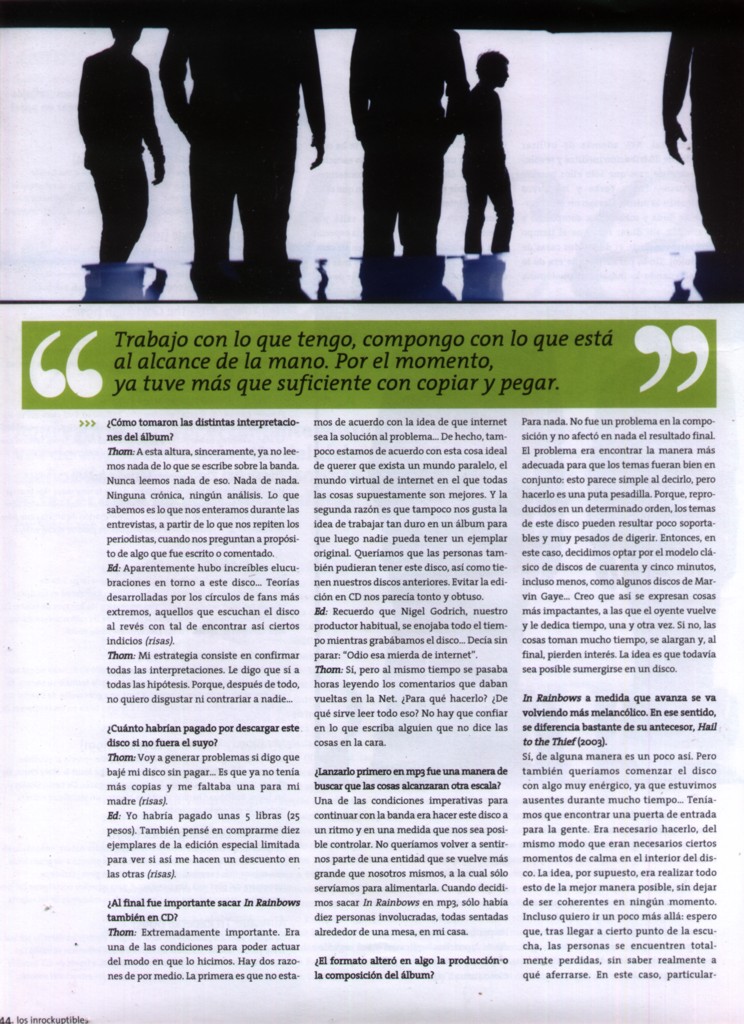
Thom: We don't read anything of what is written about the band nowadays. We never read that. Not at all. No reports, no reviews. What we know is what we are told in the interviews, what the journalists tell us when they ask us about something that was written or said.
Ed: Apparently, there were some really weird lucubration about this album ... theories developed by the hardcore fans, who listen the album in reverse to find some hints [laughs]
Thom: My strategy consists of confirming every interpretation. I say yes to every hypothesis. In the end, I don't want to upset or disappoint anyone ...
How much would you have paid for this record if it wasn't yours?
Thom: I'm getting into trouble if I say that I downloaded a copy for free ... I hadn't got anymore copies and I needed an extra one for my mother [laughs]
Ed: I would have paid 5 pounds. I even thought about buying 10 copies of the Boxset to see if I got a discount [laughs]
Was it important to release the album on CD as well?
Thom: Extremely important. It was one of the conditions to be able to proceed the way we did. There are two reasons for doing it. First, we don't agree on the idea that Internet is the solution to this problem... In fact, we don't agree with the idea that there's a parallel universe, the virtual world on the Internet where everything is supposed to be perfect either. The second reason is that we don't like the idea of working so hard on a record and then nobody can get an original copy of it. We wanted people to have this record as well, just as they have the previous ones. Not to release it on CD seemed foolish and narrowminded.
Ed: I remember Nigel Godrich, our producer, getting pissed all the time while we were recording the album... he would say "I hate that Internet crap".
Thom: Yes, but at the same time he spent hours reading comments all over the Internet. What for? What's the use of it? You can't trust somebody who wouldn't say things face to face.
Was releasing it on mp3 first a strategy to get things to a different level?
One of the conditions to keep the band going was to make this record at a pace that we could control. We didn't want to feel part of an entity that's bigger than us, and that we only feed. When we decided to release 'In Rainbows' in mp3, there were only 10 people involved, all of us sitting around a table, at my house.
Did the format have an impact on the production or the writing process?
Not at all. It didn't have an impact on the writing nor on the final product. The problem was finding the most suitable order for the final tracklist: this is easier said than done, because it is a fucking nightmare. This is because, when you play the songs in a certain order, the songs may be really hard to swallow. So, in this case, we chose to follow a more traditional model of a 45-minute album, maybe less, like Marvin Gaye records ... I guess that, in this way, you can convey more significant messages, and the listener will come back to them, spending time to get their heads around it, time and again. Otherwise, things take a long time and, in the end, you lose interest. The idea is to still be able to immerse yourself in a record.
As it goes along, 'In Rainbows' turns more and more melancholic. This makes it different prom its predecessor, 'Hail To The Thief' (2003).
Yes, in a way it is true. But we also wanted the record to begin with something more upbeat, for we'd been away for a long time. We had to find an entrance for the people. It was necessary, just as some mellower moments were necessary within the record. The idea was, of course, to do this in the best way we could, being as coherent as we could all along. I would even like to go a bit further: I hope that, when people gets to a certain point in the record, they feel totally lost in the record, having nothing to hold on to. This time, I expect this record will put the listener in an open state of mind, open to every possibility.
So, this record is less upset or angry with its context..
Yes, but I don't know why.
Is it more intimate because it took longer to be finished?
Ed: I think that's got to do with our lives. I revisited 'The Bends' and I was shocked to see how angry it was... whining, full of energy but inhabited by anger. There was a lot of that in 'Hail to the Thief'. But anger was not the most suitable feeling for this record. One of the things that I loved about Thom words was that they were timeless. The first lines of 'House of Cards', 'I don't want to be your friend / I just want to be your lover', could be from a Sam Cooke song, or Stevie Wonder, or Prince. Those words go perfectly with the song, and they're very intimate.
Thom: 'Hail to the Thief' was about starting a fight, but things have changed for the recording sessions of 'In Rainbows': I was too tired of sucking out the outer world into our music. And the intimate nature of this record is a sort of personal response to the generalised panic that we live in nowadays. It was like closing the shutters and letting our survival instinct guide us, not trusting anything or anyone around us.
Was it something easy to do? What was significantly different this time?
Thom: I work with what I have, I write with what's within my reach. For the moment, I've had enough of copying and pasting. But I also had a lot of stream of consciousness, putting whatever was on my mind on paper. This time, the first choice prevailed most of the times. Undoubtedly, this is the first time I let my instincts guide me. Generally, songs take a lot of time to come out properly, I think a lot about their meaning. This time, I tried to skip that stage and spit it all out, let it all come out. I was afraid about having to explain all these things I've written spontaneously in the interviews.
Ed: There were moments that were similar to the others. However, it was evident that there were different things developing there. And suddenly, during the interviews, I realised - by listening to Thom trying to express himself, analysing himself - that things had really changed, but that he didn't really wanted to explain his lyrics. Personally, the lyrics for this album had an impact on me, because they deal with the human condition and even have an universal meaning: after all, we're not very different from the rest of the people.
After all these years, is it still a bliss to record an album?
Ed: This time, during the first sessions, I suffered from a real lack of trust in ourselves. There were less happy moments than during the previous recording sessions. We had, however, the will to work very hard, but we hadn't had something to rely on. We were constantly in doubt. Since 'OK Computer' we've become very good in taking our time to decide things, in giving time to the parts of the songs to come up and in not losing the plot of a song. By the end of the sessions, we also understood that we should trust our instincts and strongest emotions from the start: that is the most important thing I've learnt during the recording of this album.
Thom: The longer we drag our baggage, the more we feel we're in the middle of nowhere. To be precise, Nigel had to drag us out of the shit when we were deep into it. Even when we didn't know whether we should go on or quit. Of course, the songs were there all the time, and we wanted to finish them, but we never knew if we were ready to do it. There was a time when I thought I was cursed, trapped in a whirlwind. Nigel pushed us time and again to stop feeling like that and finish stuff. Most of the times we came up with a good idea but didn't pay attention to it right then, we wanted to leave it for the next session or for the day after that. Nigel was there to tell us that this was the best moment to finish the song, not tomorrow or any other time.
Did the age have to do with this crisis?
Thom: Of course. We took a long break and each of us had the opportunity to spend time with their families, see you own children get born and grow up. The first month you do that, everything else disappears and you're no longer sure of the other reality, the life you had before. Each of us strictly separates their family life from our job as musicians: we don't want to mix them. When I'm with my family I forget about everything and very often ask myself questions like : 'Did I really do all that? Was I really part of a famous band?'. But, well, there comes a time when even our families insist on us going out on a tour again: 'come on, go and play for a while; come on, go back to work'.
Ed: When we're with our families, we give everything to our families. And when we're with the band, we give everything to the band. When I go back from touring, I go back to my house and forget everything that has just happened. Then I start doing the dishes!. But at the same time, it's hard to separate everything and not let one feed the other. It's a struggle.
Does it imply some sort of schizophrenia?
Thom: definitely! [laughs]
----
The rainbow effect
Doubtfully, 'In Rainbows' can be heard without linking it to how it was released. Why was the way in which the band administered the free release and variable price of their last record so successful? Even though the band never ran a serious economic risk, not everyone expected such a successful result, especially if we consider that the price was set by the buyer. Several analysts, in fact, said that most of the buyers decided to pay nothing or even download it through unofficial sites. Nonetheless, regardless of chance of paying nothing, 'In Rainbows' raised more money than 'Hail to the Thief', the band's previous record. And even before it was released physically. Warner Chappell, supervised the download of the album together with the band's management and explained that this album had been the most successful album - financially speaking - for the band, and that the downloads - both the free and the paid ones - had never had an impact on the bands earnings. The risk had been completely estimated and the procedure had been a masterplan: Chappel and the band's management were informed, hourly, about the number of downloads and the average price paid by the buyers. In other words: the chance of stopping it all was always there, if the experiment was not satisfactory.
Moreover, the free download didn't undermine the band's objective: 100.000 copies of the deluxe version were sold, and once the CD hit the stores it kept selling very well both in the US and in the UK, easily reaching the first places. In conclusion, the 'In Rainbows' experiment was - both financially and commercially - a hit. And that's not all: the global figures are also impressive. Thus, even though it was available first as a free download long before it was released on CD, 'In Rainbows' sold more than 3 million copies. Not too shabby, is it?