
ok composure
Bands often become unstuck on the 'difficult' third album. Building on your success while still growing musically is a tough call. Luckily for Radiohead, theirs was a breeze. After the success of previous album, The Bends, their US record company expected a Bon Jovi record and UK critics expected to continue loathing their 'mainstream' sound. So the band bought a load of recording gear and flew in the face of all expectations by producing a brilliant, multi-faceted and sonically challenging work called OK Computer.
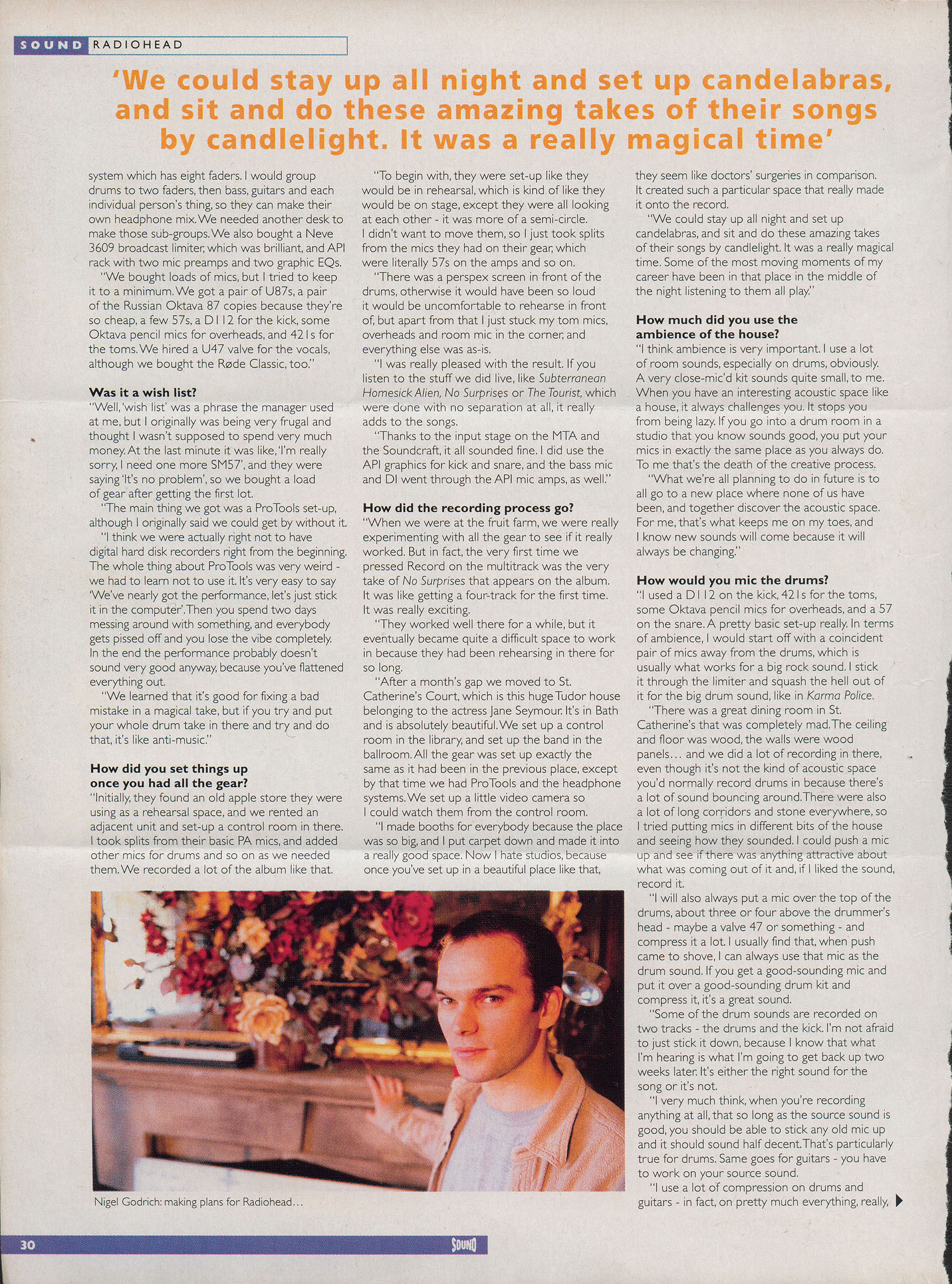
Nigel Godrich was the lucky engineer / co-producer who helped them simultaneously delight critics and freak out their record company. Here's how he did it...
First of all, Nigel, how did you get started in the business?
"I started at RAK studios in London as a tape op and I worked my way up to engineering. I've worked on many, many projects (the Sundays, McAlmont & Butler, Ride, Denim, Marc Almond and more), but most notably as an engineer for Radiohead. The last thing I did before leaving the studio was The Bends as an engineer. I was at RAK for about four years and I ended up working with a wide range of engineers and producers, which was a valuable experience in learning my trade. I left to go freelance and the guys called me about six months later. I ended up doing some B-sides with them and the charity album, War Child, which I recorded a track with them for.
How did this project come about?
"After I'd recorded The Bends, I went to see the band play live and caught up with them at the after-show. They were talking about how they wanted to record in their rehearsal space. They hadn't always had a good experience working in studios. Recording in a studio is a bit like painting on cue. If all artists had to go to the same place to paint a picture, it wouldn't really work. It's a creative thing.
"After we'd done these B-sides and the War Child track they came back and said they still wanted to do it They asked me what equipment I thought they should buy and I wrote a whole long list with the management. Three months later they'd got it all together and I was sitting in front of all this gear!"
What was on the list?
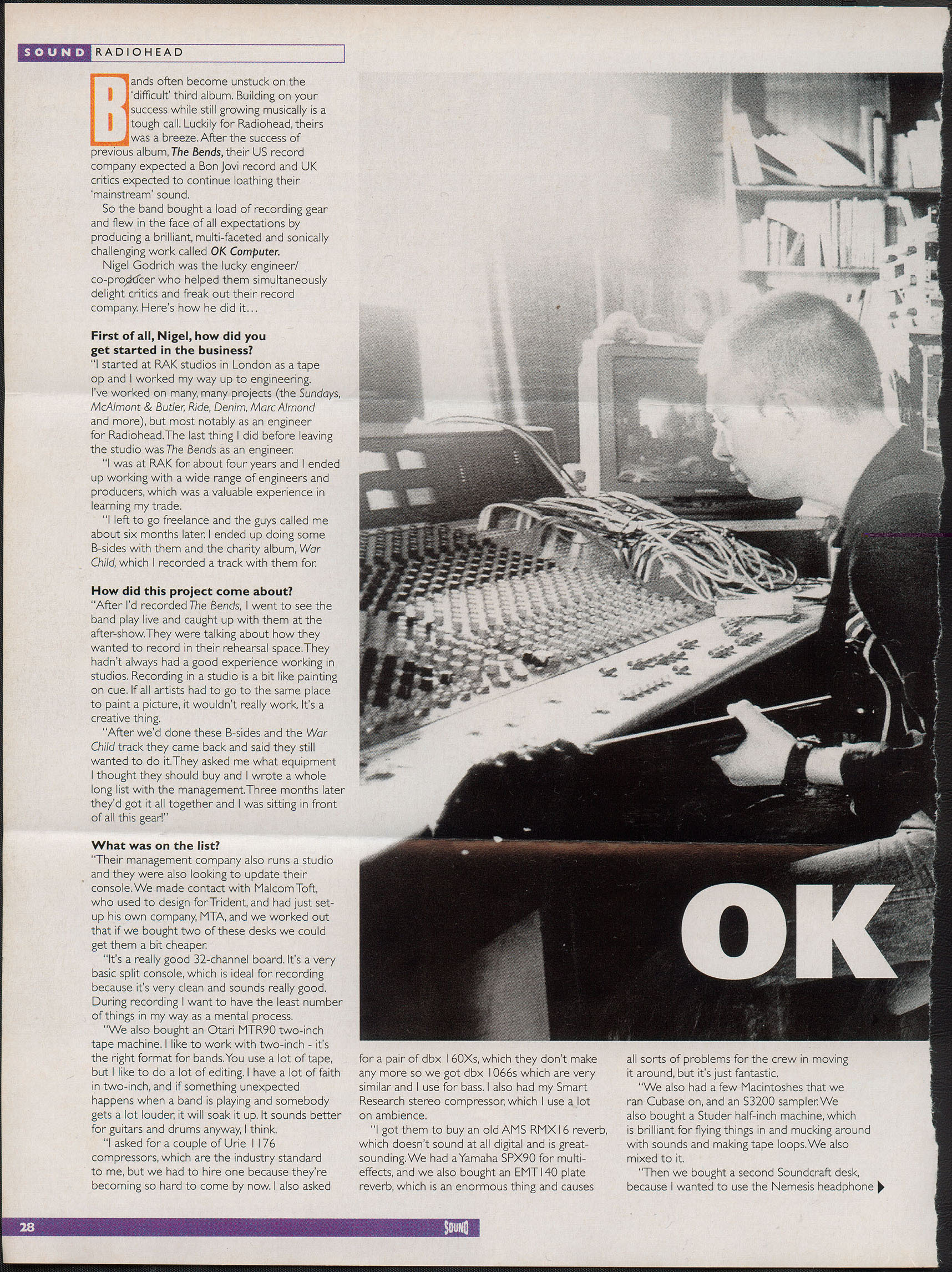
"Their management company also runs a studio and they were also looking to update their console. We made contact with Malcom Toft, who used to design for Trident, and had just setup his own company, MTA, and we worked out that if we bought two of these desks we could get them a bit cheaper. It's a really good 32-channel board. It's a very basic split console, which is ideal for recording because it's very clean and sounds really good. During recording I want to have the least number of things in my way as a mental process.
"We also bought an Otari MTR90 two-inch tape machine. I like to work with two-inch — it's the right format for bands. You use a lot of tape, but I like to do a lot of editing. I have a lot of faith in two-inch, and if something unexpected happens when a band is playing and somebody gets a lot louder; it will soak it up. It sounds better for guitars and drums anyway I think.
"I asked for a couple of Urie 1176 compressors, which are the industry standard to me, but we had to hire one because they're becoming so hard to come by now. I also asked for a pair of dbx 160Xs, which they don't make any more so we got dbx 1066s which are very similar and I use for bass. I also had my Smart Research stereo compressor which I use a lot on ambience.
"I got them to buy an old AMS RMX16 reverb, which doesn't sound at all digital and is great-sounding. We had a Yamaha SPX90 for multi-effects, and we also bought an EMT140 plate reverb, which is an enormous thing and causes all sorts of problems for the crew in moving it around, but it's just fantastic.
"We also had a few Macintoshes that we ran Cubase on, and an S3200 sampler: We also bought a Studer half-inch machine, which is brilliant for flying things in and mucking around with sounds and making tape loops. We also mixed to it
"Then we bought a second Soundcraft desk, because I wanted to use the Nemesis headphone system which has eight faders. I would group drums to two faders, then bass, guitars and each individual person's thing, so they can make their own headphone mix. We needed another desk to make those sub-groups. We also bought a Neve 3609 broadcast limiter, which was brilliant, and API rack with two mic preamps and two graphic EQs. "We bought loads of mics, but I tried to keep it to a minimum. We got a pair of U87s, a pair of the Russian Oktava 87 copies because they're so cheap, a few 57s, a D112 for the kick, some Oktava pencil mics for overheads, and 421s for the toms. We hired a U47 valve for the vocals, although we bought the Røde Classic, too."
Was it a wish list?
"Well,'wish list' was a phrase the manager used at me, but I originally was being very frugal and thought I wasn't supposed to spend very much money. At the last minute it was like, I'm really sorry, I need one more SM57', and they were saying 'It's no problem', so we bought a load of gear after getting the first lot.
"The main thing we got was a ProTools set-up, although I originally said we could get by without it.
"I think we were actually right not to have digital hard disk recorders right from the beginning. The whole thing about ProTools was very weird — we had to learn not to use it. It's very easy to say 'We've nearly got the performance, let's just stick it in the computer'. Then you spend two days messing around with something, and everybody gets pissed off and you lose the vibe completely. In the end the performance probably doesn't sound very good anyway, because you've flattened everything out.
"We learned that it's good for fixing a bad mistake in a magical take, but if you try and put your whole drum take in there and try and do that, it's like anti-music."
How did you set things up once you had all the gear?
"Initially, they found an old apple store they were using as a rehearsal space, and we rented an adjacent unit and set-up a control room in there. I took splits from their basic PA mics, and added other mics for drums and so on as we needed them. We recorded a lot of the album like that.
"To begin with, they were set-up like they would be in rehearsal, which is kind of like they would be on stage, except they were all looking at each other — it was more of a semi-circle. I didn't want to move them, so I just took splits from the mics they had on their gear; which were literally 57s on the amps and so on.
"There was a perspex screen in front of the drums, otherwise it would have been so loud it would be uncomfortable to rehearse in front of, but apart from that I just stuck my torn mics, overheads and room mic in the corner, and everything else was as-is.
"I was really pleased with the result. If you listen to the stuff we did live, like 'Subterranean Homesick Alien', 'No Surprises' or 'The Tourist', which were done with no separation at all, it really adds to the songs.
"Thanks to the input stage on the MTA and the Soundcraft, it all sounded fine. I did use the API graphics for kick and snare, and the bass mic and D1 went through the API mic amps, as well."
How did the recording process go?
"When we were at the fruit farm, we were really experimenting with all the gear to see if it really worked. But in fact, the very first time we pressed Record on the multitrack was the very take of 'No Surprises' that appears on the album. It was like getting a four-track for the first time. It was really exciting. They worked well there for a while, but it eventually became quite a difficult space to work in because they had been rehearsing in there for so long.
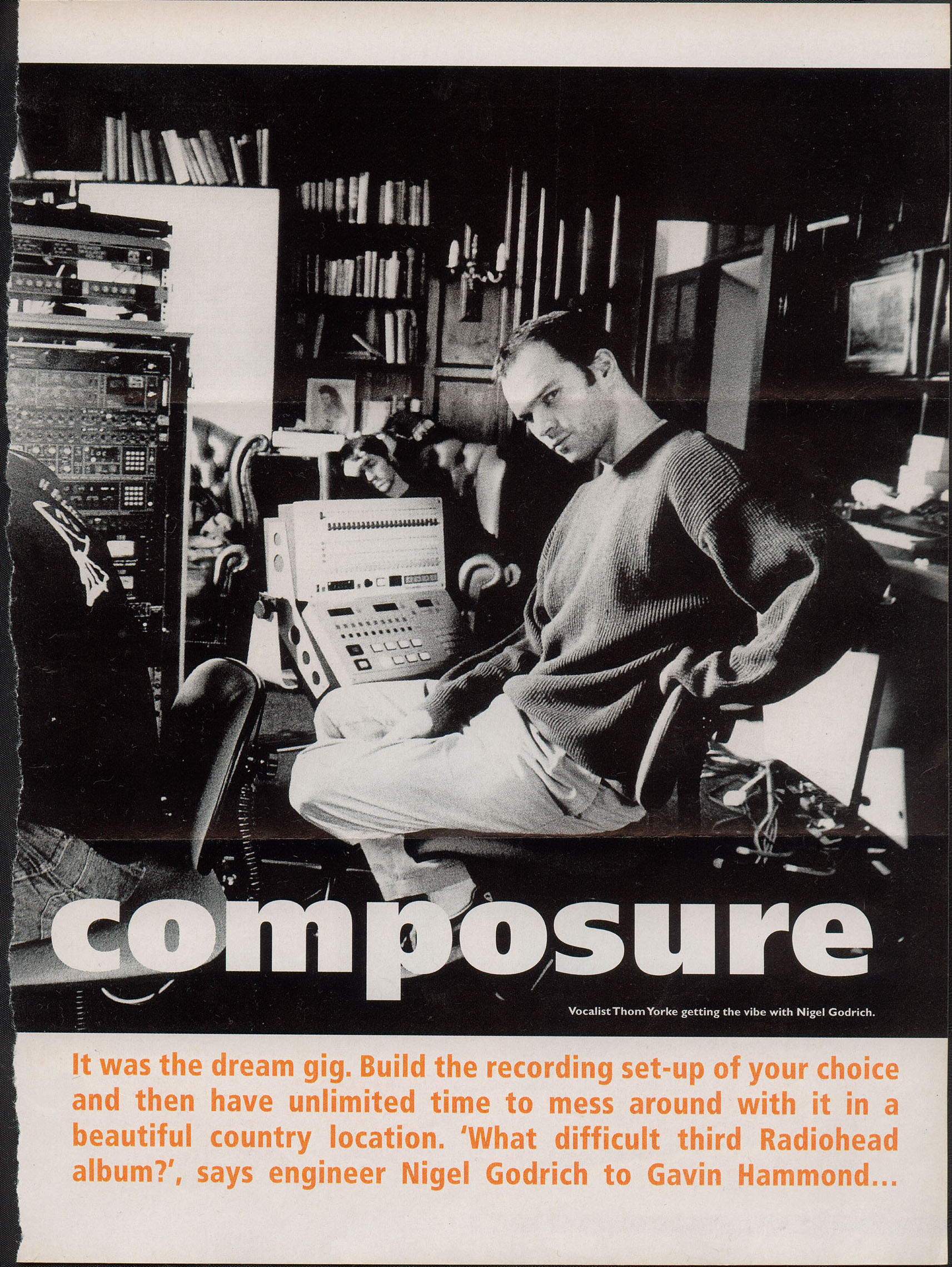
"After a month's gap we moved to St. Catherine's Court, which is this huge Tudor house belonging to the actress Jane Seymour. It's in Bath and is absolutely beautiful. We set up a control room in the library, and set up the band in the ballroom. All the gear was set up exactly the same as it had been in the previous place, except by that time we had ProTools and the headphone systems. We set up a little video camera so I could watch them from the control room.
"I made booths for everybody because the place was so big, and i put carpet down and made it into a really good space. Now I hate studios, because once you've set up in a beautiful place like that, they seem like doctors' surgeries in comparison. It created such a particular space that really made it onto the record.
"We could stay up all night and set up candelabras, and sit and do these amazing takes of their songs by candlelight. It was a really magical time. Some of the most moving moments of my career have been in that place in the middle of the night listening to them all play."
How much did you use the ambience of the house?
"I think ambience is very important. I use a lot of room sounds, especially on drums, obviously. A very close-mic'd kit sounds quite small, to me. When you have an interesting acoustic space like a house, it always challenges you. It stops you from being lazy. If you go into a drum room in a studio that you know sounds good, you put your mics in exactly the same place as you always do. To me that's the death of the creative process. "What we're all planning to do in future is to all go to a new place where none of us have been, and together discover the acoustic space. For me, that's what keeps me on my toes, and I know new sounds will come because it will always be changing."
How would you mic the drums?
"I used a D112 on the kick, 421s for the toms, some Oktava pencil mics for overheads, and a 57 on the snare. A pretty basic set-up really. In terms of ambience, I would start off with a coincident pair of mics away from the drums, which is usually what works for a big rock sound. I stick it through the limiter and squash the hell out of it for the big drum sound, like in 'Karma Police'.
"There was a great dining room in St. Catherine's that was completely mad.The ceiling and floor was wood, the walls were wood panels... and we did a lot of recording in there, even though it's not the kind of acoustic space you'd normally record drums in because there's a lot of sound bouncing around. There were also a lot of long corridors and stone everywhere, so I tried putting mics in different bits of the house and seeing how they sounded. I could push a mic up and see if there was anything attractive about what was coming out of it and, if I liked the sound, record it.
"I will also always put a mic over the top of the drums, about three or four above the drummer's head — maybe a valve 47 or something — and compress it a lot. I usually find that, when push came to shove, I can always use that mic as the drum sound. If you get a good-sounding mic and put it over a good-sounding drum kit and compress it, it's a great sound.
"Some of the drum sounds are recorded on two tracks — the drums and the kick. I'm not afraid to just stick it down, because I know that what I'm hearing is what I'm going to get back up two weeks later It's either the right sound for the song or it's not.
"I very much think, when you're recording anything at all, that so long as the source sound is good, you should be able to stick any old mic up and it should sound half decent. That's particularly true for drums. Same goes for guitars — you have to work on your source sound.
"I use a lot of compression on drums and guitars — in fact, on pretty much everything, really, while I'm recording. I'm very much a believer that you can get a sound in the moment, and you should record it as you hear it."
"Having said that, part of the art I've learned is that if you listen to a flat mic, you should work out what it is that sounds good about it, before you touch EQ or compression, If you then do something to it and it sounds not as good, or loses something, go backwards.
"The pressure is always on to get a good sound, but the skill is in not mucking it up. If something sounds good, leave it alone."
So how did you record the guitars?
"For bass I used a Fet 47 and a D1 through the API."
And the electric guitars?
"It depends on the song; but for clean sounds I prefer the 87s, otherwise I use 57s. They all have two amps, except for Thom (Yorke). Jonny (Greenwood) uses one amp for his clean sound and one for his dirty sound. Ed (O'Brien) has a Mesa Boogie and an AC30, and he usually uses one for his effected sound and one for his dry sound. It changes from song to song, so I had a basic set-up and then figured out who was doing what. Then I'd say, 'OK, I'd like to work on this sound', or sometimes it all just sounded great.
"Ed uses a digital processor; but he's very good with it — he's really got to know it. Jonny uses all analogue and, to be honest, digital is a bit of a dirty word around us all. I'm very much a believer that analogue is best.
"In the apple shed, by the way, we weren't using the headphone system yet — that was in the house later. So the band were all using the PA monitors and the spill was next to nothing, which was cool."
How did you record the acoustic guitars?
"I used a little Shoerp pencil mic on them, and squashed it a little. It was a lovely little stone room that we recorded a lot of the acoustic guitar in, which helped. Once you get the hang of recording acoustics, it's really easy."
How did you record vocals?
"The Røde suited Thom when he sang really quietly, but as soon as he sang out it got a little shrill. On 'Exit Music', we used the Røde because he wanted to sing real close with just an acoustic guitar; but on the rest of the tracks we used the 47."
"A lot of the vocals are actually guides that we kept. What happened generally is that we'd do a backing track, or get a sequence going, and Thom would nip out with his guitar and do a guide vocal. Then, two weeks later, when we're getting around to doing the vocals, we'd go 'Oh, actually this is a really good vocal'. Thom is such a great singer that he will generally open his mouth and do a great performance.
"Some of the vocals I comp'd on ProTools, and it's great for that, but it's really good to feel that you have a one-take vocal and it all feels really good."
How much overdubbing was done?
"Well, obviously we'd try to record it live, because that's usually the way to get a vibe. Everything was about the vibe — if something felt right, then it was right, and if not, not. If parts weren't ready or whatever, then we'd just try to get a drum track with guide vocals and guitar. Then we'd build the track afterwards.
"It was probably split even as to how the record was done. 'Let Down' is pretty much live, except for the vocals. The night we did that everybody was really feeling quite amazing. That's one of the tracks where the plate reverb is recorded on tape, because that's what they were vibing off. I recorded the plate onto a couple of tracks and it just sounded so right.
"'Subterranean'... was a drum track that was constructed afterwards. 'Airbag' was entirely sequenced — we made a lot of drum loops first, then they sequenced them. I got them all in time and just left Phil (Selway) and Thom for a day to make the sequence for the song.
"'Paranoid Android' is something we had trouble getting the drums performance-wise for the first part, so that's a loop as well. But it's been mucked around with. I got him to play the same part for half an hour, then I stuck it on half-inch and chopped it up. I adjusted the spaces between the kicks until it sounded in time, then sampled that. Then I got the guys to play blocks or shakers or whatever, and because they were a little sloppy — not being percussion players — it loosens up the feel.
"Tracks like 'Exit Music' were just an acoustic and vocal performance from Thom. In most cases, we recorded the songs a few times and decided which was the best. At the end of the day, you know when you have the right thing.
So how did you mix it?
"We ended up having to work in a studio to finish off Iittl3s of vocal and guitar, and tidy a few things up. The idea was to intersperse that with mixing. I did the first three mixes at Mayfair Studios in London. It's a brilliant room, because everything that sounds exciting in there sounds exciting outside. A lot of the time it will sound punchy and great in a studio, and when you take it home it sounds crap. Mayfair isn't flattering. We wanted to book a month there, but we couldn't get it, so we went to Air Lyndhurst, which is a very posh studio that's absolutely beautiful. A lovely place to work. "They have an old Neve desk, and it's great. It's got Massenberg automation and huge knobs on the EQ and stuff. We did a lot of mixing there, then went back to Mayfair and remixed, so it's about half and half in each studio.
"Mixing is a very, very intuitive thing for me, so I really can't explain what I do. I just push stuff up and it feels right or wrong. I always use NS10s and also have a set of Acoustic Energy AIs, which sound like your hi-fi. The NS10s are a sound I know and use for referencing, and the AI s just sound like speakers to me. And that's it. I use my Al Smart SSL compressor type of thing across the whole mix, and try and get it as compressed as it can possibly be. "It's an excitement thing. Even if you compress the buggery out of it in the studio and it sounds too compressed, it'll still work outside. It's about value for money. You compress it so much that you don't have a quiet moment. "I very rarely used a digital reverb on the whole thing, and if I did use one, it would be the AMS reverb, which is really warm because it's 8-bit. I do EQ a lot, especially because we were recording in spaces that weren't designed as a control room. I knew when we were recording it that what was going down was OK, but I probably did a bit more EQing in the mix stage to compensate."
Where did you master it?
"We went to a man called Chris Blair at Abbey Road, who's been doing it since I was born, probably. You just go there, sit at the back on his comfy sofa and leave it to him. We actually did it twice, because we went in to him saying,'Chris, don't brighten it up too much, keep it really nice and warm'.
"So he mastered it once and took it home and listened to it, and I decided it was a bit dull! So I went back with my tail between my legs and said, 'Look, I'm really sorry...' He actually agreed with me on some of the tracks, but we re-did a few of them and just put in a little more air: He also compressed things a little more, but I can't explain exactly how. Generally, with mastering, unless I hear something not going the way I imagined it, I'll stay out of it."
How happy were you with the results?
"We went through the healthy self-doubt process at the end, which is important. Nothing worth doing will be without pain, so we had our times of difficulty and times when everything felt right.
"Everybody loved The Bends, and I think the American record company in particular were expecting a Bon Jovi record. They thought they were going to get a very commercial album. When we first sent the album over to Capitol, I think they were quite confused. Then they listened to it a few times and went, 'No, no, it's good'.
"When I was a kid, records were different things. Led Zeppelin or the Police made amazing records that really changed your life, and I still listen to them now. I feel there aren't records like that any more, and all I ever said is that I want to make a record like that. I wanted to make a record that somebody, somewhere, thought was really brilliant, and will still listen to in 20 years. This is what I want this record to be, and I hope it is."