BBC Four 'Don't Be Denied', january 27th 2008
[Interview with Thom]
Thom was interviewed by Mark Cooper for a BBC Four documentary on Neil Young called Don't Be Denied. The conversation was filmed on january 27th 2008 at the BBC TV Centre, where Radiohead were about to soundcheck for their appearance on the 200th episode of Later...with Jools Holland. In the end, the interview went unused in the film. However, two clips from it were posted online on october 11th 2008 in a BBC website dedicated to the documentary. The raw footage was kindly made available for this website by Mark Cooper after Thom and Radiohead's manager Chris Hufford gave their blessing.

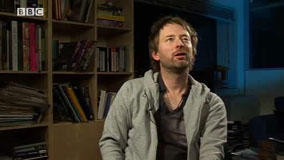
[recording starts here]
Thom: Well, you've got kids so you can't help it!
Mark:
Cameraman: I like Mondays.
Mark: Most people prefer Fridays.
Camera man: Well, it's the start of the week
Thom: Every Monday is... Well, actually, that's true, Mondays are always better than Fridays.
Cameraman: Wednesdays are the worst days, I find.
Mark: Also, the whole nation behaves appallingly on Friday. Friday is sort of the binge day, isn't it?
Cameraman: Great, well, I'm happy.
Mark: OK. Just start rolling and I'll start talking.
Cameraman: So, we are rolling now so you can go. Yep.
Mark: Thom, do you remember the first time you ever heard Neil Young's music?
Thom: Yes. The first time I heard it was erm when I was about 15 or 16 and erm I sent a demo tape into a magazine and they liked the tape and they said “This guy sounds like Neil Young”. And I was like “Who is Neil Young?” and I went and bought “After the Gold Rush” and immediately fell in love with his voice, erm and I mean, especially when you are 16 that era of music ’73 ’74 was just er pretty extraordinary – the idea of vocal harmonies and so on. But erm immediately I sort of er identified with it. Straight off.
Mark: What is about the timbre or the quality of his voice? It's so distinctive, it's so unlike anything else. What did you like about his voice?
Thom: Well, the frailty thing is obviously appealing and the register of it. You know he’s erm he’s especially during that period he was really going high up and he has this soft erm vibrato that nobody else does. But more than that it was just his attitude the way he laid the songs down – you know – not just "After the Gold Rush" but everything was all about capturing a particular moment… and … er saying what is on his mind, you know – but putting it in a way like erm it is sort of semi-abstract. At the time I was listening to lots of REM erm and erm and that semi-abstract thing I identified with Neil Young, but obviously it was I completely different er technique, you know. But even – it doesn’t matter what era it is always that thing about you are just laying down whatever is in your head, wherever you are at - at the time and staying completely true to that no matter what it is, you just stay true to that. The temptation, especially when people start listening to your writing you start agonising and worrying about how things sound or what comes across or bla bla bla. It strikes me as Neil Young has never worried about that. He has always completely stayed true to... You know, "The Needle and the Damage Done" – the only way you could possibly write a song like that is if it just comes out of you, despite you, it's like a force of nature. I mean, all good songs are like that to some extent...
Mark: How do you think he... Can you tell how he protects... As you say, most artists in rock and pop, every force suggests you should compromise, every force that's out there, the record company or the audience. There are so many forces that can lead an artist to compromise and that's particularly what's extraordinary about Neil Young. Can you... you get the impression that compromise isn't even an option for him.
Thom: Yeah, I mean... All through what's happened with us. I've always ended up falling back on a Neil Young record, it didn't really matter which one, and you're reminded of the source, if you know what I mean, the source of the spring where it's supposed to come from. And you can get lost, in a way, and it's always... you always come back and you hear his voice and you hear the simplicity in what is going on. But it’s a false simplicity, it's not sort of laziness. These are his tools and these are what he uses. It's not because he doesn’t know which other way to go. He's found his thing, his elements that he needs.
I think, maybe it’s the folk tradition thing... It's a lot of stuff, basically, I've never really delved into... I've never been a massive Dylan fan. I like Dylan for his lyrics and stuff, but I only got into Dylan because of Neil Young. And that's because Neil Young... I mean, there's so much more space and brevity to it and, you know... OK, the question of compromise. You're thinking whether he's compromised or not. I think it's out of necessity he's stayed true to speaking as he sees it and that's it. And the interesting thing is, I guess that's a folk tradition and it's something that I've always identified with, really. Not that I really understand where it comes form, because he's my channel to that whole thing.
Mark: I think it's also an obstinacy. An artistic obstinacy.
Thom: Obstinacy... I should imagine, I mean, like, in order to survive and stay true to what you're doing you have to be completely obstinate and you have to be fiercely protective to whatever forces that make you right. It's not something you can buy and it's something that's fairly intimate and unexplainable for some reason. I once went round his house because we were doing one of the Neil Young benefit things for the Bridge school. And in the middle of the hall in this grand piano, but it's like this [holds his arm diagonally], the leg's broken. And his wife's saying: "And that's where he writes on, mostly". But it's like that! [holds his arm diagonally again].
You know, it's really easy if your music is listened to by a lot of people or whatever that you let your horizons expand and expand and expand and take it all in. But he's done the exact opposite where enclosed himself in a small area within his work or whatever and protected that. Because he knows that's the thing that's gonna to keep him true to his art. I guess all artists try to do that, but to me if he can get away with being so belligerent than anybody can, really, you know because it has not, in any way, harmed his music. I dunno, it doesn't come across in the music, either, you know. The music's... it's never... If I was him, I'd do exactly the same [chuckles].
Mark: Because he plays with lots of different people, I mean, he's got his whole thing going with Crazy Horse, he's got a semi-country band going on. Sometimes he'll suddenly make a record with Pearl Jam. And then he'll make his own... So, you know, you're in a band, it's very different, I guess...
Thom: It's very different, I can't imagine what its like to work with lots of people like that. And I can't imagine what it's like to work with him. He probably switches on and is really there and then he's not. It's what I imagine...
Mark: I think he hears a sound and he thinks, "Right, to make this sound, I gotta work with these people" or he thinks "Now I gotta make a Crazy Horse record, I gotta be with those guys again". And he's almost impelled to make each record in turn. And suddenly here's sound he has to follow.
Thom: Yes, hearing a sound in your head and having to follow it, I guess, is the essence of all songwriting, anyway. [long pause] You know, can't really elaborate on that.
Mark: Tell us about this Bridge concerts, what they're like and what, kind of...
Thom: I'll just take my jacket off, sorry. [takes jacket off]
Cameraman: There won't be a problem with continuity?
Mark: Not really, cuz I think Thom fits, oddly, in different places.
[Thom takes his jacket off]
Thom: Now, where were we? Bridge school!
Mark: I was talking about asking about the Bridge school and what, sort of, feeling those concerts have and how much are they steered by Neil and what people...
Thom: The Bridge school is a long-standing tradition as far as I can work out... And it was incredibly exciting to go and play it... uhhh, excuse me... It's like a...Sorry?
[An assistant adjusts Thom's microphone]
Thom: That wasn't very good anyway.
Mark: And you can tell us about your impressions, Thom, that'd be interesting.
Thom: Yeah, that's what I should do because I'm waffling at the moment.
Mark: But what it was like and...
Thom: When I went to play the Bridge School Concert that he does. For some reason I had the balls to say to him, er before the concerts there is an event in his house the night before and it is really nice that he just invites erm everybody who is going to play to his house. I think that is really erm generous or whatever. And er I asked him at the end of the evening erm “Is it alright if I play After the Gold Rush?” [Thom laughs] “You're not going to play it are you? Is it alright...” and he looked at me like I was stark raving mad but he said “Yeah, absolutely”. And so er what of the most craziest experiences of my life was having him stand there behind me on the side of the stage while... And he said “If you're going to play that you should play it on the piano it was done on”. Erm which is erm this one, his old stand-up with all the coins on it. So ...there I was with his piano, playing the song, playing something trying to remember the words in the right way erm. But it was er I don't know why I wanted to do that.
But it was the most amazing feeling, cos - but it was er it was the best way I could say to him – you know er – how much I loved his music. Erm and he's erm he's a really nice he's erm I really open guy you know but er it is one of those weird things where erm er. When you are really in awe of someone like that you know you end up talking at them and talking at them. I was getting more and more lairy and er eventually he was like “OK” and walking away. So I felt kind of embarrassed afterwards. Erm .. I think he's a bit erm you know he's really talking to you, really talking to you and then his mind wanders off and he's off. So thinking about it afterwards I was like I understand that, I'm a bit like that myself. But that was the most in awe I've ever been with anybody, I think. I was so nervous and then watching him play that night, it was great. I've seen him a few times, we were supporting him a few times, but that particular night it was very quiet, really intimate and really spontaneous.
He does thing on stage, when you're watching, he'll go off. You can see it on the "Prairie Wind" – when he's playing "Prairie Wind", starts up and he's playing the song. And then suddenly he's lost, he's gone, like the normal Neil Young has gone off. It's like he's... what do you call it... Well, he's lost in the moment but I think it's a little bit more than that, as well. He's transformed or whatever and he did that the night of the Bridge School as well. So, he does it. That's what he does, you know. He's shuffling around and standing around or whatever. And sometimes, he'll stop and he's just playing, and then it will start again and it's like a wind blowing off the stage. I once watched him playing "Cortez the Killer" and that was with the Pearl Jam band. This irritating woman who wouldn't stop talking in my ear. And I was at in the middle of this festival. It was probably the most sustained wind – I can't think of another way of putting it – but the wind's coming from the stage and he's playing his solo and, honestly, it just did not stop, it was like a force of nature coming off the stage, absolutely extraordinary. Because, if you sat down and analyse or listen to the bits. There's nothing special necessarily in the elements. But something happens and it all comes together, like that. I think, the times we've played within the same festival with him in the park, that's the thing we all came away with thinking. The idea is to channel what is going on. And that's the idea, that's what you should be doing. Neil Young's able to free himself, I think he is extremely good at just freeing himself up and letting that happen, which I guess is what live performance is supposed to be.
[The assistant adjusts the microphone again]
Mark: Won't be much longer, Thom.
Thom: Don't worry, I was just getting into it.
Mark: It was brilliant. In fact, I suppose that's why a song like "Like a Hurricane" sums up, almost, you know. It just comes in waves like a lot of those songs, don't they? He's just good at getting in touch with himself.
Thom: Yeah. For him it's the warts and all, I guess, you know. It's like I was saying earlier when you go back to a Neil Young record you're reminded of how little you need to in order to create the thing you need to... what's inside of you. I mean, Radiohead is a classic example of having far too many tunes. And yet he's able to just bang away on his acoustic and he'll create this monumental thing, it's great. I mean, that's the folk thing.
Mark: It's kind of primitive, isn't it, his music. I'm kind of fascinated, he's primitive in his country and folk songs. And, in a way, it's sustained with any place with Crazy Horse. He's not clever. And I don't mean by that that he's not compulsively intelligent or that it's not very sophisticated. It's like, he doesn't let intelligence get in the way of his music. That's my take.
Thom: Yeah, I wouldn't..."He doesn't let intelligence get in the way of his music", I don't know, I think... I wouldn't say that's true. I'd say that... [long pause] Some of the records in the 70s and stuff, the play on that, it's always tight as anything, it's not all over the place. I mean, the Crazy Horse stuff is deliberately is all over the place. My favourite records, in terms of band records, is the 70s stuff because he was using a lot of the Motown aspect – like, getting the really tight kick and bass. In our band, that's always been the thing that's fascinated us is that you can have guitar music where the rhythm section is so tight, man. It could be, like, whatever the Motown session players are (Colin’s gonna kill me for this.)... That's always been the thing, for Radiohead, a bit of an obsession. You know, you can have the clean strumming guitars, but actually everything that is going on is funk, in a bizarre sort of way, you know. In the 70s.
Mark: Do you find it interesting that you have these two sides, the acoustic side and then the kind of... rock side? And that he can gear between them both? And which do you prefer, do you prefer either?
Thom: Which do I prefer, the acoustic or the rock thing? Well... [long pause] I quite like that synth record he did in the 70s, as well, the one with all the vocoders, I can't remember the name of right now, shit.
Mark: "Transformer man"??
Thom: Yeah.
Mark: "Re-ac-tor" or "Transformer Man".
Thom: Whatever, yeah. I really liked the, uhhh, what was it, not "Live Rust", the other live album, the double album... damn... the one when Sonic Youth were on tour with him...
Mark: "Ragged Glory"?
Thom: No... The one...
Mark: Oh! "Weld"!
Thom: "Weld", that's it, mmm. "Ragged Glory" is after that, I think. When we were starting to gig, you know, when had started leaving college, "Weld" was one of our big records for us because of this ferocious, monstrous chaos, you know. And the fact that he had Sonic Youth supporting him, you can't fault that. So, yeah, it's been really inspiring to me. I'm not as much into that now as the acoustic stuff, interestingly, just because I like to see that frailty again. I really, that just really appeals to me. I also find it really appealing that he - I don't know how old he is now - but he's writing songs about him, Neil Young, at his age. He's not pretending to be this or this or this. He's staying completely true, saying what's going on. And that's to be admired. I mean, personally speaking, if I get another 10 years worth and might still be true to the songs writing that would be a major achievement. That's where the fierce protection comes from. I mean, and every now and then, to me, "Prarie Wind", for example – you hit on something, where...uhh... I was listening to that today. The actual, the way it's made up, it sounds simple but what's going on musically is really sophisticated and really contemporary, as well. I love that song. I mean, on the live, the "Prairie Wind" thing, just watching him freak out when he's just singing and stuff is just amazing.
Mark: Do you think he's unusual inasmuch as that there’s a sense that really, that kind of any different points in his career ever, what, I mean, he’s been going, Buffalo Springfield, ’66, he’s been going over forty years and yet it still feels that – [Thom gives mildly baleful stare, waiting for the question] – he’s gonna hit it, again.
Thom: Yeah. Oh no, he'll keep hitting it, but that's because he's stayed true to his life. As far as I know, I don't know much about it, but... You walk into someone's life, you walk into their house and you do this Bridge benefit thing and I was completely in awe all the way through it. So I'm obviously wildly biased, but, to me, it was an inspiration. This is his fear and this he can understand and this he deals with. This is how he makes his music and it's all sort of small and kind and generous. And that's what I took away from it and thought "Wow, that's amazing, that's inspiring!", you know. And all the time I was there, I was thinking "This is extraordinary", because, apart from REM, Neil Young has absolutely inspired everything. You know, the way I write lyrics, it sort of comes up every day in my head, you know, all the time, this sort of simplicity and being true to yourself thing. Which... it's just a constant reminder in my head, how you can hit, like, 3 chords in the guitar and the stuff that's in the back of your mind comes out and - that's it! That's all you need! You don't need anything else. So, when I met him, it was just, I wanted to say all that stuff but I got drunk and went gaga, it's a shame really [laughs].
Mark: Just a last thing, you talked, at the start, about frailty in his voice. No-one sounds like Neil Young. Could you talk a bit to me about how his voice inspires you, as a singer?
Thom: His voice inspires me as a singer, weirdly that goes back to when I first heard him, sent the tape in, and someone writes "Oh, this bloke sounds like Neil Young" and I'm, like, "I've never heard Neil Young...what?" And, at that time, you're 16 years old and you hate your voice, obviously. You hate everything about you, you're 16. And then to have someone singing in that register in that frail way. It's like "Oh! Right, it's OK, it's OK to be like that", you know. So, that I mean, obviously, that was a massive inspiration, it was like cementing something I felt really shit about and turning it into a positive thing, you know. I mean, I have to thank him for it [laughs].
Mark: And do you think his timbre, because it's so distinctive, can reach into different emotional places than most singers' because it's so striking and so thin?
Thom: The tone of his voice, yeah, it affects people in a certain way, you know, it's like any voice. When you discover your voice it colours the way you're drawn into a song, or whatever. I think what's really, over the sort of, the course of his career, what's really interesting is that he can write lyrics that are really violent, really violent imagery and real anger, but he can put it in a way that's smooth as chocolate. You can let it come over you, and then at the end you think "Oh yeah, that's what that was about...", you know. But you don't... it's like the anger's removed. It's there in the words, the words are coming at you, but you're not... It's a way of dealing with that anger, you know. I'm sure, well, like most songwriters a lot of anger goes into the music, to be able to turn it into this rich glorious sound, you know, it's quite something.
Mark: It's different, because of the tone of his voice, his anger isn't really masculine or feminine. It's really interesting, his voice, it sits in a role that's quite high. It's not like a lot of American rock voices which are very gravelly and earnest and, you know, suffering. It's in its own plane, you know, where his voice can be, a bit genderless, you know, I think, almost.
Thom: It's... his voice is all... yeah, well, it's not strictly true, because, you know, especially live and stuff, you launch out more and stuff. But on record yeah, it always has a sensitivity to it but it's never fey, at all. Probably because of his guitar playing, because his guitar playing certainly isn't fey. He's whacking his guitar, most of the time. Well, bang on it and then stroke really quietly and then bang on it. But you never get the impression, I mean, yeah, that he's being, sort of, sensitive, to me. It's just, he's there at that moment and that's it, you know.
Mark: Last, do you think it's unusual that he invited you to... Do you think he's unusual or has been unusual over the years when reaching out to other musicians, to other generations, you know. Because a lot of musicians, they stay on their piers, their own set. He seems to reach out consistently to the next people coming along.
Thom: Well, at the Bridge show he stood, the one I was at, at the side of the stage for virtually for the whole, for everybody's set. Which is interesting because he'd watch people and they're all absolutely bricking themselves, obviously you would. And he was really, you know, he was really kind to everybody and really open. I think the worst thing you can do as an artist is to shut down and not let that stuff come over you. You know, if you truly love music, then you want to be shown other ways to go. Not least of which cause it should, certainly with Neil Young, it should make more solid what... make you realise how powerful what you do is. He's obviously never been anyone who has been threatened by anything new at all. Which is great, you know. That's... If you are going to get old and you are gonna carry on making music that's vital, then that's what you've got to be like. And he is.
Mark: That's brilliant. Thank you so much, Thom.
Thom: Thanks, man.
Mark: I'm sorry, as I start... [chuckles]. I get the impression you are kind of the same.
Thom: I am, yeah. But I can get so fumbling, like... What I wanted to say was that bit in the middle where it was like, when I met him and doing the shows and.
Mark: Yeah, that was great. And I have to say, interviewing him was terrifying because I feel the same way and I just had to be quiet.
Thom: Yeah.
Mark: Of course, when you've got a camera, you know you shouldn't fray too much. And my favourite bit when I interviewed him was right at the end. I was talking to him about loyalty and he said, he started describing his career and he said that it just comes in waves and in one moment, you are down here and nobody's looking at you and nobody gives a shit and nothing matters. And the next moment, you are on the top of the wave and everybody's looking at you and he leaned forward to the camera. When I watched it back he almost looked like a caveman at this point, you know.
[recording ends here]