Channel 4 'News', december 4th 1998
[Interview with Thom]
A report on this interview was published in the december 12th 1998 edition of Melody Maker.
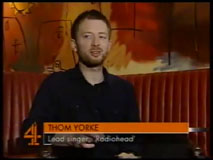
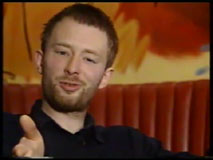
Presenter: Radiohead take to the stage in Paris in their only European concert this year. It's in aid of Amnesty International to celebrate the 50th anniversary of the United Nations Declaration of Human Rights. Thom Yorke, lead singer of Radiohead, is that rarity - a hugely successful rock star, uncomfortable with his own celebrity. Now, exclusively to Channel 4 News, Thom Yorke speaks about music, freedom and the responsibilities that come with fame.
[introductory clips of Thom ("Are we on yet?"), clips of December 1948, when 56 nations signed the universal declaration of human rights, clips of Radiohead live]
Thom: I can't really remember how I got involved. I mean, it's... by default, really. You couldn't really help it if you're on a plane all the time and you're going to these places and you're staying in posh hotels and you're not really seeing anything. After a while you kind of think, 'Well, there must be something going on. This is wrong.'
Thom: People have decided that they haven't got any power. And that's the end of it... The strength of what Amnesty [International] does and the strength of the Declaration of Human Rights is that it actually empowers people to know what their rights are.
Thom: Has it worked? No, obviously it's not worked yet. It's something to aspire to.
Thom: Ngawang Sangdrol is a buddhist nun who believes that Tibet should be independent from China. She's been sentenced to 18 years imprisonment by the Chinese authorities for shouting slogans such as 'Free Tibet', singing pro-independence songs, and participating in peaceful demonstrations. There is now serious concern for her health.
Thom: Should I use celebrity to highlight issues such as human rights? Um... I don't really use it for anything else, 'cause... I don't... I'm not very comfortable with it. What I find really offensive is the way that our culture, sort of... once anyone has got any degree of success, you get into the realms of 'Hello!' magazine, and it's like, 'Come and look at our glorious lifestyle that you should all be aspiring to', you know. 'Come look round the houses of the rich and famous. Come and watch us doing Charlie in the toilets. This is your future, this is what you should be looking for! This is success, this is what we're all aiming at'... and it's fucking obscene, frankly!
Thom: Radiohead very much came out of the culture of complaint. The 'X Generation' as they liked to call it for a while. But I think that all of them people have... they've grown up, you know. We've all grown up, and it's slowly dawned on us that our problems are utterly and utterly, UTTERLY irrelevant. And it's utterly offensive to have them hammered down your throat on MTV. I totally feel responsible for that.
Thom: The Amnesty gig is a way of... in a very small way, trying to redress our guilt, I guess.
Thom: Yeah, I feel lucky that I'm allowed to speak my mind, and write what I like - absolutely what I like - because I'm conscious of the fact that 99 per cent of people are not able to do that, and an awful lot of people will get shot, or tortured, simply by doing just that in a lot of other countries around the world.