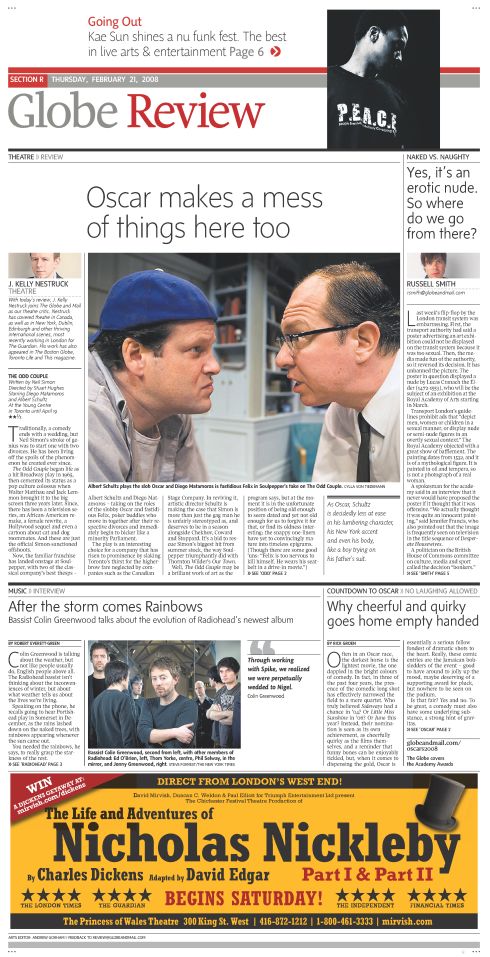
After the storm comes Rainbows
Bassist Colin Greenwood talks about the evolution of Radiohead's newest album
Colin Greenwood is talking about the weather, but not like people usually do, English people above all. The Radiohead bassist isn't thinking about the inconveniences of winter, but about what weather tells us about the lives we're living.
Speaking on the phone, he recalls going to hear Portishead play in Somerset in December, as the rains lashed down on the naked trees, with rainbows appearing whenever the sun came out.
You needed the rainbows, he says, to really grasp the starkness of the rest.
"They both need each other to exist, these transitory moments of beauty and this bleakness," he said.
So it is in life, and so also on Radiohead's latest disc, an album of beautiful, intermittently hopeful, but mostly despairing songs called In Rainbows.
The disc has been one of the most talked-out in recent months, partly because of the way it came into the world. Radiohead released the disc online last fall on a pay-what-you-will basis, then as a conventional CD last month. Even after two months of downloading, the CD held the No. 1 spot on the Canadian charts for three weeks, and has sold more than 50,000 copies in this country. All 100,000 copies of a special "discbox" set (launched last fall at $80 each) have been purchased. No figures have been released for the online revenues, but some estimate that the band's per-copy share is no less than it would have been through a conventional release with its old label, Parlophone/EMI.
In Rainbows was a long time coming, and seemed a distant prospect when the band reassembled in 2005 after a period of domesticity. They worked briefly with producer Mike (Spike) Stent, whose major contribution, Greenwood says, was to hold a mirror up to a band that needed a fresh way of working. In 2006, they went on the road, tried out new material and reunited with Nigel Godrich, who produced most of their previous records.
"Through working with Spike, we realized we were perpetually wedded to Nigel," Greenwood says. By the time Godrich returned, something had shaken loose within the group, and a new way of being uncomfortable presented itself to a band that often seems to thrive on unease.
"On previous records, Thom [Yorke] had a very strong idea of what he didn't want the music to sound like and of the sounds he was interested in," Greenwood says of the band's most demanding member. "On this one, he was more uncertain as to how it should be, with all the stresses and uncertainty that that implies."
You seldom, if ever, hear that in the music, whose lustrous beauty continually runs up against Yorke's anguished lyrics. In Weird Fishes/Arpeggi, for instance, guitar arpeggios roll serenely as Yorke sings about being held captive (by love or some other power), falling to the sea bottom and being eaten there by worms and fish.
"That's one of my favourite songs that we've ever done," Greenwood says, "because the chord sequence is so emotional and melodic, and epic and expansive. It reminded me of Isaac Hayes, and of another song of ours called Let Down, from OK Computer. ... I love the way the words thrash around, and the immolation in the middle, and being buried at the end. It's like emotional scales, with weights being laid out. There you are in your life. Should you carry on? Should you tell the truth, or lie to yourself?"
The other songs approach the same crossroads from different directions, each with a different measure of consolation and desolation. Maybe it's fitting that In Rainbows has been seen as a crossroads disc for the music industry.
EMI took its revenge, and its final opportunity, with a recent seven-disc box set of previous Radiohead albums. Radiohead was not pleased.
"They decided to capitalize on the release of In Rainbows," Greenwood says. "I think everyone understands it wasn't about Radiohead selling out, but about EMI cashing in."