Everything In Its Right Place
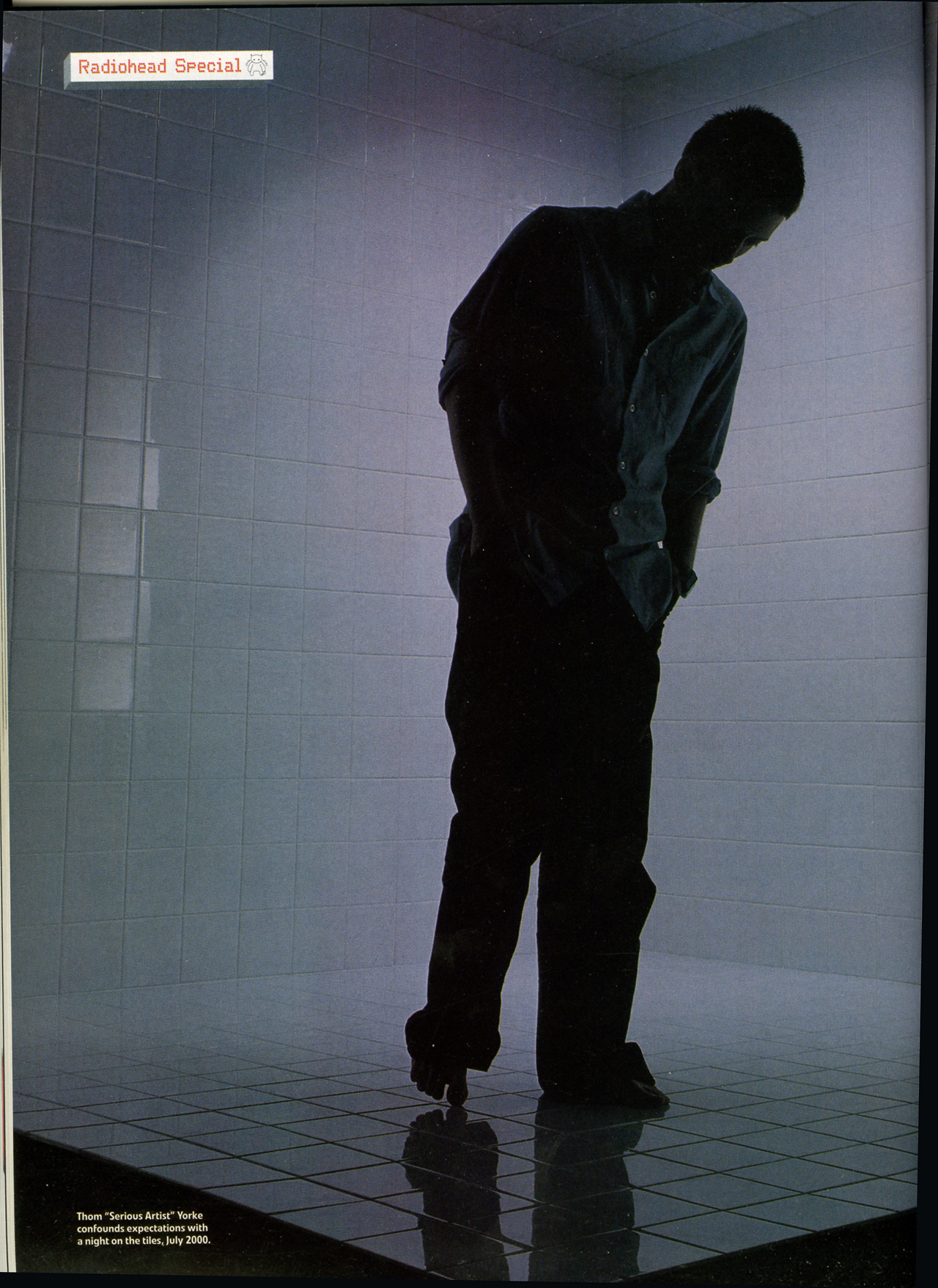
Why make the logical follow-up to OK Computer in a few months when you can go off your rocker for two years? Radiohead don't make things easy for themselves but now, with a new album, a new baby, and a clear head, Thom Yorke wants to talk. Kicking off a 20 page 'Head bonanza, rock's most innovative mind sits down for a very illuminating chat. “We went stark raving mad,” he tells Q.
“Frustration, tension, confusion,” recalls Thom Yorke, casting his mind back to the initial spurts of work for Kid A and its successor, Amnesiac. “We had no distance. It was so intense.” He grabs his hair and shakes his head in mock despair. “Fucking hell,” he marvels. “I was totally convinced we were heading in the wrong direction.”
Yorke may have since come to the conclusion that he was doing something right – but even now, it’s difficult to establish how the world feels about the left-turn that Radiohead announced to the world in late 2000. Certainly, as for The Bends and OK Computer, there is no universally-admiring consensus: for every convert, there is a puzzled soul wondering what on earth happened to the group who wrote Fake Plastic Trees. Only at the music’s most extreme can one possibly allude to any unanimity – it’s a fair bet, for example, that even the most hardened Radiohead zealot is occasionally tempted to nudge the next track button within the opening bars of Treefingers, the ambient wash-scape that marks Kid A's aimless lowpoint.
When Nick Hornby reviewed Kid A for The New Yorker, he sounded very un-chuffed indeed. “You have to work at albums like Kid A,” he wrote. “You have to sit at home night after night and give yourself over to paranoid millennial atmosphere as you try to decipher elliptical snatches of lyrics and puzzle out how the titles might refer to the songs. In other words, you have to be 16... Anyone old enough to vote may find that he has competing demands for his time – a relationship, say, or a job, or buying food, or listening to another CD he picked up on the same day.”
That review still festers with Radiohead's more hardcore constituency. Type “Nick Hornby, Radiohead” into any half-decent search engine, and you'll be confronted by irate screeds. They burst with both righteous anger and the idea that, in the post-millennial era, it is the fate of anything remotely cerebral to be unthinkingly cast to the margins. Surveying the “debate” – roughly, the consumers of the world running back to Chris Rea, while 27 devotees guard the entrance to their cave – you start to wonder how Radiohead have managed to sell any records at all.
Yet they have. Kid A is an American Number 1 album which got its authors on the Letterman show. In July, Radiohead will play a self-organised show to 30,000 people in Oxford. Pyramid Song entered the UK charts at Number 5. Roll over Erik Satie and tell Penderecki the news: there is room for this stuff in the mainstream.
So yes, Kid A (and Amnesiac, which we’ll come on to) requires a bit of “work”, ie you have to play it six or seven times before it decisively reveals its charms. Some of it – the title track, the aforementioned Treefingers – should arguably have remained in the box marked “discarded experiments”. But it soars to pretty dizzy heights on account of two trump cards: the simple quality of music as good as Everything In Its Right Place, Optimistic and The Morning Bell, and the fact that, at a time when most of popular music's ambitions are inch-high, it oozes the desperate desire to go somewhere utterly new.
When the two come together, and you get something s good as the bass-laden coda of The National Anthem, you can only swoon. This is the sound of people feeling duty-bound to push the envelope and pulling off their designs with breathtaking panache. That’s what The Beatles were famous for.
AND NOW WE have Amnesiac, which Nick Hornby probably won't like either. Trailed by whispers of a return to quickly-digestible rock music, which may have been mischievously put about by the group themselves, it is some distance from such talk. In terms of its prevailing characteristics, in fact, Amnesiac is – surprise! – of a piece with Kid A.
“When we were on tour with Kid A,” said Yorke recently, “We had the tapes with us and we were trying to work out a running order. I was listening to Amnesiac a lot then. And it was kind of nice, because it was the secret record. It felt like it was our secret weapon against all the weirdness going on – the fact that we had another one that nobody else had.”
Now it has crash-landed in the public domain, however, it allows yet more light to shine on the 18 months off fall-out, panic and eventual triumph – spread across Paris, Copenhagen and Oxfordshire – that marked Radiohead's progress after OK Computer. Given that there's now a definitive version of, say, You And Whose Army, you can read through Ed O'Brien's infamous studio diaries (still archived at www.radiohead.com) and start to make sense of exactly what this most self-analytical of groups has just emerged from.
“A pretty frustrating day,” he wrote on 27 July, 1999. “It starts well, with a different version of How To Disappear and Everything In Its Right Place... However, we have definitively lost our way with You And Whose Army – it was sounding great last week, so what happened today? Time to go home.”
By 7 December, the song was being re-routed somewhere very strange indeed. “Looked at You And Whose Army again from two weeks ago.” O’Brien wrote. “Tried this different vocal idea that Thom and Jonny had been going on about: three-part but with a very low bass harmony, kind of Ink Spots-esque. This is always dangerous territory, ie there would be nothing more sad than this slick sophisticated '40s vocal group sound.”
For the benefit of younger readers, the Ink Spots were a hugely popular black vocal quartet formed in the early 1930s, whose songs all began with the whimsical guitar figure later used on Toffee Crisp adverts. They're a pretty unlikely touchstone for a modern rock band. Still, for all O'Brien’s misgivings, it is the Spots-cribbing version of You And Whose Army that made the final cut.
It's a good thing, too. The song, as has been well documented, is a wry statement of defiance vis-a-vis the Blair regime – although righteous anger is what he often deserves, the most intelligent response is usually a quiet smile at the ludicrousness of it all. The Ink Spots reference makes that plain – once you know that, you're in on the joke. “It's not meant to be taken seriously – it's a funny song,” says Yorke. And he should know.
Now, with Kid A and Amnesiac completed, Thom Yorke is beginning to get his head around the vexatious path that led Radiohead here. Bouts of all-consuming anxiety are a recurrent feature: there was a huge crisis just after the start of the sessions for The Bends, and spasms of doubt and uncertainty throughout OK Computer. For that album, according to Ed O'Brien, they recorded 16 versions of No Surprises before going back to the original. This has never been a group endowed with the knack of making life easy for themselves.
And so it proved this time. “We couldn't possibly do anything straight until we'd gone and been completely arse-about-face with everything else,” Yorke said last month. “It took 373 days to be arse-about-face enough to realise it was alright the way it was.”
Now, though, Yorke seems to know where they went wrong and how to avoid it happening again. There seem to be two watchwords at the minute: order and leisure. Where once there were 15-hour sessions and 6am bedtimes, Radiohead seem to have established an altogether more structured regime. And, Yorke claims, they now appreciate the need for regular contact with the wider world, to avoid the kind of myopia that has hampered them in the past. Indeed, when he talks about it, there's an ironic echo of Fitter Happier: “At a better pace... slower and more calculated... an empowered and informed member of society.” One should also bear in mind that Yorke recently became a father: he and his long-standing girlfriend Rachel now have a son, Noah. When life takes in rusks and nappies, creative mania inevitably becomes a less manageable proposition.
Yorke was recently described as “Iegendarily hopeless at analysis of either himself or his music”. On today's evidence, that's way wide of the mark: not only can he identify most of the pitfalls into which Radiohead have tumbled, but he can also articulate the thinking behind both his grander schemes and his music's finer details. Thom Yorke, it transpires, knows what he's doing.
That isn't to suggest that all is clinical contrivance and cool heads. Amnesiac, after all, is a more human record than its predecessor-approachable, equipped with the sense of identity Kid A seemed to want to wriggle out of, altogether more emotional. Which, for one reason and another, is where we begin...
Have you ever had to abort a take in the studio because you've got too emotional while singing?
I have to be careful because the rule is, if you're moved singing a song, the result is usually shit. And it's a cruel irony: if you want to sing well, and move an audience, you have to be detached and cool yourself. It's selfish as well: a concert is a shared experience, but if the singer is concentrating on his own feelings, it stops being a shared experience. When I was recording that song with Björk [I've Seen It All], I got all emotional at one point, and she said, Don't do that, it's selfish! And she was right, because when I'm moved, I'm feeling good, but I'm not projecting the lyrics to the audience, and that's what a good recording or performance should do.
And how do you feel onstage?
The ideal mental state for me to perform live is when it feels as if I'm driving through the night. You know that feeling: driving through the woods, you're on automatic pilot, but tense because your vision is limited in the darkness. I perform best when I sort of feel as if I don't know what I'm doing. I'm just doing it, It's like an emotional automatic pilot.
When you recorded Amnesiac, were you able to go in and think pragmatically, “Today, I’ve got to lay down this guitar part”, or do you have to be totally in the right mood to record songs properly?
You mean, to what extent do I have to be obsessed by a song in order to make it work? Mmm… it depends. It's weird, because that changed. In the early days, our recording sessions were very intense and obsessive. For OK Computer, we locked ourselves away like hermits in this gothic house in Bath. There were never any disruptions. That's why we went stark-raving mad [laughs].
We were all insomniacs – keeping crazy hours, working until six in the morning, then getting up at three, and then starting again, for weeks on end. I was a mess. And when things didn't work out, there was nowhere to go: we were stuck there.
But now, we’ve got our own studio, and we walk in cold. We have leisure time: we have time for other activities, as opposed to being totally in the same mindset for weeks on end, We don't feel that the new way of working affects the music all that much, although Nigel [Godrich, producer] says that it does make a difference. Nigel says that OK Computer has this unique, tense vibe to it.
So what happens when the band and the producers are there, but you don't feel like it? Little Richard turned up at the studio one day, said “The Lord doesn't want me to sing today,” and buggered off.
“[Laughs] That's great. Tom Waits used to do that. He used to have a studio in a shed in his garden, where he recorded Bone Machine. Some days, he used to show up for two minutes, and then sigh and say, Nah, it's no good today, and leave. But for us, now, with our new studio, it takes me an hour in traffic to get over there, so once I'm there, I tend to say, Ah well, I might as well stay and give it a go, even when the mood isn't really right.
I really try to relax these days. I used to think everything was a matter of life and death, and every second spent in the studio was crucial. But that way, you go barmy and your work becomes shit because you lose all objectivity. If someone said to me, This bit doesn’t work, I used to explode.
Do you approach writing and recording like work, with set hours, or are you are bit more intuitive?
All of us in Radiohead are definitely the clocking in, clocking out type. It's almost as if we go to the office to work. I always write a song in one go, and I try to stay in the mood. But recording is different, because of the strange people we are [laughs]. I can't sustain too tense an atmosphere for too long, I don't want to get lost in music, because I'm lost as it is. I have a chaotic mind, so I need order as a counterweight to that chaos in my head.
Someone like Picasso had a very strict painting schedule: he'd clock in, start to paint at, say, nine in the morning, come out at six o’clock, and then go and have a swim. That sounds less artistic, but he got things done. With me, I have to have order. It’s very unhealthy for me to do insane, intense recording sessions like the ones we did in Copenhagen and Paris, which make the chaos outside my head as big as the one in my head. It took me a long time to realise that. I think Everything In Its Right Place was the crystallisation of that realisation. Basically that song says, I need order.
What was so bad about the recording sessions in Paris and Copenhagen [where initial, abortive work was done on the two albums]?
Well, the first couple of days were OK, but the next two weeks went badly wrong. The bizarre thing was that when we listened to the tapes from Paris a month later, it turned out we’d done some really cool stuff. And that's dangerous, because then you start to think maybe we must be fucked-up to do good work.
Bono recently said that every great band should begin with a period of just messing about, before going into the studio and starting the serious stuff.
Oh yeah. He’s right. But after OK Computer we spent too much time mucking about – mainly because I was refusing to commit to anything. And my mood of saying no to everything lasted about 18 months. What we tried to do with Kid A and Amnesiac is simply doing what feels right, as opposed to repeating the OK Computer formula and playing safe. Being adventurous and eccentric doesn't scare us, it's liberating. It used to be all pressure. Now, at last, we’re having fun days.
So how would you describe a fun day with Radiohead in the studio?
A fun day is when something actually gets done. When we can enjoy a result; we go in, try out a song, and it actually works. As opposed to me standing in the control booth tearing my hair out, going, This is shit! I'm off! I don't mean we're laughing and pissing around. The way we work, all of our time is pissing around, but none of it is light-hearted [laughs]. In other words: we experiment and play like children, but we're serious.
People don't necessarily associate a sense of humour with Radiohead...
It depends how you look at it. I do have a sense of humour, but nobody can follow it, not even my girlfriend [laughs]. There are things on Radiohead albums that I consider funny. I think the horns on The National Anthem [from Kid A] are hilarious, really funny. And the day that we recorded You And Whose Army? was a very relaxed day, and that song is nor meant to be taken seriously, it's a funny song.
We had such a good time when we did that, and we did about four takes, tried out some cool sounds, and then went home. Lovely. And that lyric is silly, surely no-one can take it seriously? I wrote it as a joke, but then we kept it because it seemed to have some nice connotations.
The lyric of that song is very threatening.
Yeah, it's saying Come and try to fight us if you think you're hard enough. But it's over the top.
The great thing about that song is that you're singing this threat very sweetly. The melody is almost a lullaby.
Yeah, it sounds much more threatening that way, than if a heavy metal band was shouting Come on if you think you're hard enough! That has to do with my interest in disembodied voices: when you're singing, you can use different voices as if you're acting out different parts in a play. I don't see why all Radiohead songs should be sung in the same voice. Then people would say, Oh, that's just Thom Yorke doing his thing. I try to sing in a way that fits the lyric and the subject of the song. If we start to fuck with the sounds and with the voice, it becomes more interesting. It gives me licence to say different things.
When was the last time you were moved by a piece of music – genuinely touched and choked, as opposed to merely being impressed?
I felt very emotional listening to old REM albums recently. I almost cried when I heard Electrolite from New Adventures In Hi-Fi. I hadn't heard those songs for a while. I thought they're amazing. And when REM were making that, we knew them, and when you meet the artist and befriend them, it gives you a different perspective, so it took me a couple of years to be able to hear those songs for themselves, and not think, Oh, it's Michael and the boys. The same thing happened with Up. It didn't affect me at the time, because I was a bit worried about Michael – weird things were going on then. But now, I find a song like Sad Professor very moving.
You mentioned The National Anthem. In the outro there's a snippet of classical music. What is it?
God knows. Jonny was just sitting on the roof meddling with his radio, and we just chose that little classical bit at random, and stuck it at the end. Some of the best recordings happen as pure accidents: you just tune into some channel and something blares out at you.
We used that idea on the Tent Tour, last year: when we played Climbing Up The Walls, we had a real radio playing, and the most random shit came out. We never used a sampler – it was just a radio. Which was weird because some nights a snippet of a local cookery programme would come on, while we were trying to build up this really serious, dramatic sound [laughs]. That was funny, because the local audience could understand what the cook was saying, and we couldn't.
In the live set you're playing this summer, what's the real Heart Of Darkness moment?
We've got quite a few songs that are pretty dark. On the Tent Tour last year, we did I Might Be Wrong [from Amnesiac], and that sounded very tense, very dark, almost menacing, especially because people didn't know it. We set up an enormous light box behind us, and one of the roadies stood in it with devil's horns on, which made it even more menacing [laughs]. You couldn't see him, but when the strobe lights flickered, you could see the shadows of the horns on the big screen. We didn't have it at all the gigs, because sometimes the guy chickened out. Because that strobe light is so powerful, if he turned around, he'd go blind. Satan chickened out – that's a phrase you won't hear often [laughs].
When we do Dollars And Cents live now, it sounds very dark and tense. We get loads of people on our Website saying the live version of Dollars And Cents is much better than the one on Amnesiac. The live one is just a lot faster.
A theory for you. Kid A seemed evocative of scenery – both cityscapes and natural grandeur. Can you see that?
It is very much about scenery. When we started working on it, I spent a lot of my time going on walking tours in the south of England. I explored forests and mountains and rivers. I'd never done that before. I bought that book by Julian Cope [The Modern Antiquarian}, and followed in his footsteps. I also bought another book about Standing Stones and did walking tours to those ancient monuments. I became almost obsessed. So maybe it's because of those leisure activities that Kid A sounds like a landscape soundtrack. It's perfect for walking around and travelling with.
On your Website, a Russian sculptor said he bought a Bulgarian bootleg of OK Computer, which is slightly surreal. Have any of your songs turned up in even stranger places?
The strangest one was when Kid A came out, and Ed was driving around London. He was listening to one of the pirate radio stations, and one had an unknown local rapper who'd got hold of The National Anthem, and sped it up, and over that faster version he did a skank. Ed said it sounded fucking amazing. That's the coolest thing, I love that. Ed said it didn't sound like a Radiohead song anymore, because the skank was mixed to the foreground, and our music was underneath. But it sounded great.
They've just asked us to compose the anthem for the Winter Olympics. That would be strange [laughs]. We're tempted, but there's so much sponsorship and advertising involved, and I don't want Radiohead associated with some cigarette brand that sponsors the Olympics.
You reportedly give these obscure directions when you're working on songs. Instead of saying, This should have a lot of feedback and an abrasive sound, you say things like, This should sound as if you're whacking two wet teabags against the wall.
Yeah, that's true. I tend to do that. In a way, that’s what I enjoy most, and what we’ve become good at: the ability to describe music in an original way, and approach it in an original way. We might be stuck, working on a certain song and I'd say, Maybe this should be a wall of howling feedback, but with the sound of the wheel of all old bike spinning – an old bike, not a new one, because an old one provides a better sound. Sometimes that’s the only way to come up with things that haven't been done yet.
If I describe the music I hear in my head – like, It’s two sumo wrestlers fighting it out in a glassware shop, it tickles the other musicians' imaginations, and by trying to create a sound that resembles two sumo wrestlers fighting in a glassware shop, we come up with new sounds.
The only way of working also compensates for the fact that, technically, I'm a very limited musician. 1’ve got a piano at home now, but there's no chance in hell that I could play this [the jazzy piano music playing in the café]. I can only play, like, four chords. I'm lucky we have Jonny, who's very technical. Jonny did all the horns in The National Anthem. The only suggestion I made was, Let's make the horn section sound like the traffic in New York. Or people stuck in a lift who're really tense and who aren't far from killing each other.
Any other examples of strange instructions?
Sometimes we're very blatant about our influences; about taking other people's records and taking a sound and appropriating it for a song. For instance, for You And Whose Army? the inspiration was The Ink Spots. Jonny and Colin are Ink Spots freaks. So they brought in one of their Ink Spots records and said, What about this kind of sound for You And Whose Army? And that sound, distorted, really helped the song along.
On Packt Like Sardines In A Crushd Tin Box, you do this kind of Speaking In Tongues singing. But buried in the mix there's someone making sheep noises which you can only hear on headphones.
[Laughs] They did that when I was away. That's Nigel Godrich and Ed mucking about. Amusing themselves by imitating sheep. But that Speaking In Tongues effect is really cool. We got bits of software for the musical computer programmes that don't really work. And sometimes faulty gear produces odd sounds.
I hate to say this, but we’ve all got laptop computers, and some of the days we only played our instruments for half an hour, and worked for the rest of the day on our laptop computer programmes. It’s sad and idiotic, isn't it – five musicians communing by computer. But it was necessary to get all these shreds of interesting sound together. And then we had to force ourselves to pick up our guitars and play, simply to exercise. For a long time, I detested guitars. Now, I kind of miss them.
What do you play as warm-up exercises?
Covers, mostly. At one point, we were doing Stone Roses songs really fucking badly [laughs]. And we played songs by The Smiths, and Magazine, just jamming stuff. In a sense, Knives Out is our nod to The Smiths. Ed played Knives Out to Johnny Marr a while ago, and he liked it.
Playing cover versions is a new thing for us, we never did that before. Maybe its because Ed and Phil went off and did that concert with Neil Finn [his celeb-splattered homecoming in Auckland]. It was so funny: at first they were going to do two Crowded House songs with Neil, but then Ed kept getting sent CDs. In the end, he had to learn 50 songs [laughs]. And the best thing was: he'd be flying for 15 hours to get to New Zealand, and when he finally got there, they drove him straight to rehearsal, so he didn't see a thing of the country [laughs].
On Like Spinning Plates, you sing the lyric backwards. Or is the tape played backwards?
That was Nigel’s idea. I sang ach line. Then they cut it up, and spun every word backwards, and pasted it back together. Then you got an entire line in reverse, but with the words in the correct order. And then I spent a couple of hours singing along to my own singing in reverse, until I could copy that weird reverse singing pretty well. And then I sung the reverse bit myself, which sounds ghostly, like speaking in tongues during some religious African ritual, as if a ghost speaks through me. It took a long time to do, but it was worth it.
Where are you with your sleeve art at the moment?
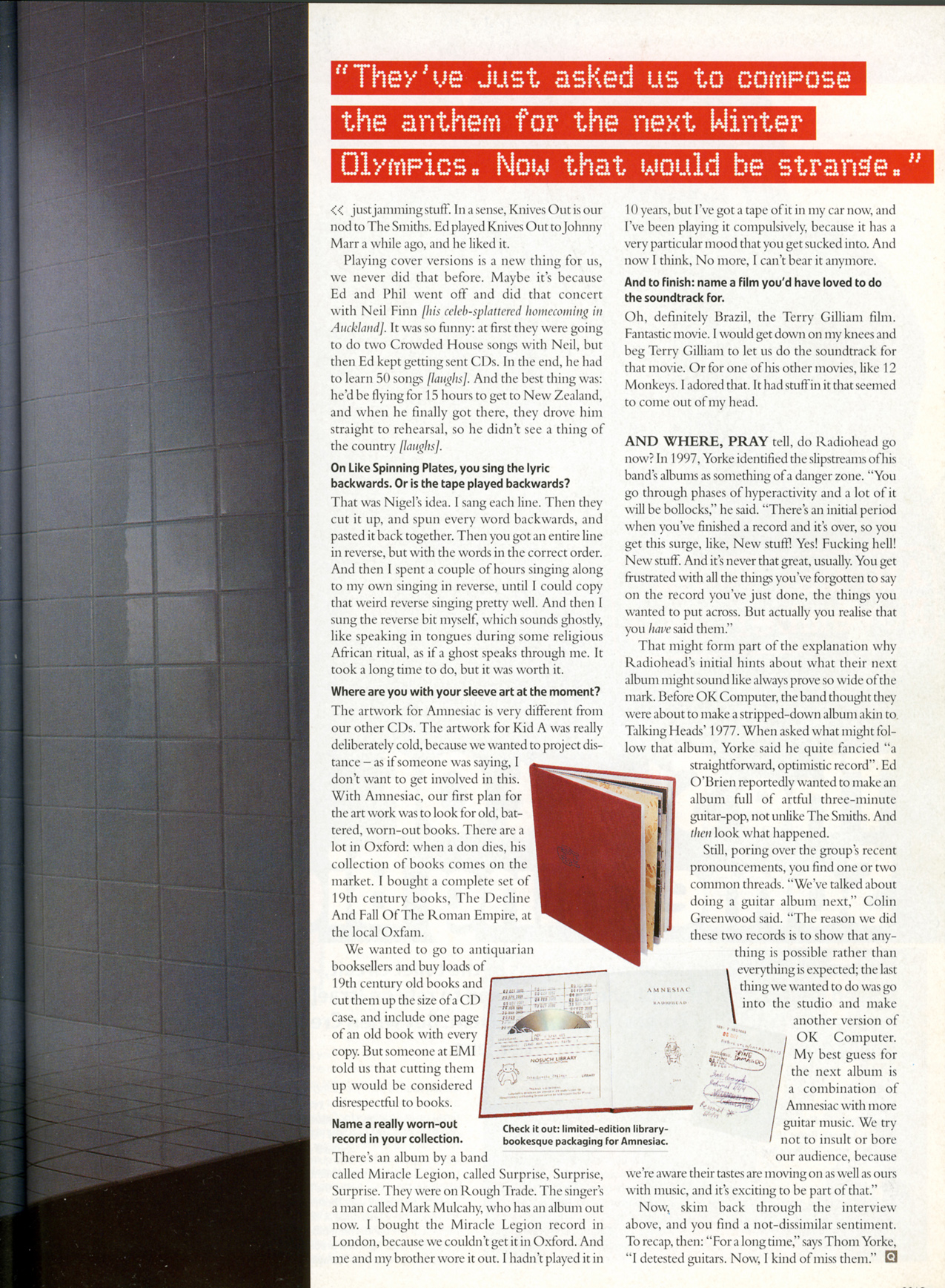
The artwork for Amnesiac is very different from our other CDs. The artwork for Kid A was really deliberately cold, because we wanted to project distance – as if someone was saying, I don't want to get involved in this. With Amnesiac, our first plan for the art work was to look for old, battered, worn-out books. There are a lot in Oxford: when a don dies, his collection of books comes on the market. I bought a complete set of 19th century books, The Decline And Fall Of The Roman Empire, at the local Oxfam.
We wanted to go to antiquarian booksellers and buy loads of 19th century old books and cut them up the size of a CD case, and include one page of an old book with every copy. But someone at EMI told us that cutting them up would be considered disrespectful to books.
Name a really worn-out record in your collection.
There's an album by a band called Miracle Legion, called Surprise, Surprise, Surprise. They were on Rough Trade. The singer's a man called Mark Mulcahy, who has an album out now. I bought the Miracle Legion record in London, because we couldn't get it in Oxford. And me and my brother wore it out. I hadn't played it in 10 years, but I've got a tape of it in my car now, and I've been playing it compulsively, because it has a very particular mood that you get sucked into. And now I think, No more, I can't bear it anymore.
And to finish: name a film you'd have loved to do the soundtrack for.
Oh, definitely Brazil, the Terry Gilliam film. Fantastic movie. I would get down on my knees and beg Terry Gilliam to let us do the soundtrack for that movie. Or for one of his other movies, like 12 Monkeys. I adored that. It had stuff in it that seemed to come out of my head.
AND WHERE, PRAY tell, do Radiohead go now? In 1997, Yorke identified the slipstreams of his band’s albums as something of a danger zone. “You go through phases of hyperactivity and a lot of it will be bollocks,” he said. “There’s an initial period when you've finished a record and it's over, so you get this surge, like, New stuff! Yes! Fucking hell! New stuff. And it's never that great, usually. You get frustrated with all the things you've forgotten to say on the record you've just done, the things you wanted to put across. But actually you realise that you HAVE said them.”
That might form part of the explanation why Radiohead's initial hints about when their next album might sound like always prove so wide of the mark. Before OK Computer, the band thought they were about to make a stripped-down album akin to Talking Heads' 1977. When asked what might follow that album, Yorke said he quite fancied “a straightforward, optimistic record”. Ed O’Brien reportedly wanted to make an album full of artful three-minute guitar-pop, not unlike The Smiths. And THEN look what happened.
Still, poring over the group's recent pronouncements, you find one or two common threads. “We've talked about doing a guitar album next,” Colin Greenwood said. “The reason we did these two records is to show that anything is possible rather than everything is expected; the last thing we wanted to do was go into the studio and make another version of OK Computer. My best guess for the next album is a combination of Amnesiac with more guitar music. We try not to insult or bore our audience, because we're aware their tastes are moving on as well as ours with music, and it's exciting to be part of that.”
Now, skim back through the interview above, and you find a not-dissimilar sentiment. To recap, then: “For a long time,” says Thom Yorke, “I detested guitars. Now, I kind of miss them.”
CONSTRUCTION TIME AGAIN
Radiohead’s recent, No Logo tour across Britain and Europe took place in specially constructed marquees which the band took with them to each venue, carny-style. Here’s how…
1 & 2: The Radiohead big top freakshow occupies three venues at once. With three sets of 12 poles and two 100,000 capacity Kyam tents, the last show is dismantled, while the next is pitched in two days by a crew of eight, and meanwhile the current venue is transformed into a mobile stadium.
3: Ensuring a steady power supply at all times, the tent has two synchronised 550 KVA generators in addition to local supplies.
4: The mixing desk possesses 48 mono and four stereo inputs.
5: The state-of-the-art PA features seven speakers on each side of the tent, pointing across the audience. These take three hours to put up, angle and then align with lasers for top fidelity. Supplementing them are two onstage overhands and two speaker stacks just to make sure those at the front don’t miss out.
6: In the post-Kid A universe, the band take two pianos on tour, a real one and an electric keyboard, which everyone except drummer Phil has to play.
7, 8 & 9: Lighting the band’s brave new techno world requires 88 show lights, some fairy lights and around 100m of light rope. The backdrop is actually a huge lightbox. Three flat screens – one on each side of the text and one towards the back – relay a mixture of live (from seven cameras) and pre-recorded freaky images to undermine the global capitalist oligarchy.
10: The tent also features a purpose-build laser which projects shapes entirely controlled by the uncompromisingly futurist sounds Thom and the boys make.
11: So uncompromising, in fact, that the band has to ban crowd-surfing and moshing.
12: Finally, with Kid A brutally cast kicking and screaming into an unsuspecting world, shaking the very foundations of the World Trade Organisation, there’s still time to get a T-shirt or perhaps try on a unisex Radiohead dress at the merchandise stall. Who said this big top had no clowns?
IMPROVE YOURSELF
The wealth of avant-gardery that informs Kid A and Amnesiac – all at your local Woolies. Possibly.
Aphex Twin
Richard D James, Warp, 1996
The Cornish electronic maverick first pricked Thom Yorke’s earsback in 1992 with his benchmark debut, Selected Ambient Works 85-92, but it’s the clattering claustrophobia and malevolent wit of James’s fourth album that helped Yorke overcome his post-OK Computer writer’s block and subsequently seeped into Kid A and Amnesiac. Haunting melodies criss-cross sliced-and-diced playground vocals over a bedrock of crackling beats, with regular explosions of aural violence – sound familiar?
As heard on: Pull/Pulk Revolving Doors
Boards of Canada
Music has The Right To Children, Warp, 1998
For those who feel life’s just too short to pretend to like headache-inducing abstract techno, this is the easy-access beginner’s version. The remarkable debut by Scots duo Mike Sandison and Marcus Eoin was recorded in a bunker in northern Scotland, and evokes dimly remembered childhoods: naïve pastoral melodies, the distant sound of infants at play and the faint sense that something isn’t quite right. There are flashes of un-Radiohead-like jollity on tracks like Roygbiv, but the abiding sense of disquieting beauty connects with Kid A’s quieter moments.
As heard on: Everything In Its Right Place
Autechre
LP5, Warp, 1998
The career highlight for Mancunian uneasy listening specialists Sean Booth and Rob Brown – ideal if grumpy, cerebral electronica is your bag. Titles such as Acroyear2 and Caliper Remote are an early indication that this isn’t exactly Phats And Small, but there are enough tunes buried in there to temper the savagery. Asked by Spin magazine to pick his favourite records of 2000, Yorke broke ranks and picked this “because nobody else in the whole world has made anything this year that sounds even close to this record. It sounds exactly like the daily chaos in my brain” This may or may not be a good thing.
As heard on: Idioteque
Various Artists
OHM: The Early Gurus of Electronic Music, Ellipsis Arts, 2000
Aka Jonny Greenwood’s record collection in one 3CD package. This compilation traces the evolution of pre-techno electonica over six decades and 42 tracks, including such boffins as Brian Eno, John Cage, Steve Reich and Karlheinz Stockhausen. It’s not so academic that you feel the need to take notes, either. Opening track Messaien’s Oraison features the Ondes Musicales, a primitive electronic instrument played by Greenwood on Kid A, while Paul Lansky’s Six Fantasies On A Poem was sampled on Idioteque. “Where electronic sound began,” Greenwood rightly comments.
As heard on: Kid A [the track]
Charles Mingus
Epitaph, Columbia, 1990
Mingus connoisseurs will argue Epitaph is not his best and they have a point: he’d been dead for a decade by the time it was recorded (by a cast of thousands, including some ex-associates). It does, however, include Freedom, the inspiration for Pyramid Song and, by extension, Everything In Its Right Place. “I was just trying to duplicate that really,” Yorke confesses. “Our first version of Pyramid Song even had the claps that you hear on Freedom.”
As heard on: Pyramid Song
Miles Davis
Bitches Brew, CBS, 1969
This hipster essential was an oft-cited influence on OK Computer (notably Subterranean Homesick Alien) and rears its head again on the gruelling dynamics of Amnesiac’s Dollars And Cents. Nobody making jazz-influenced rock, or vice versa, can escape the shadow of this landmark in jazz. It revolutionised both genres, thanks both to Davis’s combination of abstract improvisation with muscular rock rhythms and producer Teo Macero’s ahead-of-his-time use of editing, looping and sound effects. Like splitting the atom, a good idea since put to terrifying use.
As heard on: Dollars And Cents
Sigur Ros
Agaetis Byrjun, Fat Cat, 2000
Ten years ago this Icelandic quartet would have been called shoegazers and given a Chapterhouse support slot, but the vast, wintry beauty of these songs is something else entirely. Singer Jon Thor Birgisson’s high-pitched, indecipherable vocals and the dreamlike haze they generate recall Radiohead’s more narcoleptic moments. Not surprisingly, they were support on selected Kid A tour dates and raves about by Yorke “because I can’t sing that high. It sounds like… sitting in a Land Rover in frozen wastes with the heater blowing.”
As heard on: How To Disappear Completely
Art Ensemble of Chicago
Les Stances A Sophie, EMI, 1970
The quintet’s forbidding name says Go elsewhere for fat-bottomed party trills, but Jonny Greenwood approvingly describes this effort as the “perfect blend of free jazz and soul-funk”, which means the horns may honk and squonk but your hips can wiggle too. Living in Paris, the quintet recorded this for New Wave director Moshe Misrahi. It was never used, but turned out to be a defining piece of avant-garde jazz, featuring the vocals of Fontella Bass (of Rescue Me fame). Theme De Yoyo is a milestone in jazz-funk, back when that word didn’t evoke images of Jamiroquai’s hat.
As heard on: The National Anthem
Brian Eno
Ambient 4 (On Land), EG Records, 1982
One of many potential Kid A-inspired mini-debates is Treefingers: essential mid-album breathing space or a whole lot of nothing? If you lean towards the latter, you may want to steer clear of the fourth in the ambient series that Eno began with Music For Airports. Proponents of the breathing space theory should investigate this mellow offering, written to soothe away the stresses of life in New York in the early ‘80s. It has an equally handy application if you’ve had all the Autechre and free jazz you can take.
As heard on: Treefingers
Can
Tago Mago, Spoon 1971
A prog-rock double album for those who don’t like them, ie most of us. A compelling argument for why all modern rock this side of Toploader owers a debt to long-haired Germans and a must-have for any aspiring hipster. The Cologne group’s third album has it all, from spooky minimalism to planet-sized grooves. Long-time Radiohead faves, their influence is writ large on The National Anthem, which shades of Damo Suzuki’s breathy, indistinct vocals and the way bassist Holger Czukay’s trance-like repetition generates angular white funk. Pressed-for-time dilettantes might want to dip into the fine Cannibalism compilations first.
As heard on: The National Anthem
The Start Of Something Big
In the early ‘90s Radiohead were doyens of the toilet circuit, helped out on local radio phone lines and had to rely on Israeli army radio (and Gary Davies) to promote them. But when Creep finally broke, hard-won vindication was theirs.
8 AUGUST 1991
On A Friday play their first gig with the current Radiohead line-up at the Jericho Tavern (later the Philanderer & Firkin, now The Jericho)
Mac (Jericho Tavern bond booker): Ed O’Brien came in to the Jericho to see me. At the time he was a waiter at Brown’s, this incredibly trendy, incredibly expensive restaurant with rather attractive waitresses. He told me if I gave his band a show, he could guarantee he would bring plenty of his colleagues. Well, I’d heard their demo, the one with Stop Whispering on it, with a piece of a Silk Cut advert as a cover. It was good stuff. Typical Kingmaker kind of indie rock. Well, back then people thought The Stone Roses were good!
They were true to their word, loads of waitresses turned up, the place was full of grade-A totty. That ensured another booking. Oh, and the band were pretty good too. Really tight. Great songs. It was obvious they were going to get a deal.
Ronan Munro (local journalist): It was like a Robert Palmer video. That was the first time I reviewed them for Curfew [local fonzine]. They had that sound that was of the time, a bit of a Manchester indie-dance aspect to them and quite REM-ish too, and these country influences which are obligatory now, but at the time were quite bizarre. But it was Thom’s voice that really got me, it was quite at odds with the rest of the band. I remember saying they’d be huge. I got one prediction right anyway. My other was Prolapse.
OCTOBER 1991
On A Friday play Oxford Poly, with Freak! and Death By Crimpers.
Ronan Munro: I remember absolutely everything went wrong, the sound was atrocious, the equipment kept fucking up. Thom was on the verge of having a nervous breakdown onstage. But what made it so incredible was that they still came across brilliantly.
This time I took more notice of the rest of the band. Phil had hair then – quite a lot of hair. Jonny had a real schoolboy spod haircut. He was even more sunken-looking then and looked really ill. Everyone always used to refer to them as Oxford’s thinnest band. I remember thinking They could be as big as Ride.
28 APRIL 1992
Radiohead support Cork’s Sultans of Ping FC, who had a Number 67 hit with Where’s Me Jumper?
Thom Yorke: When we first signed [to Parloophone] we hadn’t a clue what we were about. So we went out on the road, and I shaved all my hair off and got really drunk every night, smoked too much. We had to cancel loads of gigs, I hit the self-destruct button pretty quickly.
Niall O’Flaherty (singer, Sultans of Ping FC): It was our first big tour. We were both nobodies, we were a little bit more somebodies than they were. Our crowd used to spit at them and give them some agro. They were very shy and likeable compared to some of those other arseholes who supported us. Like Mansun, absolute berks. But we didn’t socialise, we’d play the usual snub-the-support-band game.
Morty McCarthy (drummer, Sultans Of Ping FC}: I always remember the first night. Teesside Polytechnic in Middlesbrough – they came in and I’ve never seen so much equipment in all my life. “Radiohead” stamped on all their boxes. I didn’t really understand what they were doing supporting us.
Niall O’Flaherty: Our roadie brought me out one night in Newcastle to listen to a song that sent him into hysterics. Maybe he should be a talent scout. That song was one of the best-selling records of the last 10 years. It was Creep.
Morty McCarthy: I felt really sorry for them when their single didn’t do well I even went out and bought a copy myself, just to cheer them up, like. I remember saying Unlucky, lads! A couple of years later, I went to see Shed Seven at the Garage [London. Islington dive] and Colin came up and said Do you remember me, I supported you? I’m like You’re not going to forget the men who made a million while we’re still playing toilets.
5 MAY 1992
Newly renamed Radiohead release the Drill EP. It’s championed by Radio 1 DJ Gary Davies.
Gary Davies: I love that band. I think they’re just fantastic. I’ve always listened to every new record that came along and always tried to pick songs that stood out and were really different. Over the years, I’ve been the first to play Duran Duran, U2 and Chris Rea among others. When I heard that Radiohead record it was so different and fresh, I didn’t know anything about the band – it just sounded great, so I made it my “happening track of the week”. It didn’t happen? No, but the band did. Years later I bumped into one of them, can’t remember which one, and he said, You were the first person to play the record – not John Peel or the Evening Session guys, which I didn’t know. I did feel very proud. It’s very nice that he remembers.
Ed O’Brien: We were completely excited. It was a mainstream weekend DJ on the national radio station. Some of our friends in Oxford phoned us up and said. You were played at eight o’clock this morning on the radio and they’re going to play it again on Sunday. We all tuned in and listened to it. It was wonderful.
Keith Wozencroft (then A&R, Parlophone): It didn’t feel like a credibility knock at all. I didn’t have a radio in my house at the time, so I had to go down to my car at eight in the morning on a Saturday just to listen to it. It was a wonderful moment.
Colin Greenwood: [The group try buying a copy of the Drill EP themselves]. We all walked into a record shop in Nottingham. The guy behind the counter said. Don’t worry man, we’ll give you one. We said, No, we really want lo buy one. He said, look the record company’s just given us 20 free ones and we can’t shift them. Not even for 99p. So you might as well have a free one. We were very depressed.
Keith Wozencroft: It never occurred to me it would do that well (Drill reached Number 101 in the UK singles chart]. There wasn’t such a pressure on first releases back then. So that was regarded as a success. I bought a few copies of it myself, as well.
21 AUGUST 1992
Radiohead play the Jericho Tavern.
Mac: We have this annual shindig. Your Song, where I fill the dressing room with beer and people play cover versions.
Ronan Munro: On the same bill were The Jennifers, who became Supergrass, doing a Kenny Rogers song.
Mac: Radiohead played [Glen Campbell’s] Rhinestone Cowboy, [Barrett Strong’s] Money and Hooked On Classics, played on guitars and a beatbox. Just like the real thing, but slightly out of tune. They’re not really the austere boys they make out. I think The Egg [Oxford-based trance-funkers] played a techno-trance version of Creep called I’m A Chicken that year too. Did they think it was funny? I’m sure they were pissing themselves. Maybe Inwardly.
Ronan Munro: Mac has a video that he won’t let anyone copy or borrow. That video’s his fortune waiting to be made for his retirement. It’s all funnier looking back on it, at the time it didn’t seem too ludicrous. Back then Radiohead didn’t have that aura. They were just a local band.
29 AUGUST – 17 OCTOBER 1992
Radiohead support The Frank And Walters, whose This Is Not A Song was a concurrent flop with Creep.
Colin Greenwood: The Frank And Walters really came to our rescue. The tour was an excellent platform for our career. They were huge at the time and it’s something that none of us in Radiohead will ever forget. At that time you always had to pay for the privilege of getting a support slot, but they didn’t want any money from us. To this day anybody who supports Radiohead will never have to pay cash.
Ashley Keating (drummer, The Frank And Walters): There wasn’t much in the way of laughs. I’ve never met another band like them. They wouldn’t have a drink, they didn’t chase women, they’d go back to the hotel early. They were getting up at a normal time to eat their breakfast. The bassist and the drummer were just the most untrendy blokes in the world. At the time we were thinking They’re kind of mature. Boring, I guess.
It was almost like being on a scouting trip. They were just so focused on the music, as if they’d huddle and go Right we’ve got to work harder, play a bit more intensely, as if they thought out everything they did. Most people just get pissed and hope for the best. You couldn’t tell from the music they were going to be great, but you could from their camaraderie. They obviously had the blueprint in their back pocket all the time. They were obviously seeing the bigger picture.
21 SEPTEMBER 1992
Creep released for the first time. Their second single, it flops after two plays on Radio 1, struggling to number 78 in the charts and shifting a mere 6000 copies.
Keith Wozencroft: I saw it as a real missed opportunity on Radio 1’s part. There wasn’t a massive media press buzz, they weren’t supercool, so they didn’t pick up on it. God knows how they make their decisions about playlists. They obviously couldn’t see the rest of the story unfolding with the band. I was very angry about it at the time. I’ve mellowed a little since.
Thom Yorke (at the time): That song will always be there and in five, six, 10 years’ time, people will be saying that Creep is a fucking classic record.
21 OCTOBER – 23 DECEMBER 1992
Radiohead support Kingmaker. Beneath a juggler on the bill.
Loz Hardy (Kingmaker singer]: I don’t think the juggler particularly had any more of a fanbase than Radiohead. Though this was BC – “Before Creep”. We liked them because, like us, they were fairly straightforward rock, as well as being uncool and unglamorous! I think they’re a bit embarrassed about the association now – I saw Thom a few years later and he made no acknowledgement of the fact he’d toured with us.
I remember they were very passionate and emotive, if not particularly musically inventive. There was a very melancholy air surrounding them on that tour, because they thought they were going to be dropped. Thom’d be sat at the bar and there’d be tears in his beer. He took the responsibility of it all entirely on his own shoulders. I was trying to console them over lots of intense drinking sessions. They’d been pounding the streets with a couple of quid in their shoes and worked so hard to get a piece of the pie and there was none left. It’s hard when you realise that someone with a cheque book can control your destiny like that. I think that explains a lot about how they are as a band these days. Back then, though, the frustration and anger were palpable when they took the stage. They were fierce.
19 DECEMBER 1992
Radiohead get crucified in the NME. Captioned Uglee – Oh Yeah!, alongside some particularly unflattering shots of Thom, journalist Keith Cameron’s description of Thom as “charismatic in an ugly sort of way” became the editorial slant of the piece. He added “Were I an A&R man I’d say something terminally crass like Give the singer a solo deal and sack the band. A pitiful, lily-livered excuse for a rock’n’roll group.”
Keith Cameron: Not one of my better predictions, but I stand by the sentiments. At that time there was nothing to indicate they would become what they are today. They were a very derivative outfit. You could see that Thom had the potential to be quite an impressive frontman, he was a very anguished presence. But what really struck me was that they had three guitar players yet still sounded very weedy. They were trying to play grungy pop and they couldn’t master it at all. If you talk the talk, you’ve got to walk the walk. Still, I did think the captions were a bit harsh and I remember thinking If I ever meet this lot in a darkened alley, I’ll be in trouble, But when I met Colin in ‘95, after my Damascene conversion, he was very nice. He just said Oh, you wrote that nasty review. Fair point, we were rubbish.
Thom Yorke: We’re going to save pop music? Nah, we’re a lily-livered excuse for a rock band. We might as well accept the truth and carry on.
DECEMBER 1992 – MARCH 1993
Creep breaks in Israel.
Jonny Greenwood: While we were all down in the dumps we heard from Israel that it was high in their charts, so we went there and it proved it could be successful as long as people heard it.
Carol Baxter (International department, Parlophone): It came out of nowhere, Israel and Greece, funny little countries like that, really go for that kind of English intensity, deep meaningful-type tunes. Perhaps in Israel, it’s because they live in that sense of uncertainty. Were they embarrassed about being big in Israel? No, they loved it. Even now if you tell them the single’s gone into the chart in Norway, they go Wow, that’s great. They’ve got a soft spot for Israel. And Jonny, of course, met the girl he’s now married to when they were over there. Suddenly they were superstars, I remember once when Thom went there passing through the airport. They wouldn’t let him through till he had sung a little bit of Creep at the gate.
Uzi Preuss (Israeli EMI label manager): I sent a copy of Creep to a friend who was a DJ at IDF, the army station. He started playing it like crazy, and from there on it became a huge hit all over the radio. Because Israel was the only country paying attention, they started to pay attention to us. They came over at the end of March 1993 for three dates, and that was when they did their first TV programme, Can you imagine, Radiohead miming Creep? But they weren’t complaining, they were just excited someone was taking notice. They were recognised in the street by people, and after the last concert they were mobbed at the venue. Thom was sitting there signing autographs for hours. It seems amazing now. Then of course, the States started to catch on.
10 MAY 1993
Pop Is Dead, Radiohead’s fourth single released. It reaches Number 42.
Thom Yorke: It’s a vitriolic epitaph to 1992.
Ed O’Brien: It’s crap, it’s bollocks.
Keith Wozencroft: There was a lapse of concentration. I just can’t explain why that happened. Nothing was right about that track – it didn’t work live, the video didn’t work out particularly well. I do remember having doubts about it. They weren’t forced to release it, though, We all collectively got into a roll with it. It’s not something to be embarrassed about, just not quite the right thing at the time. Hindsight is a wonderful thing.
22 JUNE – 24 JULY 1993
With Creep suddenly exploding on alternative radio, the band are hastily flown to the States to capitalise on the publicity. Indignities included MTV’s Beach Party, Thom’s advert for Iceberg jeans and half the audience leaving shows after they’d played Creep.
Carol Baxter: Eight am – breakfast with this executive. One pm – lunch with 55 retailers. Seven pm – dinner with this many journalists, and by the way, can you do a live radio phone-in at two am? Solid press interviews in between. It was a 16 to 18 hour day with no breaks. I couldn’t handle that. But they managed it. I was sitting there going grey, thinking I’ll never make my bands do this again.
Jonny Greenwood: I got this fax saying. Please record the following message: Hi I’m Jonny from Radiohead. You’re listening to those crazy heads on the radio, and hey, we’re creeps. Then, when we were in LA, we were forced to participate in the K-ROQ Love Lines. That’s what bands are asked to do there. It’s very embarrassing, it’s kind of shit. We were told it would be a joke kind of thing with people phoning in with false stories and stuff. What actually happened was that real people were phoning up and saying: My boyfriend’s started hitting me, should I stay with him? So what can you do? You can’t give advice to that, so it was very embarrassing and we sat there saying nothing,
2 JULY 1993
Radiohead support Ned’s Atomic Dustbin, Toronto. Canada.
Jonn Penney (Ned’s singer): A lot of people were saying there was a British invasion, and Radiohead fit perfectly into the Anglophile market, being all conceptual and artistic and that. I bumped into them backstage in the catering department and it was strange because I felt a bit of a rivalry vibe. I tried to talk to them, whether they were shy or just thinking Wankers from the Midlands I don’t know, but they weren’t having any of it. I wasn’t bothered, I thought Well, they can behave however they want. As long as they don’t piss in our crisps. We all had to play on a revolving stage which kept speeding up and slowing down. I remember thinking Bloody hell, this lot are good. They’re going to overshadow everyone else.
25 OCTOBER 1993
At their record company’s insistence, Radiohead support Tears For Fears and Oingo Boingo at the Aladdin Theater, Las Vegas, where Roland Orzabal performs a version of Creep.
Roland Orzabal (Tears For Fears): I had no contact with them. I watched them play from backstage. Yeah, I thought they were promising. They seemed like quite a few bands with the Nirvana-esque quiet verse and raucous chorus. Thom had a bit of a run-in about not having a soundcheck. Don’t blame me – it was Oingo Boingo.
Thom Yorke: The lights were down the front and they were all eminently kickable. We smashed them all in and it was great.
Roland Orzabal: Playing Las Vegas is a weird experience. It’s the place they made so that Los Angeles would seem sane. It was like a post-holocaust crowd, there was a kind of madness in everyone’s eyes, they were so desperate for culture. I had a stage invasion during my set – it was all so mad that I ended up doing this impromptu version of Creep, as a sort of tribute, and because no-one would have expected Tears For Fears to be doing a song like that.
Colin Greenwood: He changed the lyrics to say he was special. And there was no self-doubt in the tone of his voice.
Sources: Standing On The Edge, Alex Ogg: From A Great Height, Jonathan Hale: Hysterical & Useless, Marin Clarke.
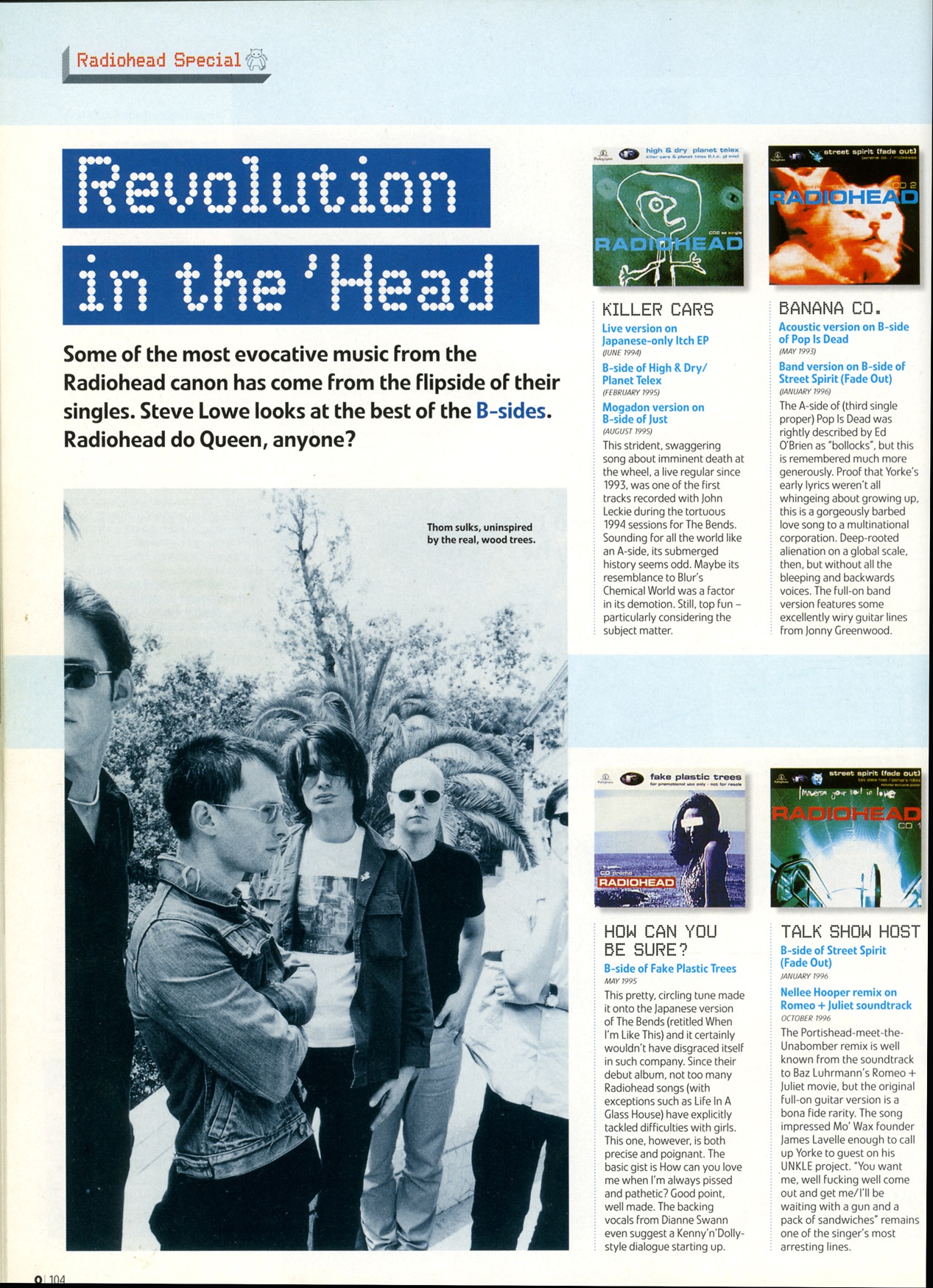
Revolution In The 'Head
Some of the most evocative music from the Radiohead canon has come from the flipside of their singles. Steve Lowe looks at the best of the B-sides. Radiohead do Queen, anyone?
by Steve Lowe
KILLER CARS
Live version on Japanese-only Itch EP
(JUNE 1994)
B-side of High & Dry/Planet Telex
(FEBRUARY 1995)
Mogadon version on B-side of Just
(AUGUST 1995)
This strident, swaggering song about imminent death at the wheel, a live regular since 1993, was one of the first tracks recorded with John Leckie during the torturous 1994 sessions for The Bends. Sounding for all the world like an A-side, its submerged history seems odd. Maybe its resemblance to Blur’s Chemical World was a factor in its demotion. Still, top fun – particularly considering the subject matter.
BANANA CO.
Acoustic version on B-side Pop Is Dead
(MAY 1993)
Band version on B-side of Street Spirit (Fade Out)
(JANUARY 1996)
The A-side of (third single proper) Pop Is Dead was rightly described by Ed O’Brien as “bollocks”, but this is remembered much more generously. Proof that Yorke’s early lyrics weren’t all whingeing about growing up, this is a gorgeously barbed love song to a multinational corporation. Deep-rooted alienation on a global scale, then, but without all the bleeping backwards voices. The full-on band version features some excellently wiry guitar lines from Jonny Greenwood.
HOW CAN YOU BE SURE?
B-side of Fake Plastic Trees
MAY 1995
This pretty, circling tune made it onto the Japanese version of The Bends (retitled When I’m Like This) and it certainly wouldn’t have disgraced itself in such company. Since their debut album, not too many Radiohead songs (with exceptions such as Life In A Glass House) have explicitly tackled difficulties with girls. This one, however, is both precise and poignant. The basic gist is How can you love me when I’m always pissed and pathetic? Good point, well made. The backing vocals from Diane Swann even suggest a Kenny’n’Dolly-style dialogue starting up.
TALK SHOW HOST
B-side of Street Spirit (Fade Out)
JANUARY 1996
Nellee Hooper remix on Romeo + Juliet soundtrack
OCTOBER 1996
The Portishead-meet-the-Unabomber remix is well known from the soundtrack to Baz Luhrmann’s Romeo + Juliet movie, but the original full-on guitar version is a bona fide rarity. The song impressed Mo’Wax founder James Labelle enough to call up Yorke to guest on his UNKLE project. “You want me, well fucking well come out and get me/I’ll be waiting with a gun and a pack of sandwiches” remains one of the singer’s most arresting lines.
THE TRICKSTER
B-side of My Iron Lung
(SEPTEMBER 1994)
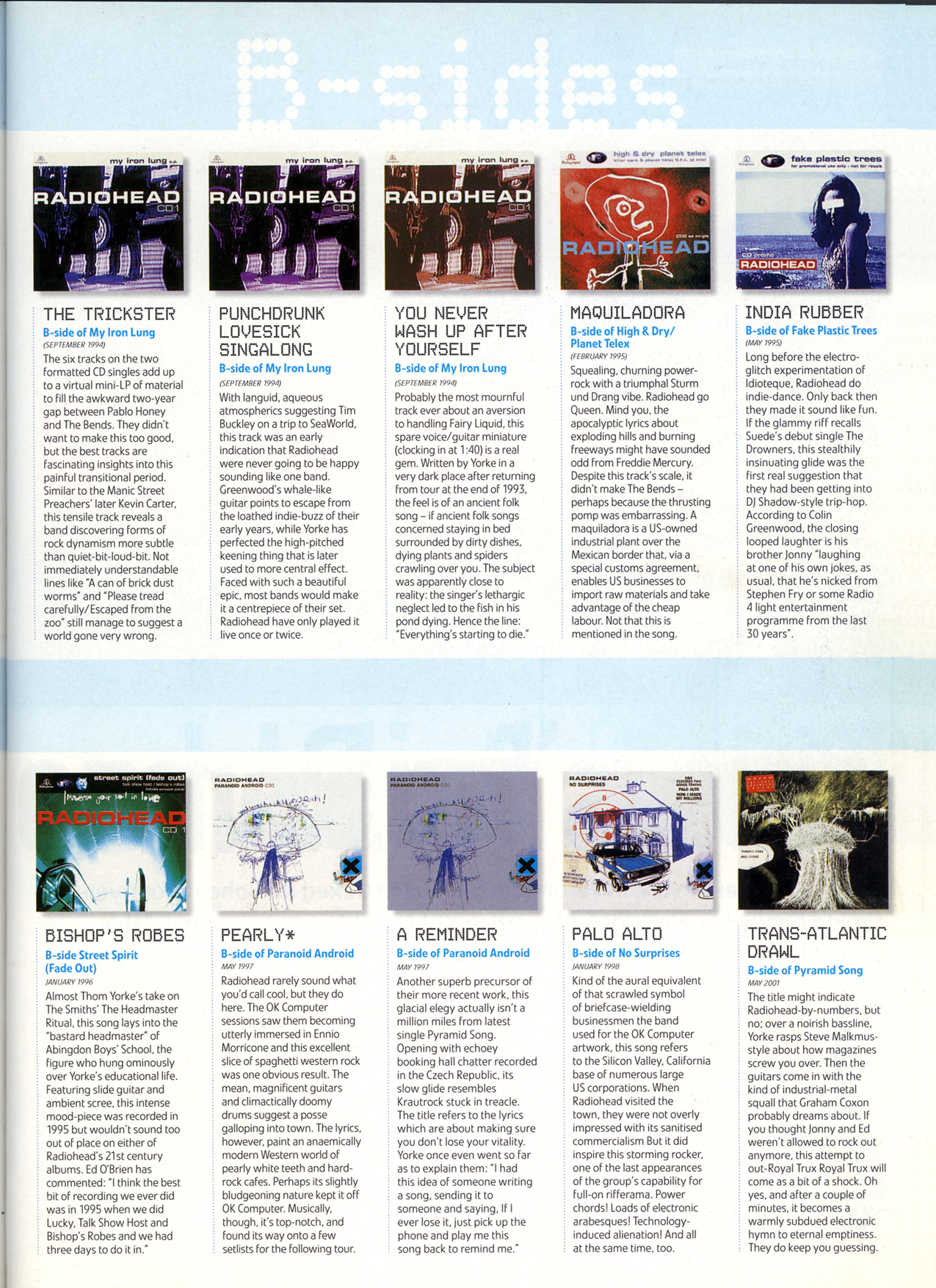
The six tracks on the two formatted CD singles add up to a virtual mini-LP of material to fill the awkward two-year gap between Pablo Honey and The Bends. They didn’t want to make this too good, but the best tracks are fascinating insights into this painful transitional period. Similar to the Manic Street Preachers’ later Kevin Carter, this tensile track reveals a band discovering forms of rock dynamism more subtle than quiet-bit-loud-bit. Not immediately understandable line like “A can of brick dust worms” and “Please tread carefully/Escaped from the zoo” still manage to suggest a world gone very wrong.
PUNCHDRUNK LOVESICK SINGALONG
B-side of My Iron Lung
(SEPTEMBER 1994)
With languid, aqueous atmospherics suggesting Tim Buckley on a trip to SeaWorld, this track was an early indication that Radiohead were never going to be happy sounding like one band. Greenwood’s whale-like guitar points to escape from the loathed indie-buzz of their early years, while Yorke has perfected the high-pitched keening thing that is later used to more central effect. Faced with such a beautiful epic, most bands would make it a centerpiece of their set. Radiohead have only played it live once or twice.
YOU NEVER WASH UP AFTER YOURSELF
B-side of My Iron Lung
(SEPTEMBER 1994)
Probably the most mournful track ever about an aversion to handling Fairy Liquid, this spare voice/guitar miniature (clocking at 1:40) is a real gem. Written by Yorke in a very dark place after returning from tour at the end of 1993, the feel is of an ancient folk song – if ancient folk songs concerned staying in bed surrounded by dirty dishes, dying plants and spiders crawling over you. The subject was apparently close to reality: the singer’s lethargic neglect led to the fish in his pond dying. Hence the line: “Everything’s starting to die.”
MAQUILADORA
B-side of High & Dry/Planet Telex
(FEBRUARY 1995)
Squealing, churning power-rock with a triumphal Sturm und Drang vibe. Radiohead go Queen. Mind you, the apocalyptic lyrics about exploding hills and burning freeways might have sounded odd from Freddie Mercury. Despite this track’s scale, it didn’t make The Bends – perhaps because the thrusting pomp was embarrassing. A maquiladora is a US-owned industrial plant over the Mexican border that, via a special customs agreement, enables US businesses to import raw materials and take advantage of the cheap labour. Not that this is mentioned in the song.
INDIA RUBBER
B-side of Fake Plastic Trees
(MAY 1995)
Long before the electro-glitch experimentation of Idioteque, Radiohead do indie-dance. Only back then they made it sound like fun. If the glammy riff recalls Suede’s debut single The Drowners, this stealthy insinuating glide was the first real suggestion that they had been getting into DJ Shadow-style trip-hop. According to Colin Greenwood, the closing looped laughter is his brother Jonny “laughing at one of his own jokes, as usual, that he’s nicked from Stephen Fry or some Radio 4 light entertainment programme from the last 30 years.”
BISHOP’S ROBES
B-side of Street Spirit (Fade Out)
JANUARY 1996
Almost Thom Yorke’s take on The Smiths’ The Headmaster Ritual, this song lays into the “bastard headmaster” of Abingdon Boys’ School, the figure who hung ominously over Yorke’s educational life. Featuring slide guitar and ambient scree, this intense mood-piece was recorded in 1995 but wouldn’t sound too out of place on either of Radiohead’s 21st century albums. Ed O’Brien has commented: “I think the best bit of recording we ever did was in 1995 when we did Lucky, Talk Show Host and Bishops Robes and we had three days to do it in.”
PEARLY*
B-side of Paranoid Android
MAY 1997
Radiohead rarely sound what you’d call cool, but they do here. The OK Computer sessions saw them becoming utterly immersed in Ennio Morricone and this excellent slice of spaghetti western rock was one obvious result. The mean, magnificent guitars and climactically doomy drums suggest a posse galloping into town. The lyrics, however, paint an anaemically modern Western world of pearly white teeth and hard-rock cafes. Perhaps its slightly bludgeoning nature kept it off OK Computer. Musically, though, it’s top-notch, and found its way onto a few setlists for the following tour.
A REMINDER
B-side of Paranoid Android
MAY 1997
Another superb precursor of their more recent work, this glacial elegy actually isn’t a million miles from latest single Pyramid Song. Opening with echoey booking hall chatter recorded in the Czech Republic, its slow glide resembles Krautrock stuck in treacle. The title refers to the lyrics which are about making sure you don’t lose your vitality. Yorke once even went so far as to explain them: “I had this idea of someone writing a song, sending it to someone and saying, If I ever lose it, just pick up the phone and play me this song back to remind me.”
PALO ALTO
B-side of No Surprises
JANUARY 1998
Kind of the aural equivalent of that scrawled symbol of briefcase-wielding businessmen the band used for the OK Computer artwork, this song refers to the Silicon Valley, California base of numerous large US corporations. When Radiohead visited the town, they were not overly impressed with its sanitized commercialism. But it did inspire this storming rocker, one of the last appearances of the group’s capability for full-on rifferama. Power chords! Loads of electronic arabesques! Technology-induced alienation! And all at the same time, too.
TRANS-ATLANTIC DRAWL
B-side of Pyramid Song
MAY 2001
The title might indicate Radiohead-by-numbers, but no; over a nourish bassline, Yorke rasps Steve Malkmus-style about how magazines screw you over. Then the guitars come in with the kind of industrial-metal squall that Graham Coxon probably dreams about. If you thought Jonny and Ed weren’t allowed to rock out anymore, this attempt to out-Royal Trux Royal Trux will come as a bit of a shock. Oh yes, and after a couple of minutes, it becomes a warmly subdued electronic hymn to eternal emptiness. They do keep you guessing.
"This is for Romeo and Juliet"
The five gentleman are in Verona on the most relaxed Radiohead tour yet, aiming finally to gain “closure” on their Kid A and Amnesiac period. “This should be the most enjoyable thing you can do,” they tell Dorian Lynskey.
by Dorian Lynskey
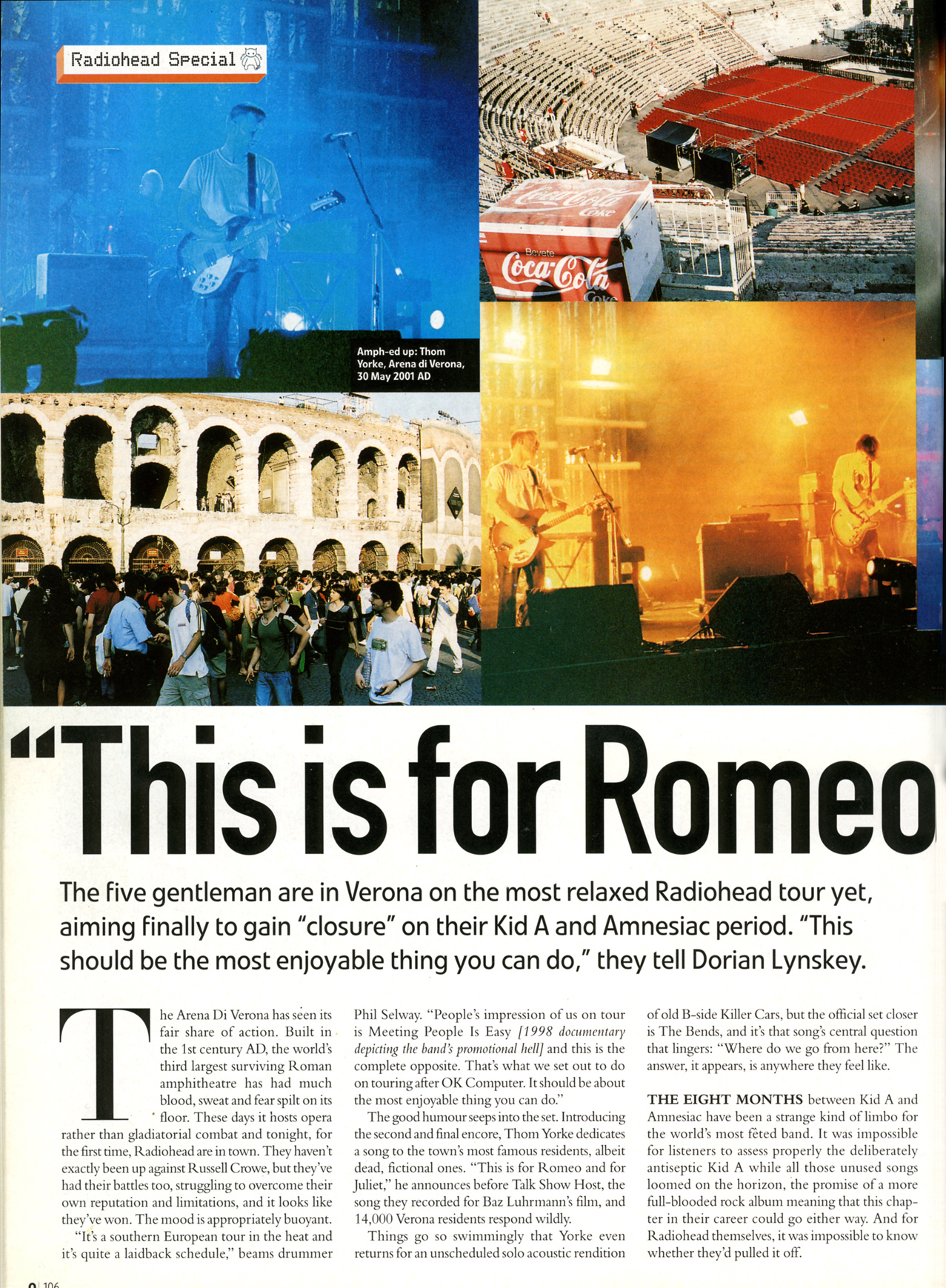
The Arena Di Verona has seen its fair share of action. Built in the 1st Century AD, the world's third largest surviving Roman amphitheatre has had much blood, sweat and fear spilt on its floor. These days it hosts opera rather than gladiatorial combat and tonight, for the first time, Radiohead are in town. They haven't exactly been up against Russel Crowe, but they’ve had their battles too, struggling to overcome their own reputation and limitations, and it looks like they’ve won. The mood is appropriately buoyant.
“It's a southern European tour in the heat and it's quite a laidback schedule,” beams drummer Phil Selway. “People's impression of us on tour is Meeting People Is Easy [1998 documentary depicting the band’s promotional hell] and this is the complete opposite. That's what we set out to do on touring after OK Computer. It should be about the most enjoyable thing you can do.”
The good humour seeps into the set. Introducing the second and final encore, Thom Yorke dedicates a song to the town's most famous residents, albeit dead, fictional ones. “This is for Romeo and for Juliet,” he announces before Talk Show Host, the song they recorded for Baz Luhrmann's film, and 14,000 Verona residents respond wildly.
Things go so swimmingly that Yorke even returns for an unscheduled solo acoustic rendition of old B-side Killer Cars, but the official set closer is The Bends, and it's that song's central question that lingers: “Where do we go from here?” The answer, it appears, is anywhere they feel like.
THE EIGHT MONTHS between Kid A and Amnesiac have been a strange kind of limbo for the world's most fêted band. It was impossible for listeners to assess properly the deliberately antiseptic Kid A while all those unused songs loomed on the horizon, the promise of a more full-blooded rock album meaning that this chapter in their career could go either way. And for Radiohead themselves, it was impossible to know whether they'd pulled it off.
Now that the dust has settled, it’s finally clear that Radiohead have done what they set out to do. The twin albums amount to a daring musical jailbreak, tunnelling their way out of the prison of expectation built by OK Computer and emerging triumphant into the daylight with any number of roads ahead of them. If it's difficult to find anything celebratory in the hermetic paranoia of Kid A and Amnesiac, then it's equally hard to miss it in the two hours that Radiohead hold the Arena Di Verona in their spell.
The first sign of how different the band's live and studio incarnations have become is at the afternoon's soundcheck. Outside the arena, fans are pressed against the crash barriers three hours before the gates even open, some of them shouting incongruously “Tommy, we love you.” On stage, “Tommy” and friends run through fragments of the ser in sunhats, sunglasses and shorts beneath the blazing Italian sunshine. The first song they play opens unfamiliarly with a monstrous fuzz bassline from Colin Greenwood, a clipped drum beat from Phil Selway and frenzied tambourine shaking from Yorke. It's not until he starts singing that you realise this is Packt Like Sardines In A Crushd Tin Box, Amnesiac’s chilly electronic opener dazzlingly reborn as a thuggish Krautrocky cousin to The National Anthem.
Guitarist Ed O'Brien has described the recording of the last two albums as learning to become a production outfit rather than a band, but this is the point where the musicians get to wrest these songs out of their studio bubble and let them breathe. Only the title track of Kid A has so far proven stubbornly resistant to the open air. “We're getting close though,” Selway promises. “It will be at a gig near you soon.”
Ironically, neither of the most conventional rock moments on each album - Optimistic and Knives Out - make it onto the setlist tonight. It's hard to imagine anybody hearing Everything In Its Right Place or Packt Like Sardines for the first time and thinking, This one’s going to blow the roof off live, but that's precisely what makes them so compelling. “In comparison to where we've just gone out and basically done carbon copies of what’s gone before, this is much more challenging,” says Selway. “Actually going into rehearsals not knowing if we'd be able to pull off a convincing version of a particular song. Idioteque in particular has a completely different life there which is as valid and possibly more exciting:'
“It's great,' agrees Ed O'Brien. “It's different each night. You have to think laterally about ways of creating things where sometimes guitars aren't needed. That's the part I enjoy most. It's a total band thing. These songs were made in the studio and the fun part, the Oh Shit factor, is how can we make this music work in a live situation?”
So what happened to the idea that Amnesiac would be a straight ahead rock record compared to Kid A?
“I think we honestly felt that it was,” O'Brien protests. “But it's not straight ahead at all. If you want straight ahead rock music, U2 have delivered an album like that which people have lauded. I guess when we heard that record it was like, OK, Amnesiac's not the direct rock record that everyone thought we were going to make. We thought it was pretty direct.” He shrugs apologetically. “But obviously not.”
In vivid contrast to the mud and beer cups littering last autumn's UK tent tour, it's hard to imagine a more congenial setting in which to see Radiohead than the Arena Di Verona. Thanks to the open-air layout and tiered seating, it manages to seat 14,000 while retaining a sense of intimacy. As jaunty pre-war jazz drifts through the PA and vendors stroll around dispensing ice creams to impeccably groomed young Italians, it feels gloriously civilised,
The sun is just about to sink behind the stage when Radiohead appear to an instant standing ovation and power into The National Anthem. For obvious reasons, the album's eight-piece brass section isn't a regular part of the show, so Jonny Greenwood fills the gap by generating unearthly warbles from his Ondes Martenot, the primitive electronic keyboard employed elsewhere on Kid A. More than ever, Greenwood looks like he's doing two jobs at once: half-guitar hero, half-techno boffin. In rock mode during My Iron Lung, he plays guitar like he's wrestling an electric eel, slashing violently at it then recoiling as if from a sudden shock, but more often he's darting between keyboards, Ondes Martenot and numerous tiny devices. O'Brien, traditionally the more conventional guitarist, also does his share of crouching down to fiddle with samplers and effects boxes.
“We're a different band, even from last year,” O'Brien explains later. “We're not scared anymore. We used to be fraught with such tension before we went on but now we're fairly relaxed. If you're looking for the full-on mental fuck-out that we used to do then you'll be disappointed. We don’t do that every night. But I think we play the songs a lot better because the Kid A and Amnesiac songs need you to be relaxed. You can't go on with that speedy type thing. The bands got a natural kind of swing.”
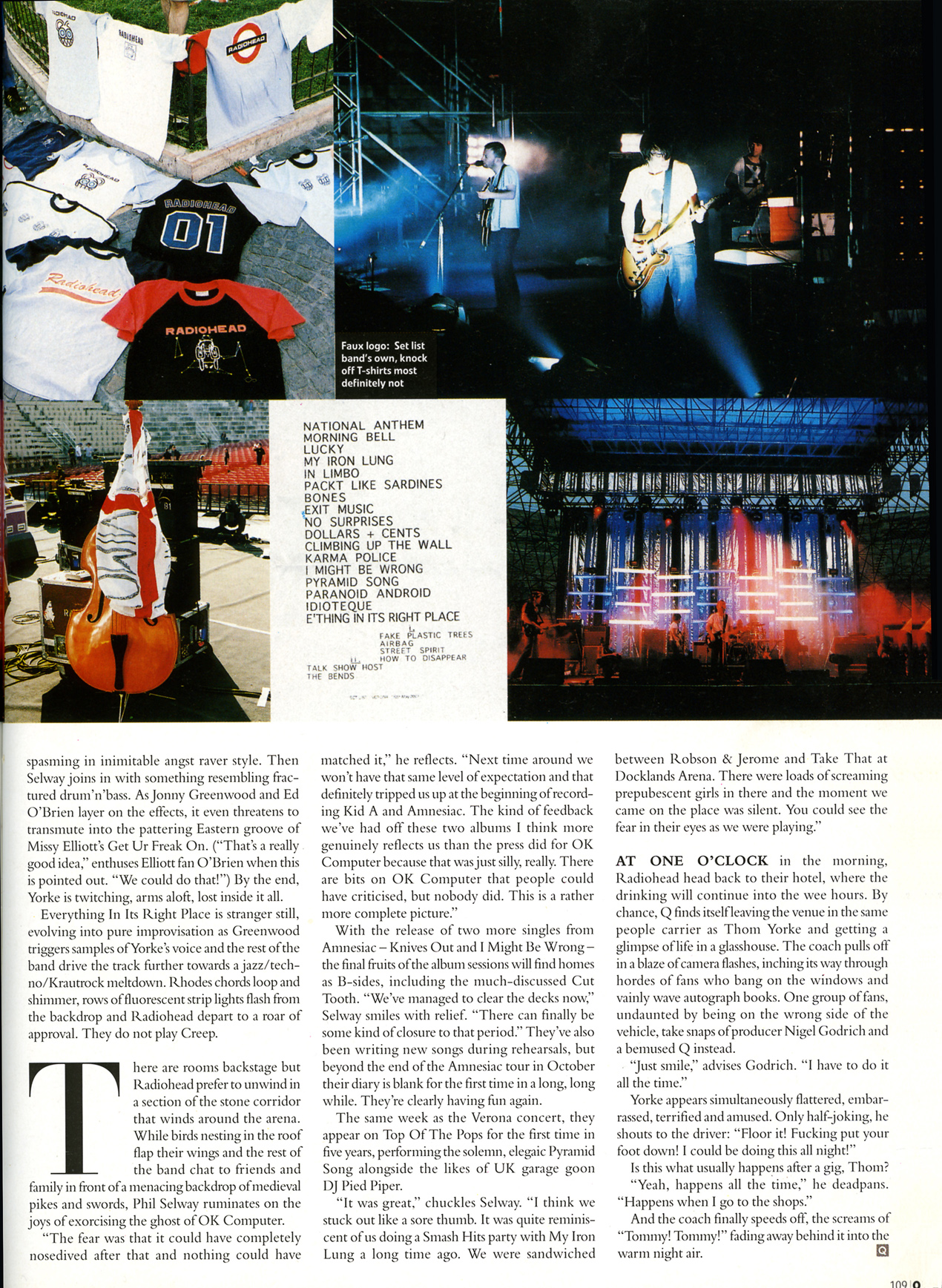
Even in their most obtuse moments, Radiohead have never been the kind of group to shun the hits. Theirs is all artfully constructed set, sandwiching newer songs between seasoned crowd-pleasers. Thus Dollars And Cents, which is hard work whichever way you slice it, falls between No Surprises and Climbing Up The Walls. The fragile, troubling Morning Bell segues into a stunning Lucky, during which the sun sets behind the band and the combination of dry ice and lurid red and yellow lights creates the illusion that the sky is on fire. The lights play tricks during No Surprises as well, casting a colossal shadow of Greenwood on the xylophone against the side of the arena, like a spectre hammering on the audience's heads. The first encore commences with a performance of Fake Plastic Trees so vast and moving that lighters and candles flicker like fireflies across the arena and one girl actually bursts into tears halfway through.
As evidence of just how far Radiohead have come, however, it's impossible to beat the main set's closing trio of Paranoid Android, ldioteque and Everything In Its Right Place. However odd Paranoid Android sounded back in 1997, it's the Ramones compared to what follows. Idioteque’s cruel synthesized pulse strikes up and Yorke Starts spasming in inimitable angst raver style. Then slowly joins in with something resembling fractured drum'n'bass. As Jonny Greenwood and Ed O'Brien layer on the effects, it even threatens to transmute into the pattering Eastern groove of Missy Elliot’s Get Ur Freak On. (“That’s a really good idea.” enthuses ElIiot fan O'Brien when this is pointed out. “We could do that!”) By the end, Yorke is twitching, arms aloft, lost inside it all.
Everything In Its Right Place is stranger still, evolving into pure improvisation as Greenwood triggers samples of Yorke’s voice and the rest of the band drive the track further towards a jazz/techno Krautrock meltdown. Rhodes chords loop and shimmer, rows of fluorescent strip lights flash from the backdrop and Radiohead depart to a roar of applause. They do not play Creep.
There are rooms backstage but Radiohead prefer to unwind in a section of the stone corridor that winds around the arena. While birds nesting in the roof flap their wings and the rest of the band chat to friends and family in front of a menacing backdrop of medieval pikes and swords, Phil Selway ruminates on the joys of exercising the ghost of OK Computer.
“The fear was that it could have completely nosedived after that and nothing could have matched it,” he reflects. “Next time around we won't have that same level of expectation and that definitely tripped us up at the beginning of recording Kid A and Amnesiac. The kind of feedback we’ve had off these two albums I think more genuinely reflects us than the press did for OK Computer because that was just silly, really. There are bits on OK Computer that people could have criticized, but nobody did. This is a rather more complete picture.”
With the release of two more singles from Amnesiac – Knives Out and I Might Be Wrong – the final fruits of the album sessions will find homes as B-sides, including the much-discussed Cut Tooth. “We've managed to clear the decks now,” Selway smiles with relief. “There can finally be some kind of closure to that period.” They’ve also been writing new songs during rehearsals. But beyond the end of the Amnesiac tour in October their diary is blank for the first time in a long, long while. They’re clearly having fun again.
The same week as the Verona concert, they appear on Top Of The Pops for the first time in five years, performing the solemn, elegiac [sic] Pyramid Song alongside the likes of UK garage goon DJ Pied Piper.
“It was great,” chuckles Selway. “I think we stuck out like a sore thumb. It was quite reminiscent of us doing a Smash Hits party with My Iron Lung a long time ago. We were sandwiched between Robson & Jerome and Take That at Docklands Arena. There were loads of screaming prepubescent girls in there and the moment we came on the place was silent. You could see the fear in their eyes as we were playing.”
AT ONE O'CLOCK in the morning, Radiohead head back to their hotel, where the drinking will continue into the wee hours. By chance, Q finds itself leaving the venue in the same people carrier as Thom Yorke and getting a glimpse of life in a glasshouse. The coach pulls off in a blue of camera flashes, inching its way through hordes of fans who bang on the windows and vainly wave autograph books. One group of fans, undaunted by being on the wrong side of the vehicle, take snaps of producer Nigel Godrich and a bemused Q instead.
“Just smile,” advises Godrich. “I have to do it all the time.”
Yorke appears simultaneously flattered, embarrassed, terrified and amused. Only half-joking, he shouts to the driver: “Floor it! Fucking put your foot down! I could be doing this all night!”
Is this what usually happens after a gig, Thom?
“Yeah, happens all the time,” he deadpans. “Happens when I go to the shops.”
And the coach finally speeds off, the screams of “Tommy! Tommy!” fading away behind it into the warm night air.