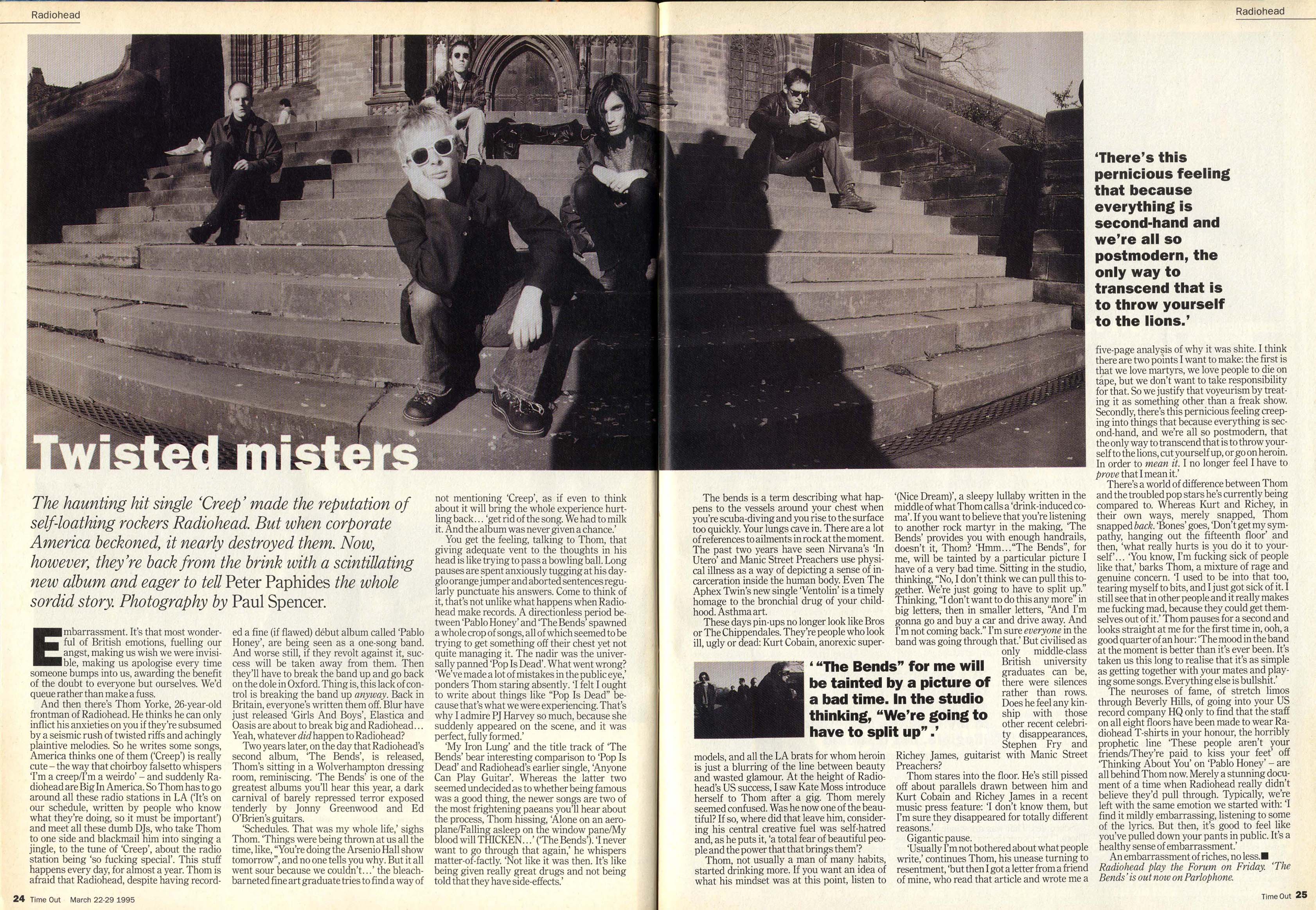
Twisted misters
The haunting hit single ‘Creep’ made the reputation of self-loathing rockers Radiohead. But when corporate America beckoned, it nearly destroyed them. Now, however, they’re back from the brink with a scintillating new album and eager to tell Peter Paphides the whole sordid story.
Embarrassment. It’s that most wonderful of British emotions, fuelling our angst, making us wish we were invisible, making us apologise every time someone bumps into us, awarding the benefit of the doubt to everyone but ourselves. We’d queue rather than make a fuss.
And then there’s Thom Yorke, 26-year-old frontman of Radiohead. He thinks he can only inflict his anxieties on you if they’re subsumed by a seismic rush of twisted riffs and achingly plaintive melodies. So he writes some songs, America thinks one of them (‘Creep’) is really cute - the way that choirboy falsetto whispers ‘I'm a creep/I'm a weirdo’ - and suddenly Radiohead are Big In America. So Thom has to go around all these radio stations in LA (‘It’s on our schedule, written by people who know what they’re doing, so it must be important’) and meet all these dumb DJs, who take Thom to one side and blackmail him into singing a jingle, to the tune of ‘Creep’, about the radio station being ‘so fucking special’. This stuff happens every day, for almost a year. Thom is afraid that Radiohead, despite having recorded a fine (if flawed) debut album called ‘Pablo Honey’, are being seen as a one-song band. And worse still, if they revolt against it, success will be taken away from them. Then they’ll have to break the band up and go back on the dole in Oxford. Thing is, this lack of control is breaking the band up anyway. Back in Britain, everyone’s written them off. Blur have just released ‘Girls And Boys’, Elastica and Oasis are about to break big and Radiohead... Yeah, whatever did happen to Radiohead?
Two years later, on the day that Radiohead’s second album, ‘The Bends’, is released, Thom’s sitting in a Wolverhampton dressing room, reminiscing. ‘The Bends’ is one of the greatest albums you’ll hear this year, a dark carnival of barely repressed terror exposed tenderly by Jonny Greenwood and Ed O’Brien’s guitars.
‘Schedules. That was my whole life,’ sighs Thom. ‘Things were being thrown at us all the time, like, “You’re doing the Arsenio Hall show tomorrow”, and no one tells you why. But it all went sour because we couldn’t... ’ the bleach-barneted fine art graduate tries to find a way of not mentioning ‘Creep’, as if even to think about it will bring the whole experience hurtling back... ‘get rid of the song. We had to milk it. And the album was never given a chance.’
You get the feeling, talking to Thom, that giving adequate vent to the thoughts in his head is like trying to pass a bowling ball. Long pauses are spent anxiously tugging at his dayglo orange jumper and aborted sentences regularly punctuate his answers. Come to think of it, that’s not unlike what happens when Radiohead make records. A directionless period between ‘Pablo Honey’ and ‘The Bends’ spawned a whole crop of songs, all of which seemed to be trying to get something off their chest yet not quite managing it. The nadir was the universally panned ‘Pop Is Dead’. What went wrong? ‘We’ve made a lot of mistakes in the public eye,’ ponders Thom staring absently. ‘I felt I ought to write about things like “Pop Is Dead” because that’s what we were experiencing. That’s why I admire PJ Harvey so much, because she suddenly appeared on the scene, and it was perfect, fully formed.’
‘My Iron Lung’ and the title track of ‘The Bends’ bear interesting comparison to ‘Pop Is Dead’ and Radiohead’s earlier single, ‘Anyone Can Play Guitar’. Whereas the latter two seemed undecided as to whether being famous was a good thing, the newer songs are two of the most frightening paeans you’ll hear about the process, Thom hissing, ‘Alone on an aeroplane/Falling asleep on the window pane/My blood will THICKEN... ’ (‘The Bends’). ‘I never want to go through that again,’ he whispers matter-of-factly. ‘Not like it was then. It’s like being given really great drugs and not being told that they have side-effects.’
The bends is a term describing what happens to the vessels around your chest when you’re scuba-diving and you rise to the surface too quickly. Your lungs cave in. There are a lot of references to ailments in rock at the moment. The past two years have seen Nirvana’s ‘In Utero’ and Manic Street Preachers use physical illness as a way of depicting a sense of incarceration inside the human body. Even The Aphex Twin’s new single ‘Ventolin’ is a timely homage to the bronchial drug of your childhood. Asthma art.
These days pin-ups no longer look like Bros or The Chippendales. They’re people who look ill, ugly or dead: Kurt Cobain, anorexic supermodels, and all the LA brats for whom heroin is just a blurring of the line between beauty and wasted glamour. At the height of Radiohead’s US success, I saw Kate Moss introduce herself to Thom after a gig. Thom merely seemed confused. Was he now one of the beautiful? If so, where did that leave him, considering his central creative fuel was self-hatred and, as he puts it, ‘a total fear of beautiful people and the power that that brings them’?
Thom, not usually a man of many habits, started drinking more. If you want an idea of what his mindset was at this point, listen to ‘(Nice Dream)’, a sleepy lullaby written in the middle of what Thom calls a ‘drink-induced coma’. If you want to believe that you’re listening to another rock martyr in the making, ‘The Bends’ provides you with enough handrails, doesn’t it, Thom? ‘Hmm...“The Bends”, for me, will be tainted by a particular picture I have of a very bad time. Sitting in the studio, thinking, “No, I don’t think we can pull this together. We’re just going to have to split up.” Thinking, “I don’t want to do this any more" in big letters, then in smaller letters, “And I’m gonna go and buy a car and drive away. And I’m not coming back.” I’m sure everyone in the band was going through that.’ But civilised as only middle-class British university graduates can be, there were silences rather than rows. Does he feel any kinship with those other recent celebrity disappearances, Stephen Fry and Richey James, guitarist with Manic Street Preachers?
Thom stares into the floor. He’s still pissed off about parallels drawn between him and Kurt Cobain and Richey James in a recent music press feature: ‘I don’t know them, but I’m sure they disappeared for totally different reasons.’
Gigantic pause.
‘Usually I’m not bothered about what people write,’ continues Thom, his unease turning to resentment, ‘but then I got a letter from a friend of mine, who read that article and wrote me a five-page analysis of why it was shite. I think there are two points I want to make: the first is that we love martyrs, we love people to die on tape, but we don’t want to take responsibility for that. So we justify that voyeurism by treating it as something other than a freak show. Secondly, there’s this pernicious feeling creeping into things that because everything is second-hand, and we’re all so postmodern, that the only way to transcend that is to throw yourself to the lions, cut yourself up, or go on heroin. In order to mean it. I no longer feel I have to prove that I mean it.’
There’s a world of difference between Thom and the troubled pop stars he’s currently being compared to. Whereas Kurt and Richey, in their own ways, merely snapped, Thom snapped back. ‘Bones’ goes, ‘Don’t get my sympathy, hanging out the fifteenth floor’ and then, ‘what really hurts is you do it to yourself’ ... ‘You know, I’m fucking sick of people like that,’ barks Thom, a mixture of rage and genuine concern, i used to be into that too, tearing myself to bits, and I just got sick of it. I still see that in other people and it really makes me fucking mad, because they could get themselves out of it.’ Thom pauses for a second and looks straight at me for the first time in, ooh, a good quarter of an hour: ‘The mood in the band at the moment is better than it’s ever been. It’s taken us this long to realise that it’s as simple as getting together with your mates and playing some songs. Everything else is bullshit.’
The neuroses of fame, of stretch limos through Beverly Hills, of going into your US record company HQ only to find that the staff on all eight floors have been made to wear Radiohead T-shirts in your honour, the horribly prophetic line ‘These people aren’t your friends/They’re paid to kiss your feet’ off ‘Thinking About You’ on ‘Pablo Honey’ - are all behind Thom now. Merely a stunning document of a time when Radiohead really didn’t believe they’d pull through. Typically, we’re left with the same emotion we started with: ‘I find it mildly embarrassing, listening to some of the lyrics. But then, it’s good to feel like you’ve pulled down your pants in public. It’s a healthy sense of embarrassment.’
An embarrassment of riches, no less.
Radiohead play the Forum on Friday. 'The Bends ’ is out now on Parlophone.
‘ “The Bends” for me will be tainted by a picture of a bad time. In the studio thinking, “We’re going to have to split up”
‘There’s this pernicious feeling that because everything is second-hand and we’re all so postmodern, the only way to transcend that is to throw yourself to the lions, cut yourself up, or go on heroin.