mother, should I build a wall?
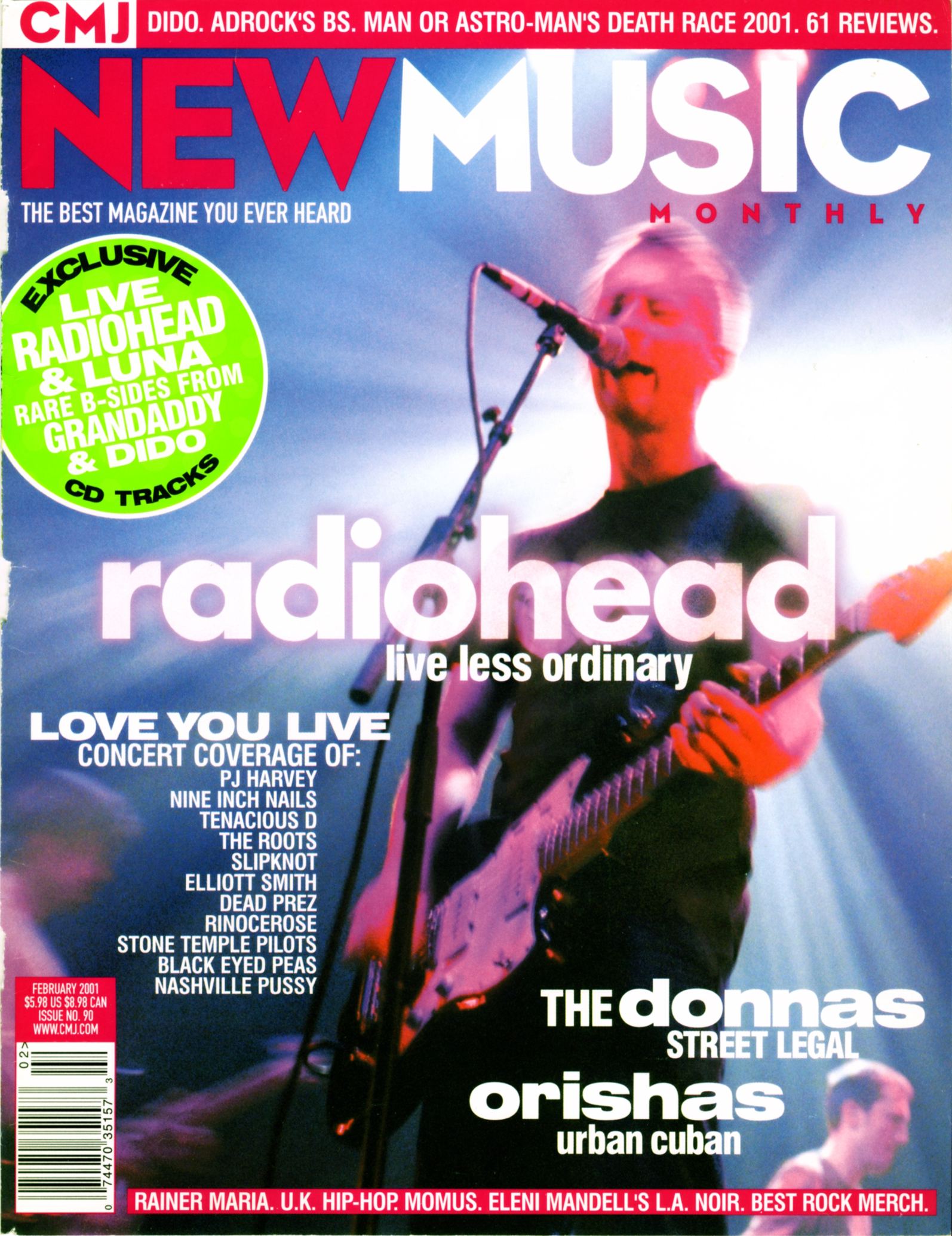
Now that Radiohead has taken rock to new planes, they face a bigger challenge: taking it to the stage.


In The Flesh
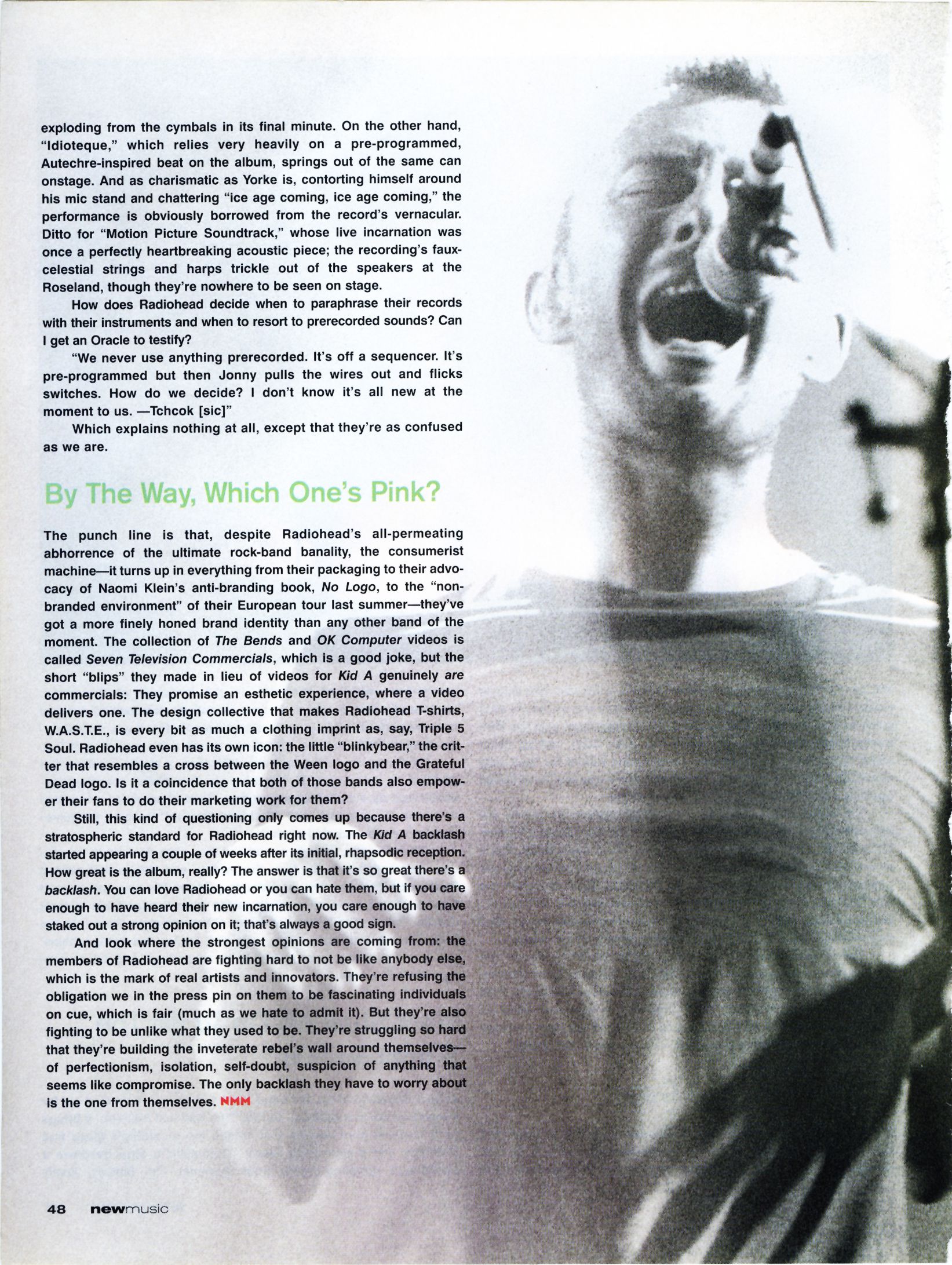
The audience at Radiohead’s Roseland Ballroom show look like the only 3,000 people in New Yorke who’ve found the golden tickets to paradise. They’re crying in anticipation, screaming with joy and bathing in a warm, ecstatic glow, even if scalpers charged them hundreds of dollars for the privilege.
They’ve paid to be in the presence of Radiohead’s aura as much as to see the performance. And why shouldn’t they? Radiohead is arguably the most exciting rock band in the world right now, the group hose next move matter more than their last one. And part of the thrill is that their show, one of only three in the U.S. last year, is not a rote greatest-hits set: A lot of what the band will play isn’t even on their new album, Kid A (Capitol). The bandmembers skip most of their best-known songs, they don’t indulge in stage gimmickry, and they don’t ask anyone to sing along (though the “rain down” but of “Paranoid Android” turns Into a roar from the audience anyway). We're gratified, because they're not trying too hard to please us.
Still, you can see a change come over the whole band's body language as they switch between new material and old, between more traditionally structured rock songs and the songs that haunt rock's abandoned house. When the group members reach back for old nuggets like “Just” or “The Bends,” they're incandescent and physical, lunging Into every chord, looking as if they're remembering a skill they'd put aside; when they try “Everything In Its Right Place” or the brand new, groove-based encore “I Might Be Wrong,” they barely move, and seem to be concentrating very hard on losing themselves inside the song. Yorke recently said in an interview that he's contemplated changing Radiohead's name, and at the Roseland show, that choice suddenly made sense. But if it's tough to be the most exciting band in the world, imagine being the two most exciting bands in the world.
You Gotta Be Crazy, You Gotta Have A Real Need
If you want to shield your eyes from the Radiohead halo and actually interview the mystical wizards behind the curtain, keep in mind that there are plenty of guards at the gate. These days, here's what you do: First, apply for a username and a password from one of their publicists. If you're approved, you go to a special Web site (www.spinwithagrin.co.uk), log In with the password, and type your question in. Your query is forwarded to the publicist, who determines if it's Interesting enough for the band to answer; if it passes that test, it's re-forwarded to Radiohead, who respond to it (if they feel like it, maybe, eventually), and post both the question and answer on the site, whereupon every Radiohead fan site on the planet links to it.
Transmitting a question is like an act of supplication to the Oracle at Delphi: Sacrifice the calf wrong, and you'll get a curt, sarcastic comeback. Sometimes a bandmember writes something meaningful, and signs it (“JG” is guitarist Jonny Greenwood, “Dr. Tchock” and its variants are singer/guitarist Thom Yorke); sometimes you just get an uncredited torrent of sub-Joycean misspellings and self-contradicting thoughts. But no one gets to see the Wizard – not directly, at any rate.
Don't Leave Me Now
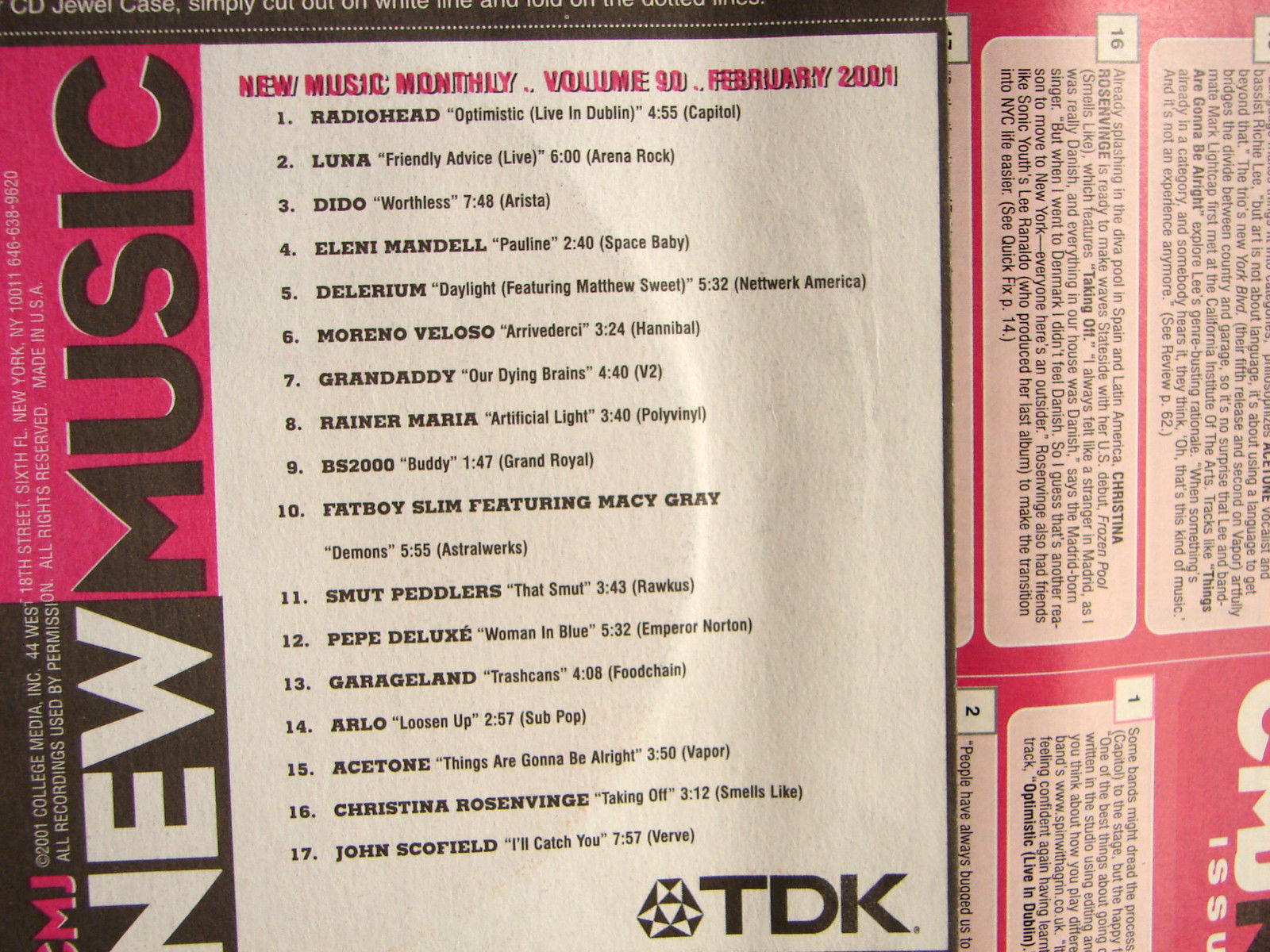
Is it weird for Radiohead to perform old songs from when their creative process was very different and their heads were in a very different place – and have they ever wanted to ditch them altogether? We asked the Oracle, and the answer came:
“I think it's basically unhealthy to disown music that you've done in the past. So long as you're not attached to it and realize it comes from where you were, then it's okay. And that now you have moved on elsewhere, playing a song in a concert in front of people is a way of reclaiming it back. If we could not play any of our old stuff, I don't think we would, simply. It fucks with the flow of writing and making music to try too hard to distance yourself from certain things you do. But then crowd-pleasing doesn't exactly come natural to us so, sometimes when you play it doesn't mean anything, sometimes you remember something in it that you thought you forgot, which is great. In a way it's whatever the audience gives back to you.”
“Crowd-pleasing” is a central problem of Radiohead's career – they've never, ever been comfortable with it. At this point, if people expect Radiohead to do something, that makes them pretty much incapable of doing it; Kid A and what comes after it are Radiohead inventing workarounds to avoid rock normalcy.
The two-year record/tour cycle is unfathomably depressing to them, so we can expect album number five shortly; the original plan was that it would be more of the dozens of songs from the epic Kid A sessions, but the latest word is that at least some of it will be newer. The interview process bugs them, so we get Spin With A Grin. They had one fairly straightforward old-style Radiohead song going into Kid A” Knives Out,” a recent live staple-and they spent more than a year, off and on, trying to get the recording right (and haven't released it yet).
And then there's the matter of touring the way rock bands are “supposed” to, and what's supposed to happen when they're onstage, which may be why their 2001 tour is rumored to be up in the air. It's part of their appeal that they never do the obvious thing. And when not doing the obvious thing becomes what they're expected to do-well, that's where they hit a wall of their own devising.
Waiting For The Worms
That's not to say that Radiohead is afflicted with creative stagnation. Just the opposite, actually; snap open the CD tray of Kid A, and you'll find an extra, hidden booklet, with fragments of lyrics from material they left off the album. Nonetheless, Kid A's tune “How To Disappear Completely” could be about their songs – especially songs that have been eagerly anticipated but haven't yet shown up on record. “Lift,” “Follow Me Around” and “True Love Waits,” among others, have surfaced in the band's live repertoire, been tossed around as possible album tracks or singles, and then vanished before a recording ever appeared. There's a song called “Cuttooth” that guitarist Ed O'Brien's online diaries suggested was a highlight of the Kid A sessions, an extended three-chord juggernaut. One of the best Radiohead fan sites is named after it. Nobody beyond Radiohead's inner circle has ever even heard it. So what's the story with the disappearing material? Is it that certain songs, even some of their best, resist recording? We asked the Oracle: “If you got to the unofficial sites, you'll see there are lists of songs that have never made it right to tape. We're trying to work from the basis that it doesn't matter how it is done technically in the studio, that is one workspace, and playing it in front of people is another. It's a case of rewriting things. Some of it works, some of it doesn't. The most important thing is not feeling in any way restricted. Sometimes what sounds good live cannot be translated like that. It sounds dull and lifeless. But so what? It's in a different place. We try hard not to have a problem with it. Missing songs find their way back eventually. – Tchocky (Keen aren't I?)”
Welcome To The Machine
Oh, yes, the unofficial sites – ground zero for Radiohead 's fanbase, and for the PR coups that helped drive Kid A to No. 1. In the old way of thinking, if you're a fan of a band, its direct involvement with your life stops at discrete, “official” activities: buying the album, going to see them play, maybe getting a T-shirt. But we are not in that world anymore; we are in a world with unstoppable information flow, and the old paradigm no longer pertains.
Radiohead's brilliant move is blurring the “official”/”unofficial” line, so that they can draw their listeners more deeply into their world. Instead of updates on current band news, Radiohead.com points to fans' volunteer sites like the excellent Greenplastic.com and Ateaseweb.com; Radiohead.com itself is mostly a deep, dense, marvelously complicated piece of art designed by Stanley Donwood, who plays Hipgnosis to their Pink Floyd. (Earlier versions of it have been archived by fans; there are links at www.radiohead.com/waitingroom.html.) The band's marketers programmed an “iBlip” – a mini-site with links to multimedia goodies – for Kid A, available to anyone who wanted to stick a link to it on the Web; they streamed the entire album over the Web weeks before its release. The band has even been making noise about considering an electronic subscription model for their new music, so it could come out as they finish it in a way that hasn't been possible since the fall of the non-album single.
The band knows that any song they perform in public will immediately circulate to all of their serious fans. They depend on that. Kid A proper is so carefully engineered, so rich in sonic detail, that a pirated MP3 is simply not an adequate substitute, and the fan sites are windows to their work in progress. At Roseland, Yorke dedicated the new “Pyramid Song” to “everyone who's already heard it on Napster.” But how do they feel about the fact that when they change a song before they release it officially, the previous draft is already documented?
Speak, great Oracle: “It doesn't matter at all. I always get worried when a song gets set in a certain way. Because to me that can just end up being habit forming, you loose [sic] where it's coming from and you get bored, so much so that we used to tape everything we played and listen to it and analyze it to make sure we hadn't missed anything. Then [we] remembered, actually, the good stuff sticks.”
A Lead Role In A Cage
The dilemma that the members of Radiohead are facing as musicians right now is another facet of the crowd-pleasing problem: how to express their new music, constructed out of sound manipulations in the gravity-free world of ProTools, in the language of the stage. Radiohead's first couple of albums essentially documented material from live performances, very often road-tested before it was recorded the demi-hit “My Iron Lung” (1994) was mostly a live recording, in fact.
OK Computer (1997) split the difference, a studio creation that doubled as arena-rock; if “Climbing Up The Walls” sounded half obliterated by a malicious subroutine, “Lucky” spawned a hundred thousand air-guitarists, and “Paranoid Android” became the junior axeman's math-rock drill of choice.
Kid A's songs, though, sound like they were devised in the studio; their essence is far from the muscle and riffage that earned Radiohead their live rep. In order to perform the new songs (and they've played them all onstage, aside from the ineffable textural doodle “Treefingers”), the band can either translate them into the fingers-and-instruments idiom, and risk losing the compositions' power and meaning, or be faithful to the recordings, and risk becoming slaves to a tape.
What Shall We Do To Fill The Empty Spaces?
At their Roseland show, the band has a few solutions worked out for translating the new material. During “The National Anthem,” it brings on a massive horn section that stokes the recording's gluey free Dixieland Into a four-alarm blaze; “Optimistic'''s loop becomes a continuous rumbling tattoo from drummer Phil Selway, finally exploding from the cymbals in its final minute. On the other hand, “Idioteque,” which relies very heavily on a pre-programmed, Autechre-inspired beat on the album, springs out of the same can onstage. And as charismatic as Yorke is, contorting himself around his mic stand and chattering “ice age coming, ice age coming,” the performance is obviously borrowed from the record's vernacular. Ditto for “Motion Picture Soundtrack,” whose live incarnation was once a perfectly heartbreaking acoustic piece; the recording's faux-celestial strings and harps trickle out of the speakers at the Roseland, though they're nowhere to be seen on stage.
How does Radiohead decide when to paraphrase their records with their instruments and when to resort to prerecorded sounds? Can I get an Oracle to testify?
“We never use anything prerecorded. It's off a sequencer. It's pre-programmed but then Jonny pulls the wires out and flicks switches. How do we decide? I don't know it's all new at the moment to us. – Tchcok [sic]”
Which explains nothing at all, except that they're as confused as we are.
By The Way, Which One’s Pink?
The punch line is that, despite Radiohead's all-permeating abhorrence of the ultimate rock-band banality, the consumerist machine – it turns up in everything from their packaging to their advocacy of Naomi Klein's anti-branding book, No Logo, to the “non-branded environment” of their European tour last summer – they've got a more finely honed brand identity than any other band of the moment. The collection of The Bends and OK Computer videos is called Seven Television Commercials, which is a good joke, but the short “blips” they made in lieu of videos for Kid A genuinely are commercials: They promise an esthetic: experience, where a video delivers one. The design collective that makes Radiohead T-shirts, W.A.S.T.E., is every bit as much a clothing imprint as, say, Triple 5 Soul. Radiohead even has its own icon: the little “blinkybear,” the critter that resembles a cross between the Ween logo and the Grateful Dead logo. Is it a coincidence that both of those bands also empower their fans to do their marketing work for them?
Still, this kind of questioning only comes up because there's a stratospheric standard for Radiohead right now. The Kid A backlash started appearing a couple of weeks after its initial, rhapsodic reception. How great is the album, really? The answer is that it's so great there's a backlash. You can love Radiohead or you can hate then, but if you care enough to have heard their new incarnation, you care enough to have staked out a strong opinion on it; that's always a good sign.
And look where the strongest opinions are coming from: the members of Radiohead are fighting hard to not be like anybody else which is the mark of real artists and innovators. They're refusing obligation we in the press pin on them to be fascinating individuals on cue, which is fair (much as we hate to admit it). But they're also fighting to be unlike what they used to be. They’re struggling so hard that they're building the inveterate rebel’s wall around themselves – of perfectionism, isolation, self-doubt, suspicion of anything that seems like compromise. The only backlash they have to worry about is the one from themselves.