
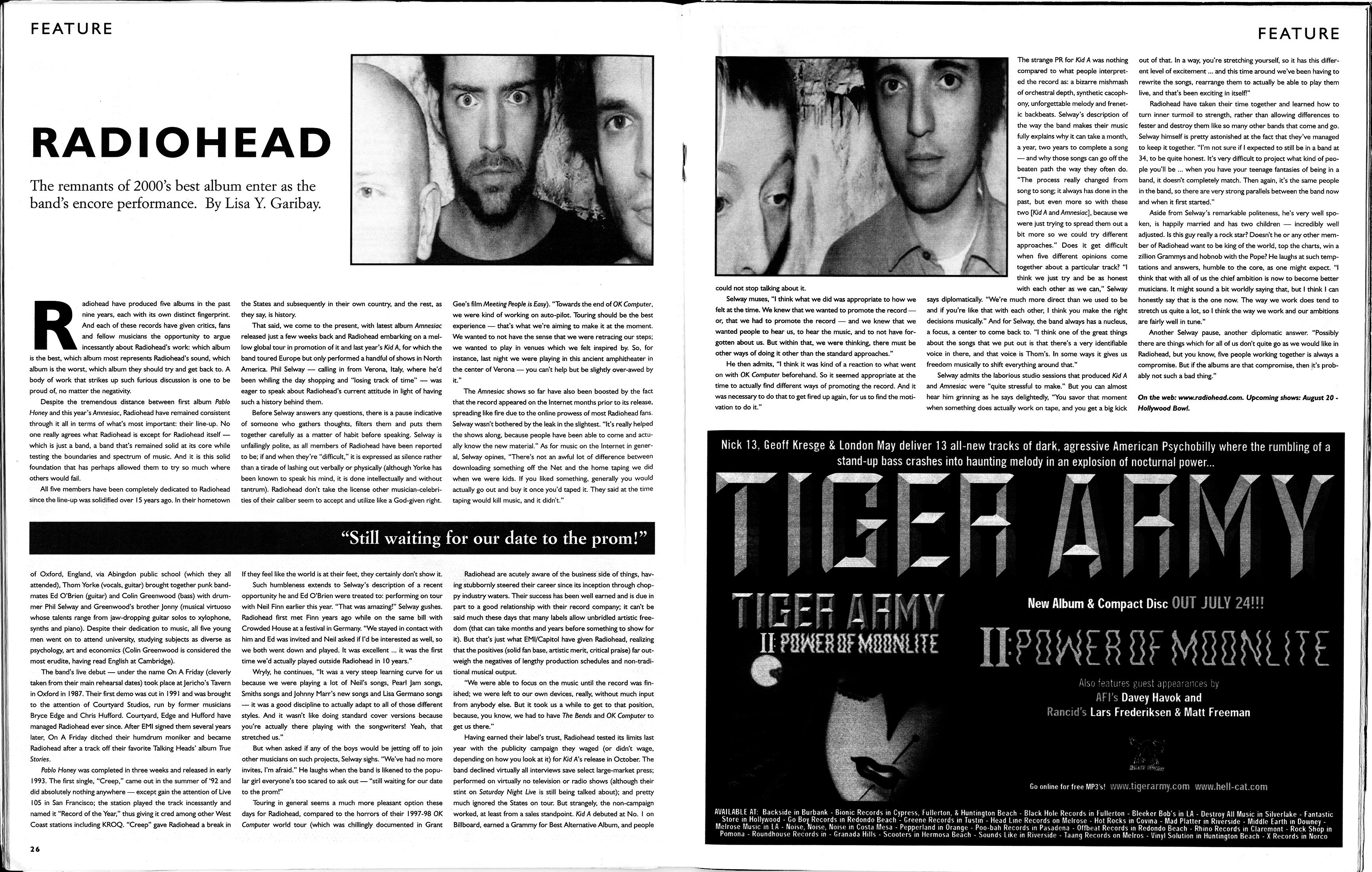
Radiohead have produced five albums in the past nine years, each with its own distinct fingerprint. And each of these records has given critics, fans and fellow musicians the opportunity to argue incessantly about Radiohead's work: which album is the best, which album most represents Radiohead's sound, which album is the worst, which album they should try and get back to. A body of work that strikes up such furious discussion is one to be proud of no matter the negativity.
Despite the tremendous distance between first album Pablo Honey and this year's Amnesiac, Radiohead have remained consistent through it all in terms of what's most important: their line-up. No one really agrees what Radiohead is except for Radiohead itself - which is just a band a band that's remained solid at its core while testing the boundaries and spectrum of music. And it is this solid foundation that has perhaps allowed them to try so much where others would fail.
All five members have been completely dedicated to Radiohead since the line-up was solidified over 15 years ago. In their hometown of Oxford, England, via Abington public school (which they all attended), Thom Yorke (vocals, guitar) brought together punk band-mates Ed O'Brien (guitar) and Colin Greenwood (bass) with drummer Phil Selway and Greenwood's brother Jonny (musical virtuoso whose talent ranges from jaw-dropping guitar solos to xylophone, synths and piano). Despite their dedication to music, all five young men went on to attend university studying subjects as diverse as psychology, art and economics (Colin Greenwood is considered the most erudite, having read English at Cambridge).
The band's live debut - under the name On A Friday (cleverly taken from their main rehearsal dates) took place at Jericho's Tavern in Oxford in 1987. Their first demo was cut in 1991 and was brought to the attention of Courtyard Studios, run by former musicians Bryce Edge and Chris Hufford. Courtyard, Edge and Hufford have managed Radiohead ever since. After EMI signed them several years later, On A Friday ditched their humdrum moniker and became Radiohead after a track off their favored Talking Heads' album True Stories.
Pablo Honey was completed in three weeks and released in early 1993. The first single 'Creep' carne out in the summer of '92 and did absolutely nothing anywhere - except gain the attention of Live 105 in San Francisco; the station played the track incessantly and named it 'Record of the Year," thus giving it cred among other West Coast stations including KROQ. 'Creep' gave Radiohead a break in the States and subsequently in their own country, and the rest, as they say, is history.
That said, we come to the present, with latest album Amnesiac released just a few weeks back and Radiohead embarking on a mellow global tour in promotion of it and last year's Kid A, for which the band toured Europe but only performed a handful of shows in North America, Phil Seaway - calling in from Verona, Italy, where he'd been whiling the day shopping and "losing track of time" - was eager to speak about Radiohead's current attitude in light of having such a history behind them. Before Selway answers any questions, there is a pause indicative of someone who gathers thoughts, filters them and puts them together carefully as a matter of habit before speaking. Selway is unfailingly polite, as all members of Radiohead have been reported to be; if and when they're ''difficult '', it is expressed as silence rather than a tirade of lashing out verbally or physically (although Yorke has been known to speak his mind, it is done intellectually and without tantrum). Radiohead don't take the license other musician-celebrities of their caliber seem to accept and utilise like a God-given right. If they feel like the world is at their feet, they certainly don't show it.
Such humbleness extends to Selway's description of a recent opportunity he and Ed O'Brien were treated to: performing on tour with Neil Finn earlier this year. ''That was amazing!" Seaway gushes.
Radiohead first met Finn years ago while on the same bill with Crowded House at a festival in Germany. ''We stayed in contact with him and Ed was invited and Neil asked if I'd be interested as well. So we both went down and played. It was excellent... it was the first time we'd actually played outside Radiohead in 10 years."
Wryly, he continues, "It was a very steep learning curve for us because we were playing a lot of Neil's songs, Pearl Jam songs, Smiths songs and Johnny Marr's new songs and Lisa Germano songs - it was a good discipline to actually adapt to all of those different styles. And it wasn't like doing standard cover versions because you're actually there playing with the songwriters! Yeah, that stretched us.''
But when asked if any of the boys would be jetting off to join other musicians on such projects, Selway sighs. "We've had no more invites. I'm afraid.'' He laughs when the band is likened to the popular girl everyone's too scared to ask out - ''still waiting for our date to the prom!'' Touring in general seems a much more pleasant option these days for Radiohead, compared to the horrors of their 1997-98 OK Computer world tour (which was chillingly documented in Grant Gee's film Meeting People Is Easy). Towards the end if OK Computer, we were kind of working on auto-pilot. Touring should be the best experience - that's what we're aiming to make it at the moment. We wanted to not have the sense that we were retracing our steps; we wanted to play in venues which we felt inspired by. So, for instance, last night we were playing in this ancient amphitheater in the center of Verona - you can't help but be slightly over-awed by it.”
The Amnesiac shows so far have also been boosted by the fact that the record appeared on the Internet months prior to its release, spreading like fire due to the online prowess of most Radiohead fans. Selway wasn't bothered by the leak in the slightest. "It's really helped the shows along, because people have been able to come and actually know the new material." As for music on the Internet in general, Selway opines, ''There's not an awful lot of difference between downloading something off the Net and the home taping we did when we were kids. If you liked something, generally you would actually go out and buy it once you'd taped it. They said at the time taping would kill music, and it didn't.''
Radiohead are acutely aware of the business side of things, having stubbornly steered their career since its inception through choppy industry waters. Their success has been well earned and is due in part to a good relationship with their record company. It can't be said much these days that many labels allow unbridled artistic freedom (that can take months and years before something to show for it). But that's just what EMI/Capitol have given Radiohead, realizing that the positives (solid fan base, artistic merit, critical praise) far out- weigh the negatives of lengthy production schedules and non-traditional musical output.
"We were able to focus on the music until the record was finished; we were left to our own devices, really, without much input from anybody else. But it took us a while to get to that position because, you know, we had to have The Bends and OK Computer to get us there."
Having earned their label's trust, Radiohead tested its limits last year with the publicity campaign they waged (or didn't wage, depending on how you look at it) for Kid A's release in October. The band declined virtually all interviews save select large-market press; performed on virtually no television or radio shows (although their stint on Saturday Night Live is still being talked about); and pretty much ignored the States on tour. But strangely, the non-campaign worked, at least from a sales standpoint. Kid A debuted at No. 1 on Billboard, earned a Grammy for Best Alternative Album, and people could not stop talking about it.
Selway muses, "I think what we did was appropriate to how we felt at the time. We know that we wanted to promote the record - or, that we had to promote the record - and we know that we wanted people to hear us, to hear the music, and to not have forgotten about us. But within that, we were thinking, there must be other ways of doing it other than the standard approaches.'' He then admits, "I think it was kind of a reaction to what went on with OK Computer beforehand. So it seemed appropriate at the time to actually find different ways of promoting the record. And it was necessary to do that to get fired up again, for us to find the motivation to do it."
The strange PR for Kid A was nothing compared to what people interpreted the record as: a bizarre mishmash of orchestral depth, synthetic cacophony, unforgivable melody and frenetic backbeats. Selway's description of the way the band makes their music fully explains why it can take a month - and why those songs can go off the beaten path the way they often do.
"The process really changed from song to song: it always has done in the past, but even more so with these two [Kid A and Amnesiac], because we were just trying to spread them out a bit more so we could try different approaches." Does it get difficult when five deferent opinions co me together about a particular track? "I think we just try and be as honest with each other as we can,'' Selway says diplomatically. “We're much more direct than we used to be and if you're like that with each other, I think you make the right decisions musically.'' And for Selway, the band always has a nucleus, a focus, a center to come back to. ''I think one of the great things about the songs that we put out is that there's a very identifiable voice in there, and that voice is Thom's. In some ways it gives us freedom musically to shift everything around that.”
Selway admits the laborious studio sessions that produced Kid A and Amnesiac were "quite stressful to make.'' But you can almost hear him grinning as he says delightedly, "You savor that moment when something does actually work on tape, and you get a big kick out of that. In a way, you're stretching yourself, so it has this different level of excitement... and this time around we've been having to rewrite the songs, rearrange them to actually be able to play them live, and that's been exciting in itself!"
Radiohead have taken their time together and learned how to turn inner turmoil to strength, rather than allowing differences to fester and destroy them like so many other bands that come and go. Selway himself is pretty astonished at the fact that they've managed to keep it together. ''I'm not sure if I expected to still be in a band at 34, to be quite honest. It's very difficult to project what kind of people you'll be... when you have your teenage fantasies of being in a band, it doesn't completely match. Then again it's the same people in the band so there are very strong parallels between the band now and when it just started.''
Aside from Selway's remarkable politeness, he's very well spoken, is happily married and has two children - incredibly well adjusted. Is this guy really a rock star? Doesn't he or any other member of Radiohead want to be king of the world, top the charts, win a zillion Grammys and hobnob with the Pope? He laughs at such temptations and answers humble to the core as one might expect. "I think that with all of us the chief ambition is now to become better musicians. It might sound a bit worldly saying that, but I think I can honestly say that is the one now. The way we work does tend to stretch us quite a lot, so I think the way we work and our ambitions are fairly well in tune."
Another Selway pause, another diplomatic answer. ''Possibly there are things which for all of us don't quite go as we would like in Radiohead. but you know, five people working together is always a compromise. But if the albums are that compromise, then it's probably not such a bad thing."
On the web: www.radiohead.com. Upcoming shows: August 20 - Hollywood Bowl.