Wired, december 18th 2007
[Interview with Thom]
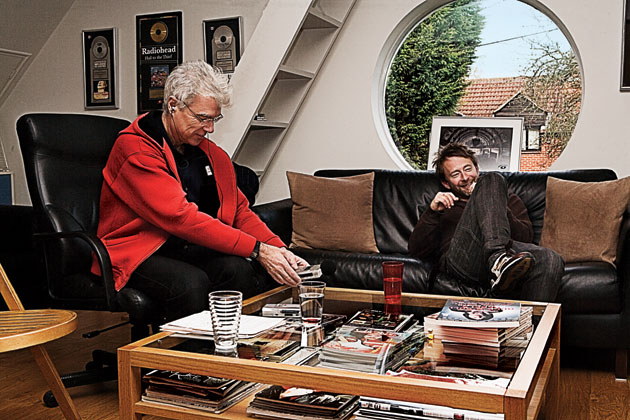
This interview took place on november 9th 2007, several hours before the thumbs_down webcast was broadcast live in the evening. Thom was interviewed by David Byrne, previously singer in the Talking Heads and one of Thom's musical heroes, for an article in the january 2008 edition of Wired. This is a transcript from mp3 files of Byrne's interview recording, which were posted on the Wired website on december 18th 2007 and accompanied the online edition of this feature. These files contain considerably more of the conversation than the article. The breaks in the text represent the track separation of the interview files, which otherwise seem to represent a continuous, unedited recording.

DB: Nice record--very nice record.
TY: Thank you!
DB: [laughs]
TY: Wicked!
DB: First off--. [Laughs.]
TY: [Laughs.]
DB: Yeah, lovely record. It’s—more-blatantly-beautiful--I think.
TY: Uh?
DB: It’s a nice--but okay, that’s--.
TY: No, that’s really because--we had a more fixed--more fixed--a more, uh, specific place we were aiming at--.
DB: Uh-huh.
TY: --than we have for--a while, which was not necessarily a fun thing. You know--if you’ve got a specific place you’re aiming at and you’re not getting there, that’s not fun--.
DB: Uh-huh.
TY: --for months on end.
DB: [Laughs.]
TY: [Laughs.]
DB: And there’s a—it’s a--I think--more of a--whatever--synthesis or balance between man and machine.
TY: Yeah, well--umm, it’s because the songs themselves were so formed, because we actually went and played them in front of people—and were almost at the point where we were bored of them…
DB: Umm.
TY: when we came to the studio, which is a real drag, but it also mean that the endless normal routes I—me, specifically, would drag things down—were restricted because--you know--well, we sort of knew how--well, we knew when, uh, something was being placed on something that just didn’t fit, or whatever--.
DB: Uh-huh.
TY: The rule about working about being in the studio is that we were working on these songs. Normally I would—umm—umm--find a blackboard or—well, it was a blackboard—and I would fill the blackboard up with--usually quite half-formed stuff.
DB: Uh-huh.
TY: Umm, which would try the patience of everybody else. But because now we got kids and stuff, you know, the idea of actually committing to be in the same room is such a big deal.
DB: Oh, that’s right.
TY: Yeah, yeah.
DB: You kind of have to make appointments.
TY: Yes. And everybody has to be--agree to the appointments. Anyway… Well, that’s a restriction, you know? Right now we really can’t--if we start going into other stuff, then you-- right now we can’t do that, you know? And I think we’re aware that we’ve been a bit lazy as well, beforehand--a bit, at times. Not lazy but sort of, uh--enjoying the process and not-- thinking about where you’re headed. Which I think is fine, you know?
DB: Yeah, yeah.
TY: Right now. At that point that’s--I think, it’s probably mostly the fact that we had to focus so much on something we had such a fixed idea of what it was. But, umm, yeah, it was less, uh--less programming and stuff like that. We tried it!
DB: Yeah?
TY: Oh yeah!
DB: [Laughs.]
TY: Oh God we tried torturously many--. I mean, I can’t think of an example. I mean “Videotape” was the absolute--uh, the last track--the last track was the absolute agony, because that went through every possible parameter. I had an absolute obsession that it should be umm--like Surgeon, which is really hard, you know, uh, post-rave trance track. [Laughs.]
DB: [Laughs.]
TY: And umm... Tried endlessly, you know? [Laughs.]
DB: [Laughs.]
TY: And to be fair to the others, they didn’t--they didn’t—as they possibly should’ve done—kick me out of the room. Uh, but--uh, you know--we tried and possibly we got something out of it but probably not. But you know, and the other thing was that-- with that track--was that Jonny was absolutely obsessed about the fact that the piano was in the wrong, you know, the piano was ahead--it’s an eighth ahead of where the one is. [Laughs.] The one is an eighth ahead. And he wanted to just stuck to the whole rhythm an eighth ahead. So you--but it didn’t. It was a constant argument about where the one was. [Laughs.]
DB: [Laughs.] Yeah, yeah!
TY: And shifting it and blah-blah. And then we ended up with something really, really bad, you know. And what happened was I left the--funny enough, I left the studio--. [Laughs.]
DB: [Laughs.]
TY: --for, like, most of the day. [Laughs.] Came back in the evening, umm, and Jonny and Nigel had stripped everything away. And what we were left with is what was on the record. So there you go
DB: Have you performed any of them live?
TY: Yeah, all of them except “Reckoner,” which was like a last minute ‘Oh, okay, then we’ll add that to the list’, ‘cause it was really good. Umm--and that was one of the few times where that was written on the spot-, on the cuff--unexpected sort of--. That was one of those occasions where you know you’ve come up--you’ve come up with something you’re really into it and you’re not--you’re not bored of it. You haven’t had time to think about it or anything. It’s just happening. And it’s happening while you’re in the studio. And you’re coming up with lots of ideas that you don’t really have time to tear apart. So it’s just happening. And then you--then you’re—and 3 days later you’re listening to it going ‘Uh--w--what? Where did that come from? You’re not sure if that’s exactly what you meant at all but it’s far too late now ‘cause everybody’s into it. [Laughs.]
DB: [Laughs.]
DB: What do you think the live audience gets out of--out of a show--maybe distinct from what they hear on a recording? I’m thinking that--audiences get all sorts of different--things. I mean, I sense--. Okay, one of it--part of it is just being together--.
TY: Yeah, I think that’s a massive thing.
DB: Being together and all of them going ‘we’re all together; we all like the same thing.
TY: Umm.
DB: ‘There’s one thing we can all agree on here.’
TY: [Laughs.]
DB: [Laughs.] And then music comes on, and uh--of course yeah with some bands it’s a fist-pumping thing and uh--but it’s--yeah…
TY: Collective will.
DB: It’s a collective thing, and I think--okay, I’m going to say it, like, with you guys it’s uh--there’s a kind of collective--I feel like it’s a collective--the audience experiences a kind of collective introspection--that kind of--. They’re all together, so they’re social, but then when the music is more--.
TY: Umm?
DB: --is kind of an interior—at least for me--…
TY: Umm hmm.
DB: Maybe I’m just talking about myself.
TY: Umm hmm, that’s probably right.
DB: Uh—which--.
TY: Yeah, I don’t--.
DB: To me, that’s really--that’s something--different.
TY: Is it?
DB: Nah! I mean, it’s not like it doesn’t exist--.
TY: No…
DB: --but--.
TY: Okay--. [Laughs.] It’s good! [Laughs.]
DB: We’re not going anywhere.
TY: [Laughs.] No, no, it is! I mean, no, because you’re original question was ‘what was--what do they get--what do people get from the live show--.
DB: Umm hmm.
TY: --uh--relative to--the record?’ Isn’t it?
DB: Mm-huh.
TY: Well, I guess there’s a collective will for it to happen. Um--and there is--well, obviously, the obvious thing is the--for the moment--umm, you know, when you’ve been uh--the thing about the record is every—every--it’s very difficult to avoid that feeling of every note is a note that is going to get scrutinized, or everything that’s happening will be re-valued or reassessed, but you don’t get that with the live thing. You’re--you get back to the original energy of--the original emotional energy—hopefully—of what you wrote. What you wrote.
DB: Umm hmm.
TY: That’s kind of clichéd, though, isn’t it?
[Long pause].
TY: Maybe it isn’t going anywhere. Maybe you’re right! [Laughs.]
DB: [Laughs.] If that’s what they’re getting—we didn’t really figure out, but--what are you but what are you guys giving?
TY: Wow. Umm--.
DB: We can skip over stuff.
TY: No! No! Uh, what? Umm--I don’t know, you--sometimes you think, ‘Well, this is--. Umm.
DB: Well, like the way you just said it, it sounds like you’re giving an--the audience gets a kind of like an emotional insight into where the songs--where the music came from in the first place.
TY: Umm?
DB: They sort of re--they’re allowed into kind of the active creation in a certain kind of way.
TY: In a way. But then--
DB: I mean--.
TY: --but there--.
DB: .--they don’t make decisions about what goes on, but--.
TY: I mean, I would assume like with all--with all the music that you love, you--it’s a videotape, isn’t it? It’s a videotape to a certain period of your life or whatever, and so you’re going through umm--. There’s that weird thing where time--there’s a weird thing with time. Uh--if music is--if live music is going well, you get lost in the time of it. Uh, and you-- you are—thinking--you’re in the present and you’re in the past and you’re in the future and you’re tarararara…sometimes--I have that. But you get all your energy and stuff from-from them.
DB: Umm.
TY: You know--I mean, you know--. I’m sure you know, when you go on stage and you get that—this--It can be one person in the audience. It can literally be one person in the audiencewho absolutely wants it to go wrong. And it will effect--.
DB: Yeah.
TY: --what happens, you know.
DB: And you have to, uh--God, okay--‘Play to he one who wants it to go right.’
TY: Yeah.
DB: ‘Find the other one--.’
TY: Escort the other one from the--. [Laughs.]
DB: [Laughs.]
TY: Alert security. [Laughs.]
DB: [Laughs.]
TY: So what you’re giving is—is—what you’re giving—you’re just giving—umm—I don’t know—it’s a show, you know—you’re doing a show—umm—but every now and again, when you’re playing—and it is every now and again—you’ll get those ‘whoosh’ things that come through--.
DB: Umm.
TY: --you know--. But that’s it! There’s never sort of—there’s nothing worse than, you know—say, going on tour and things are going really well and then people’s expectations start going up and blah-blah-blah. I mean, you start to feel that—that pressure to have the ‘whooshes’ happen, and it’s never going to happen. And then you’re stopped.
DB: And sometimes it doesn’t—it doesn’t—it only takes that--minute, or second or instant—for that to happen, to confirm that kind of ‘Yes’—that kind of transcendent whatever connection, then that can happen—now we can move on.
TY: Yeah, but you—yeah--.
DB: It’s there.
TY: The temptation is to grab of it—‘C’mon, c’mon!’
DB: Yeah, it’s coming
TY: [Laughs.] But then when you’re recording—you see, the interesting thing is those—I, really—it’s a collection of those ‘whooshes’. [Laughs.]
DB: [Laughs.]
TY: Yeah, I think that’s a massive thing.
DB: Being together and all of them going ‘we’re all together; we all like the same thing.
TY: Umm.
DB: ‘There’s one thing we can all agree on here.’
TY: [Laughs.]
DB: [Laughs.] And then music comes on, and uh--of course yeah with some bands it’s a fist-pumping thing and uh--but it’s--yeah…
TY: Collective will.
DB: It’s a collective thing, and I think--okay, I’m going to say it, like, with you guys it’s uh--there’s a kind of collective--I feel like it’s a collective--the audience experiences a kind of collective introspection--that kind of--. They’re all together, so they’re social, but then when the music is more--.
TY: Umm?
DB: --is kind of an interior—at least for me--…
TY: Umm hmm.
DB: Maybe I’m just talking about myself.
TY: Umm hmm, that’s probably right.
DB: Uh—which--.
TY: Yeah, I don’t--.
DB: To me, that’s really--that’s something--different.
TY: Is it?
DB: Nah! I mean, it’s not like it doesn’t exist--.
TY: No…
DB: --but--.
TY: Okay--. [Laughs.] It’s good! [Laughs.]
DB: We’re not going anywhere.
TY: [Laughs.] No, no, it is! I mean, no, because you’re original question was ‘what was--what do they get--what do people get from the live show--.
DB: Umm hmm.
TY: --uh--relative to--the record?’ Isn’t it?
DB: Mm-huh.
TY: Well, I guess there’s a collective will for it to happen. Um--and there is--well, obviously, the obvious thing is the--for the moment--umm, you know, when you’ve been uh--the thing about the record is every—every--it’s very difficult to avoid that feeling of every note is a note that is going to get scrutinized, or everything that’s happening will be re-valued or reassessed, but you don’t get that with the live thing. You’re--you get back to the original energy of--the original emotional energy—hopefully—of what you wrote. What you wrote.
DB: Umm hmm.
TY: That’s kind of clichéd, though, isn’t it?
[Long pause].
TY: Maybe it isn’t going anywhere. Maybe you’re right! [Laughs.]
DB: [Laughs.] If that’s what they’re getting—we didn’t really figure out, but--what are you but what are you guys giving?
TY: Wow. Umm--.
DB: We can skip over stuff.
TY: No! No! Uh, what? Umm--I don’t know, you--sometimes you think, ‘Well, this is--. Umm.
DB: Well, like the way you just said it, it sounds like you’re giving an--the audience gets a kind of like an emotional insight into where the songs--where the music came from in the first place.
TY: Umm?
DB: They sort of re--they’re allowed into kind of the active creation in a certain kind of way.
TY: In a way. But then--
DB: I mean--.
TY: --but there--.
DB: .--they don’t make decisions about what goes on, but--.
TY: I mean, I would assume like with all--with all the music that you love, you--it’s a videotape, isn’t it? It’s a videotape to a certain period of your life or whatever, and so you’re going through umm--. There’s that weird thing where time--there’s a weird thing with time. Uh--if music is--if live music is going well, you get lost in the time of it. Uh, and you-- you are—thinking--you’re in the present and you’re in the past and you’re in the future and you’re tarararara…sometimes--I have that. But you get all your energy and stuff from-from them.
DB: Umm.
TY: You know--I mean, you know--. I’m sure you know, when you go on stage and you get that—this--It can be one person in the audience. It can literally be one person in the audiencewho absolutely wants it to go wrong. And it will effect--.
DB: Yeah.
TY: --what happens, you know.
DB: And you have to, uh--God, okay--‘Play to he one who wants it to go right.’
TY: Yeah.
DB: ‘Find the other one--.’
TY: Escort the other one from the--. [Laughs.]
DB: [Laughs.]
TY: Alert security. [Laughs.]
DB: [Laughs.]
TY: So what you’re giving is—is—what you’re giving—you’re just giving—umm—I don’t know—it’s a show, you know—you’re doing a show—umm—but every now and again, when you’re playing—and it is every now and again—you’ll get those ‘whoosh’ things that come through--.
DB: Umm.
TY: --you know--. But that’s it! There’s never sort of—there’s nothing worse than, you know—say, going on tour and things are going really well and then people’s expectations start going up and blah-blah-blah. I mean, you start to feel that—that pressure to have the ‘whooshes’ happen, and it’s never going to happen. And then you’re stopped.
DB: And sometimes it doesn’t—it doesn’t—it only takes that--minute, or second or instant—for that to happen, to confirm that kind of ‘Yes’—that kind of transcendent whatever connection, then that can happen—now we can move on.
TY: Yeah, but you—yeah--.
DB: It’s there.
TY: The temptation is to grab of it—‘C’mon, c’mon!’
DB: Yeah, it’s coming
TY: [Laughs.] But then when you’re recording—you see, the interesting thing is those—I, really—it’s a collection of those ‘whooshes’. [Laughs.]
DB: [Laughs.]
DB: Because of what you did, this record didn’t—in a traditional sense—there wasn’t like advance copies going out--.
TY: No.
DB: --to the press, and—.
TY: It was the--the way—the way that we termed it was-was--it was a leak day.
DB: Umm hmm.
TY: Every record we’d done—the last—including my one—every record—for the last four records had been leaked, so the idea was like, ‘well, leak it then.
DB: Yeah. So, does that change what Steve and—those kind of people do because before they would say, ‘Oh no! There’s a’—previously there’d be a release date, and then you then you say ‘no, no, we have to put things out before that’.
TY: Yeah. And then you ring up ‘Did you like it? What do you think of it?,’ you know, and ‘nah-nah-nah’.
DB: You have to talk--.
TY: ‘And it’s three months in advance. Would you like to do some advertisements for this magazine?’
DB: [Laughs.] Yes.
TY: --and maybe this journalist has heard it’, ‘blah-blah-blah.’ And then all these silly games go and uh--.
DB: Now, is that—is that mainly about--the charts?
TY: Y—as you know, Chris and Bryce have been saying to the record companies for years before this, you know, ‘It won’t, it won’t—it’s does us no good--because we don’t cross over.’ We don’t slip off the tracks—on somebody else’ s tracks. So it’s no good to us, you know. Um but the main thing wasn’t that. The main thing was that there’s all this history. [Laughs.] There’s all this history. There’s all this bollocks, as one would call it. Um, and it was just trying to avoid all that. Avoid all this sort of stupid um—uh--. Oh, actually, yes! Well, actually, mainly—as well as the history thing—uh, whoever gets in first with their reviews--. The nature of the way it works these days is because there’s so much—there’s so much paper to fill--or, digital paper to fill--whoever writes the first few things—whoever writes the first few things, get cut and pasted. Literally. You can then read them. Not that I do but— they get cut and pasted so whoever’s opinion gets in first, has all that power, which is—especially for someone like us—for a band like us--that’s totally the luck of the draw—whether that person is into us or not. And it just seems wildly unfair--.
DB: Uh-huh.
TY: --um, for that to happen, I think. Um, there’s all that stuff, but also--.
DB: So this bypasses--.
TY: In a way, yeah, in a way. But, you know, like I said initially, it was like, we’d had enough of some—the record being leaked anyway and, you know, these things being completely out of our control, and playing the games magazines want us to--.
DB: Uh-huh.
TY: Suddenly, just-- And that thrill—sort of the old John Lennon thrill-- of sort of literally we mastered it. We took a while to figure out—to finish the mastering and stuff. And we mastered it and two days after we mastered it, it was on the site being down—you know, pre-ordered. No, it was being pre-ordered and we were still frantically mastering it! [Laughs.]
DB: [Laughs.]
TY: So, you know, it was that—that was just a—it was a really exciting few weeks to sort of have that direct connection—you know. We didn’t really think much beyond that, really.
DB: That works for you guys. I mean--.
TY: Yeah.
DB: --I mean, like me, I uh—I hear there’s something new out there, I’ll just go and buy it, without—
TY: Umm.
DB: --without, like, poking around going ‘well, what do the reviews say?’
TY: No. Absolutely. Yeah.
DB: With pop--with a lot of pop artists, it’s uh--people want to wait and hear the single and all that sort of thing. It’s a different sort of thing. I try and talk to people in vastly different situations.
TY: Yeah, because the only reason that we could even get away with this—the only reason anyone would give a shit, is the fact that we’d actually gone through the whole mill of the business in the first place, to have--have enough people interested to be able to say that instead, in the first place. And people think ‘Oh, that’s interesting. What’s that about?’ And it’s not--it’s not supposed to be a model or anything else. It was simply the response to a situation. We’re out of contract. We’ve spent a huge amount of money on this server, uh--. [Laughs.] We have our own studio. What the Hell else would we be doing, you know? This is the obvious thing to do.
DB: Are servers really expensive?
TY: Pfft.
DB: I just have a small one in my office.
TY: I don’t know, apparently, yeah. I mean, it depends wh--.
DB: In order to handle that kind of load?
TY: Yeah. When you’re doing the down--we actually had to parcel that out in the end.
DB: Uh-huh.
TY: Um--the actual physical downloading stuff. And even—even—even with the server we still went down um—on the first day, and then a few days after it as well. Just because of the level of traffic going through and stuff. So—it’s a bit an on-going thing, you know. Now we’re trying to do our own -–the idea is to have our own TV channel, essentially off--.
DB: Yeah.
TY: --off our website, which most of the time is just an annoying test card which will probably come up and change every now and again. [Laughs.]
DB: [Laughs.]
TY: But every time, you know--but we only--.
DB: Yeah, but when and if there is things, then--.
TY: Two and a half hours beforehand, or half an hour or whatever. ‘Oh, we’re going to go on and play this song we’ve written’ or whatever. Oh, great idea.
DB: Yeah, that’s great.
TY: But it only works for us because of where we are.
DB: Uh-huh. A few bands I know that are now just getting started and trying to figure out: ‘What do we do?’
TY: Exactly. Well you don’t sign a huge record contract--.
DB: Yeah.
TY: --which first and foremost strips you of all your digital rights--. [Laughs.]
DB: [Laughs.]
TY: --so that when you do sell something on iTunes you get absolutely zero. That would be the first priority. Second would be, I—pfft--I don’t—I don’t know, but I certainly what—what the—the status quo--or however one would call it—seems to be um—uh--going down—in all respects.
DB: It is true, there’s a band or a musician, somebody who is coming out with something new, it spreads so quickly now.
TY: Yeah.
DB: And I don’t even know how it happens. I read, leaf through magazines and newspapers for something interesting. I’ll rip the page out or write it down and then I’ll go online and order it, or I’ll--or whatever. It’s amazing how uh--a lot of that, I think, for emerging bands—to some extent, the audience starts to find--.
TY: Yeah--.
DB: --to find the band, or find the artist that they like, and then--.
TY: There’s obviously the problem with saturation, isn’t there?
DB: Uh-huh.
TY: But then—but then, that to me—that’s where--radio always is supposed to come in. Isn’t it? Because--.
DB: To act as a filter or--.
TY: Well--.
DB: --or let you hear?
TY: To let you hear things in their entirety, to begin with--.
DB: Yeah.
TY: Because, you know, when you’re like uh—when you’ve got your 30-second preview—it’s fairly useless
DB: Yeah.
TY: Um--but also someone who might have, like, the same ideas as you, you know. Like going into the record shop and asking for this record, and the guy then shows a whole other list, that sort of thing. I mean, and they do that a bit, don’t they? I mean, it’s--. There’s a couple of shops I use, you know, net shops, to download stuff. And there is a--it is quite handy when they, you know--that silly thing when they say: ‘other people who have bought this, have bought this and this and this.’
DB: Yeah.
TY: That’s quite good too, yeah. I don’t see the downside at all to big record companies, um, not having access to new artists, because they’ve no idea what to do with them now, anyway.
DB: Yeah. It should be a load off their minds. [Laughs.]
TY: Well, yeah. Exactly. But it’s a shame that, as you say, I don’t know how--if you are an emerging artist, um—it must be quite frightening at the moment, I guess--maybe not.
DB: Well, I get out fairly regularly--.
TY: I don’t.[Laughs.]
DB: --and occasionally I’ll go to see some new--performer, singer, whatever that I’ve heard about, that I think—well, maybe it’s my age—but I think ‘nobody’s heard of this person’ and I’ll walk in and the room is full.
TY: Mm. Alright!
DB: And I go: ‘How did all these people hear about this?’ This person’s not on the radio; isn’t making TV appearances, or conventional press or whatever. How does it start? So it must be all online kind of things. But there’s the performance thing too that I think people like bringing the community together--.
TY: Yeah.
DB: --bring people with similar interests together, and a chance—an opportunity to do that is something not to be missed.
TY: I think that electronica really suffered from that. When it was uh—when it had its real, sort of, strength—well, I mean, I guess in a way it does but it’s sort of moved into different areas now. But that was—the fact that there wasn’t, really, the performance thing, was a shame, really, because um—in terms of sort of purely, on a sort of maybe technical or aesthetical--aesthetic point of view. Aesthetical? Um, you know, what a lot of people like Autechre are doing, is just completely out there their philosophy on music and stuff, and is to be massively admired for that, you know, it’s bravery. But—but the—there’s not the—there’s this whole sort of thing with the electronica thing of pulling back whenever um—uh—the connection with the audience is a really odd one in this sort of--.
DB: Uh-huh, uh-huh.
TY: And I think that’s as much to do with the fact that there’s not the—the ‘standing in a room, sharing that music in the same way as you do when you’re physically having to play it, you know? Not that I’m saying one is more noble.
TY: No.
DB: --to the press, and—.
TY: It was the--the way—the way that we termed it was-was--it was a leak day.
DB: Umm hmm.
TY: Every record we’d done—the last—including my one—every record—for the last four records had been leaked, so the idea was like, ‘well, leak it then.
DB: Yeah. So, does that change what Steve and—those kind of people do because before they would say, ‘Oh no! There’s a’—previously there’d be a release date, and then you then you say ‘no, no, we have to put things out before that’.
TY: Yeah. And then you ring up ‘Did you like it? What do you think of it?,’ you know, and ‘nah-nah-nah’.
DB: You have to talk--.
TY: ‘And it’s three months in advance. Would you like to do some advertisements for this magazine?’
DB: [Laughs.] Yes.
TY: --and maybe this journalist has heard it’, ‘blah-blah-blah.’ And then all these silly games go and uh--.
DB: Now, is that—is that mainly about--the charts?
TY: Y—as you know, Chris and Bryce have been saying to the record companies for years before this, you know, ‘It won’t, it won’t—it’s does us no good--because we don’t cross over.’ We don’t slip off the tracks—on somebody else’ s tracks. So it’s no good to us, you know. Um but the main thing wasn’t that. The main thing was that there’s all this history. [Laughs.] There’s all this history. There’s all this bollocks, as one would call it. Um, and it was just trying to avoid all that. Avoid all this sort of stupid um—uh--. Oh, actually, yes! Well, actually, mainly—as well as the history thing—uh, whoever gets in first with their reviews--. The nature of the way it works these days is because there’s so much—there’s so much paper to fill--or, digital paper to fill--whoever writes the first few things—whoever writes the first few things, get cut and pasted. Literally. You can then read them. Not that I do but— they get cut and pasted so whoever’s opinion gets in first, has all that power, which is—especially for someone like us—for a band like us--that’s totally the luck of the draw—whether that person is into us or not. And it just seems wildly unfair--.
DB: Uh-huh.
TY: --um, for that to happen, I think. Um, there’s all that stuff, but also--.
DB: So this bypasses--.
TY: In a way, yeah, in a way. But, you know, like I said initially, it was like, we’d had enough of some—the record being leaked anyway and, you know, these things being completely out of our control, and playing the games magazines want us to--.
DB: Uh-huh.
TY: Suddenly, just-- And that thrill—sort of the old John Lennon thrill-- of sort of literally we mastered it. We took a while to figure out—to finish the mastering and stuff. And we mastered it and two days after we mastered it, it was on the site being down—you know, pre-ordered. No, it was being pre-ordered and we were still frantically mastering it! [Laughs.]
DB: [Laughs.]
TY: So, you know, it was that—that was just a—it was a really exciting few weeks to sort of have that direct connection—you know. We didn’t really think much beyond that, really.
DB: That works for you guys. I mean--.
TY: Yeah.
DB: --I mean, like me, I uh—I hear there’s something new out there, I’ll just go and buy it, without—
TY: Umm.
DB: --without, like, poking around going ‘well, what do the reviews say?’
TY: No. Absolutely. Yeah.
DB: With pop--with a lot of pop artists, it’s uh--people want to wait and hear the single and all that sort of thing. It’s a different sort of thing. I try and talk to people in vastly different situations.
TY: Yeah, because the only reason that we could even get away with this—the only reason anyone would give a shit, is the fact that we’d actually gone through the whole mill of the business in the first place, to have--have enough people interested to be able to say that instead, in the first place. And people think ‘Oh, that’s interesting. What’s that about?’ And it’s not--it’s not supposed to be a model or anything else. It was simply the response to a situation. We’re out of contract. We’ve spent a huge amount of money on this server, uh--. [Laughs.] We have our own studio. What the Hell else would we be doing, you know? This is the obvious thing to do.
DB: Are servers really expensive?
TY: Pfft.
DB: I just have a small one in my office.
TY: I don’t know, apparently, yeah. I mean, it depends wh--.
DB: In order to handle that kind of load?
TY: Yeah. When you’re doing the down--we actually had to parcel that out in the end.
DB: Uh-huh.
TY: Um--the actual physical downloading stuff. And even—even—even with the server we still went down um—on the first day, and then a few days after it as well. Just because of the level of traffic going through and stuff. So—it’s a bit an on-going thing, you know. Now we’re trying to do our own -–the idea is to have our own TV channel, essentially off--.
DB: Yeah.
TY: --off our website, which most of the time is just an annoying test card which will probably come up and change every now and again. [Laughs.]
DB: [Laughs.]
TY: But every time, you know--but we only--.
DB: Yeah, but when and if there is things, then--.
TY: Two and a half hours beforehand, or half an hour or whatever. ‘Oh, we’re going to go on and play this song we’ve written’ or whatever. Oh, great idea.
DB: Yeah, that’s great.
TY: But it only works for us because of where we are.
DB: Uh-huh. A few bands I know that are now just getting started and trying to figure out: ‘What do we do?’
TY: Exactly. Well you don’t sign a huge record contract--.
DB: Yeah.
TY: --which first and foremost strips you of all your digital rights--. [Laughs.]
DB: [Laughs.]
TY: --so that when you do sell something on iTunes you get absolutely zero. That would be the first priority. Second would be, I—pfft--I don’t—I don’t know, but I certainly what—what the—the status quo--or however one would call it—seems to be um—uh--going down—in all respects.
DB: It is true, there’s a band or a musician, somebody who is coming out with something new, it spreads so quickly now.
TY: Yeah.
DB: And I don’t even know how it happens. I read, leaf through magazines and newspapers for something interesting. I’ll rip the page out or write it down and then I’ll go online and order it, or I’ll--or whatever. It’s amazing how uh--a lot of that, I think, for emerging bands—to some extent, the audience starts to find--.
TY: Yeah--.
DB: --to find the band, or find the artist that they like, and then--.
TY: There’s obviously the problem with saturation, isn’t there?
DB: Uh-huh.
TY: But then—but then, that to me—that’s where--radio always is supposed to come in. Isn’t it? Because--.
DB: To act as a filter or--.
TY: Well--.
DB: --or let you hear?
TY: To let you hear things in their entirety, to begin with--.
DB: Yeah.
TY: Because, you know, when you’re like uh—when you’ve got your 30-second preview—it’s fairly useless
DB: Yeah.
TY: Um--but also someone who might have, like, the same ideas as you, you know. Like going into the record shop and asking for this record, and the guy then shows a whole other list, that sort of thing. I mean, and they do that a bit, don’t they? I mean, it’s--. There’s a couple of shops I use, you know, net shops, to download stuff. And there is a--it is quite handy when they, you know--that silly thing when they say: ‘other people who have bought this, have bought this and this and this.’
DB: Yeah.
TY: That’s quite good too, yeah. I don’t see the downside at all to big record companies, um, not having access to new artists, because they’ve no idea what to do with them now, anyway.
DB: Yeah. It should be a load off their minds. [Laughs.]
TY: Well, yeah. Exactly. But it’s a shame that, as you say, I don’t know how--if you are an emerging artist, um—it must be quite frightening at the moment, I guess--maybe not.
DB: Well, I get out fairly regularly--.
TY: I don’t.[Laughs.]
DB: --and occasionally I’ll go to see some new--performer, singer, whatever that I’ve heard about, that I think—well, maybe it’s my age—but I think ‘nobody’s heard of this person’ and I’ll walk in and the room is full.
TY: Mm. Alright!
DB: And I go: ‘How did all these people hear about this?’ This person’s not on the radio; isn’t making TV appearances, or conventional press or whatever. How does it start? So it must be all online kind of things. But there’s the performance thing too that I think people like bringing the community together--.
TY: Yeah.
DB: --bring people with similar interests together, and a chance—an opportunity to do that is something not to be missed.
TY: I think that electronica really suffered from that. When it was uh—when it had its real, sort of, strength—well, I mean, I guess in a way it does but it’s sort of moved into different areas now. But that was—the fact that there wasn’t, really, the performance thing, was a shame, really, because um—in terms of sort of purely, on a sort of maybe technical or aesthetical--aesthetic point of view. Aesthetical? Um, you know, what a lot of people like Autechre are doing, is just completely out there their philosophy on music and stuff, and is to be massively admired for that, you know, it’s bravery. But—but the—there’s not the—there’s this whole sort of thing with the electronica thing of pulling back whenever um—uh—the connection with the audience is a really odd one in this sort of--.
DB: Uh-huh, uh-huh.
TY: And I think that’s as much to do with the fact that there’s not the—the ‘standing in a room, sharing that music in the same way as you do when you’re physically having to play it, you know? Not that I’m saying one is more noble.
DB: Months to come, so will you have your own marketing company?
TY: Uh—umm, no because it starts to get a little more traditional, really, and you know, you--. When we first came up with the idea, we weren’t going to do a normal—a normal physical version of CD at all, and after a while it was like ‘well, that’s just snobbery,’ you know. [Laughs.]
DB: [Laughs.]
TY: a) I think that’s asking for trouble, and cool.gif it’s snobbery.
DB: So vinyl only?
TY: Well, yeah. And so—so yeah, you kind of have to go that route, really, so that’s like putting it on the radio and that sort of thing. I don’t know, I guess that’s normal. Is that one stopping?
DB: No, it’s still going round.
TY: Is it? Only when you picked it up--.
DB: Here’s the one I use for writing.
TY: No! On a Dictaphone?
DB: Yeah, cause I’ll improvise or come up with a melody or something and sing it into this.
TY: You don’t use that one? But then you can sample it. [Laughs.]
DB: Umm, I think I like the fact that it’s so bad--.
TY: Yeah. You can’t use it. [Laughs.]
DB: I can’t use it so I have to kind of--.
TY: Yeah. Yeah.
DB: --I have to either learn it and make it—and see if it’s worth--.
TY: Uh—umm, no because it starts to get a little more traditional, really, and you know, you--. When we first came up with the idea, we weren’t going to do a normal—a normal physical version of CD at all, and after a while it was like ‘well, that’s just snobbery,’ you know. [Laughs.]
DB: [Laughs.]
TY: a) I think that’s asking for trouble, and cool.gif it’s snobbery.
DB: So vinyl only?
TY: Well, yeah. And so—so yeah, you kind of have to go that route, really, so that’s like putting it on the radio and that sort of thing. I don’t know, I guess that’s normal. Is that one stopping?
DB: No, it’s still going round.
TY: Is it? Only when you picked it up--.
DB: Here’s the one I use for writing.
TY: No! On a Dictaphone?
DB: Yeah, cause I’ll improvise or come up with a melody or something and sing it into this.
TY: You don’t use that one? But then you can sample it. [Laughs.]
DB: Umm, I think I like the fact that it’s so bad--.
TY: Yeah. You can’t use it. [Laughs.]
DB: I can’t use it so I have to kind of--.
TY: Yeah. Yeah.
DB: --I have to either learn it and make it—and see if it’s worth--.
DB: The thing I read on—was that in The Guardian or something?
TY: [Whispers.] Oh, you don’t want to read that.
DB: Yeah, okay. It was in-- [laughs.] said the average--.
TY: They’re making it up.
DB: They’re making it--.
TY: [Laughs.] I mean, whatever they get--we’ve not released any figures on any of this so--.
DB: They’re making it up.
TY: So they’re making it up.
DB: They’re totally making it up.
TY: I’m not sure what I’m supposed to say.
DB: No-no-no. I--.
TY: I’m supposed to check it out with the authorities. [Laughs.]
DB: From what I’ve read, it seems that the audience—your audience, of course—is-- not only do they trust that it’s gonna be—they’re gonna get something for their money that they like--.
TY: [Laughs.] I think that’s pretty obvious, yes.
DB: Yes. [Laughs].] But they do, uh—but they feel that—some of them, anyway—feel that if they pay something, it’s kind of a show of faith in--.
TY: Umm.
DB: --like uh--and trust, uh. And it’s kind of—it is kind of a human thing like, ‘if I trust you not to hit me, will you hit me?
TY: [Laughs.] If I ask you nicely…
DB: It was ‘don’t hit me’.
TY: [Laughs.]
DB: ‘Will you not hit me, even though you can?’ [Laughs.]
TY: Yeah. Yep.
DB: --and a lot of people won’t hit.
TY: No.
DB: They won’t steal from your hit [undecipherable]. Actually…
TY: That was Chris’s idea, and uh--.
DB: Mm hum.
TY: --and we all thought it was balmy.
DB: [Laughs.]
TY: Basically. And literally—as we were writing—you know--as we were putting up the site and stuff—we were still saying, ‘Are you sure about this?’ Um—but it was really good because uh—it sort of uh—released us from something--I don’t know exactly, you know—released us from the pressure of thinking about it in a certain way. And people took it as what it was meant, you know. It wasn’t sort of, like--it wasn’t sort of nihilistic and ‘music’s not worth anything’ thing at all.
DB: Yeah-yeah.
TY: It was the total opposite. But maybe that’s just the nature of—as you’re saying--people having a little faith in what we we’re doing, which in itself was an extremely nice little ego boost, which--
DB: Yeah.
TY: --after being in the studio, you know, a very long a long time--.
DB: [Laughs.]
TY: --it’s always nice.
DB: Yeah.
TY: You’re actually—you hate everything you’re doing. Well, we don’t. By the end of it you’re alright, but you know--.
DB: [Laughs.]
TY: --there is that process.
DB: Uh-huh. ‘Hate it one day and love it the next’.
TY: Yeah.
DB: Cliff Richards--.
TY: [Laughs.] [Clears his throat.]
DB: Yeah.
TY: No, Cliff Richards—no, he’s doing it, but um--.
DB: I guess the price will go down based on pre-orders.
TY: He’s doing----this is through EMI. Please note.
DB: [Laughs.]
TY: Anyway—he’s uh—he is doing it but they take like an average uh--price once people have bought in their thing, and that’s then what people are going to pay--which is a little bit like--well, I’d like to be the person doing the average, you know, because there’s a lot of ways you can do averages and it’s kind of open to abuse—somewhat. It’s uh—I don’t get it… at all.
TY: [Whispers.] Oh, you don’t want to read that.
DB: Yeah, okay. It was in-- [laughs.] said the average--.
TY: They’re making it up.
DB: They’re making it--.
TY: [Laughs.] I mean, whatever they get--we’ve not released any figures on any of this so--.
DB: They’re making it up.
TY: So they’re making it up.
DB: They’re totally making it up.
TY: I’m not sure what I’m supposed to say.
DB: No-no-no. I--.
TY: I’m supposed to check it out with the authorities. [Laughs.]
DB: From what I’ve read, it seems that the audience—your audience, of course—is-- not only do they trust that it’s gonna be—they’re gonna get something for their money that they like--.
TY: [Laughs.] I think that’s pretty obvious, yes.
DB: Yes. [Laughs].] But they do, uh—but they feel that—some of them, anyway—feel that if they pay something, it’s kind of a show of faith in--.
TY: Umm.
DB: --like uh--and trust, uh. And it’s kind of—it is kind of a human thing like, ‘if I trust you not to hit me, will you hit me?
TY: [Laughs.] If I ask you nicely…
DB: It was ‘don’t hit me’.
TY: [Laughs.]
DB: ‘Will you not hit me, even though you can?’ [Laughs.]
TY: Yeah. Yep.
DB: --and a lot of people won’t hit.
TY: No.
DB: They won’t steal from your hit [undecipherable]. Actually…
TY: That was Chris’s idea, and uh--.
DB: Mm hum.
TY: --and we all thought it was balmy.
DB: [Laughs.]
TY: Basically. And literally—as we were writing—you know--as we were putting up the site and stuff—we were still saying, ‘Are you sure about this?’ Um—but it was really good because uh—it sort of uh—released us from something--I don’t know exactly, you know—released us from the pressure of thinking about it in a certain way. And people took it as what it was meant, you know. It wasn’t sort of, like--it wasn’t sort of nihilistic and ‘music’s not worth anything’ thing at all.
DB: Yeah-yeah.
TY: It was the total opposite. But maybe that’s just the nature of—as you’re saying--people having a little faith in what we we’re doing, which in itself was an extremely nice little ego boost, which--
DB: Yeah.
TY: --after being in the studio, you know, a very long a long time--.
DB: [Laughs.]
TY: --it’s always nice.
DB: Yeah.
TY: You’re actually—you hate everything you’re doing. Well, we don’t. By the end of it you’re alright, but you know--.
DB: [Laughs.]
TY: --there is that process.
DB: Uh-huh. ‘Hate it one day and love it the next’.
TY: Yeah.
DB: Cliff Richards--.
TY: [Laughs.] [Clears his throat.]
DB: Yeah.
TY: No, Cliff Richards—no, he’s doing it, but um--.
DB: I guess the price will go down based on pre-orders.
TY: He’s doing----this is through EMI. Please note.
DB: [Laughs.]
TY: Anyway—he’s uh—he is doing it but they take like an average uh--price once people have bought in their thing, and that’s then what people are going to pay--which is a little bit like--well, I’d like to be the person doing the average, you know, because there’s a lot of ways you can do averages and it’s kind of open to abuse—somewhat. It’s uh—I don’t get it… at all.
DB: I started asking myself—well, I still ask myself all the time—‘why, why do these things hold out?’
TY: …
DB: Why? Yeah. My—the answer I came up with was—well, sometimes it’s artistically viable; it’s not just a random collection of songs. Sometimes, kind of unconsciously or intuitively they have a common--
TY: Mm-hum.
DB: --thread together, even if it’s not obvious. Maybe it’s just because everybody’s thinking musically in the same way for those couple of months.
TY: Mm.
DB: And then, uh—
TY: --or years.
DB: Yeah, or years—however long it takes.
TY: [Laughs.]
DB: And, other times it’s um—otherwise sometimes there’s an obvious um—you go to records with story threads or--.
TY: It might end up being my template for that—yeah.
DB: Probably the reason it’s a little hard to break away from that completely—is that it’s just--it makes just obvious financial sense to--if you’re making—if you’re getting a the band together into the studio, it makes more sense to do more than one song.
TY: Mm.
DB: [Laughs.] Once you’ve got everybody there. And it makes more sense—if you’re going to all the effort of performing—
TY: Mm.
DB: --doing whatever else—whatever else is going on, if there’s more than—if there’s a kind of bundle.
TY: Yeah, but the other thing is that that bundle can make—the songs themselves can, can uh—what’s the word? Not ‘exemplify’—the songs themselves can, uh, amplify each other—
DB: Yes.
TY: --if you put them in the right way.
DB: Mm-hum.
TY: I mean, this—I mean, I don’t know about you but with us lot, it’s always been the case where it’s very difficult making the record. It’s extremely difficult mixing it. And then it’s ‘knives out’, ‘weapons out’—
DB: [Laughs.]
TY: --‘kill to the death’, every trick you could possibly know in the book, every—emotional blackmail, everything, tararara--that you could possibly do to get your way in the playlist at the end of it, um, because that’s when things get really fraught, you know.
DB: Mm-hum.
TY: Because people have real emotional attachments to things, and blah-blah, and you discover what-it-is-you’ve-done, as well.
DB: One thing kind of tells you about the next one or so--
TY: Yeah!
DB: --or sets up, or destroys the one--.
TY: Yeah, but if you—if you can get through that, and this time was bloody awful --you do end up with this—‘cause if you get it wrong—one thing in the middle will not get you all this work, you know. Well, that’s a bit extreme--.
DB: [Laughs.]
TY: But it can do—it can—it can just ruin the flow of where you’re, um—where you’ve been headed.
DB: Um-huh.
TY: But the point is, you’ve got to be able to sit back just enough to tolerate the concept that possibly someone else might possibly know something about it you don’t. [Laughs.]
DB: [Laughs.]
TY: Um—and uh—so that’s--that’s the other reason for albums.
DB: Um-hum.
TY: That was, uh—maybe it’s the sonata form of our time.
DB: Yeah.
TY: We just have to accept the fact that that’s just the way it is, … , you know. But we did toy with it—I mean, I’ve always toyed with the idea of, you know, if it’s a CD--it’s seventy-blah-blah-minutes, or whatever it is—you should do what some of the electronica guys are doing and absolutely fill it up.
DB: Oh, every possible second that you can.
TY: Yeah, sort of that, but it’s too long.
DB: It is. It is too long.
TY: And anyway, what idiot thought of seventy minutes being a good time to--? That’s too long, really! You certainly can’t sit in a maths lesson seventy minutes… I mean, straight, anyway.
DB: Now, you’ve gone back to a manageable—
TY: Yeah.
DB: --a more manageable level.
TY: Yes, that was a very conscious decision.
DB: Yeah. That someone can actually sit and listen to—.
TY: It works.
DB: Yes, it’s true. I agree with that. But once you’re past a certain mark, it’s kind of like, ‘oh’,
TY: Yeah.
DB: Now this is really taking up too much of my day.
TY: Someone’s knee’s twitching while listening to this.
DB: [laughs.]
TY: …
DB: Why? Yeah. My—the answer I came up with was—well, sometimes it’s artistically viable; it’s not just a random collection of songs. Sometimes, kind of unconsciously or intuitively they have a common--
TY: Mm-hum.
DB: --thread together, even if it’s not obvious. Maybe it’s just because everybody’s thinking musically in the same way for those couple of months.
TY: Mm.
DB: And then, uh—
TY: --or years.
DB: Yeah, or years—however long it takes.
TY: [Laughs.]
DB: And, other times it’s um—otherwise sometimes there’s an obvious um—you go to records with story threads or--.
TY: It might end up being my template for that—yeah.
DB: Probably the reason it’s a little hard to break away from that completely—is that it’s just--it makes just obvious financial sense to--if you’re making—if you’re getting a the band together into the studio, it makes more sense to do more than one song.
TY: Mm.
DB: [Laughs.] Once you’ve got everybody there. And it makes more sense—if you’re going to all the effort of performing—
TY: Mm.
DB: --doing whatever else—whatever else is going on, if there’s more than—if there’s a kind of bundle.
TY: Yeah, but the other thing is that that bundle can make—the songs themselves can, can uh—what’s the word? Not ‘exemplify’—the songs themselves can, uh, amplify each other—
DB: Yes.
TY: --if you put them in the right way.
DB: Mm-hum.
TY: I mean, this—I mean, I don’t know about you but with us lot, it’s always been the case where it’s very difficult making the record. It’s extremely difficult mixing it. And then it’s ‘knives out’, ‘weapons out’—
DB: [Laughs.]
TY: --‘kill to the death’, every trick you could possibly know in the book, every—emotional blackmail, everything, tararara--that you could possibly do to get your way in the playlist at the end of it, um, because that’s when things get really fraught, you know.
DB: Mm-hum.
TY: Because people have real emotional attachments to things, and blah-blah, and you discover what-it-is-you’ve-done, as well.
DB: One thing kind of tells you about the next one or so--
TY: Yeah!
DB: --or sets up, or destroys the one--.
TY: Yeah, but if you—if you can get through that, and this time was bloody awful --you do end up with this—‘cause if you get it wrong—one thing in the middle will not get you all this work, you know. Well, that’s a bit extreme--.
DB: [Laughs.]
TY: But it can do—it can—it can just ruin the flow of where you’re, um—where you’ve been headed.
DB: Um-huh.
TY: But the point is, you’ve got to be able to sit back just enough to tolerate the concept that possibly someone else might possibly know something about it you don’t. [Laughs.]
DB: [Laughs.]
TY: Um—and uh—so that’s--that’s the other reason for albums.
DB: Um-hum.
TY: That was, uh—maybe it’s the sonata form of our time.
DB: Yeah.
TY: We just have to accept the fact that that’s just the way it is, … , you know. But we did toy with it—I mean, I’ve always toyed with the idea of, you know, if it’s a CD--it’s seventy-blah-blah-minutes, or whatever it is—you should do what some of the electronica guys are doing and absolutely fill it up.
DB: Oh, every possible second that you can.
TY: Yeah, sort of that, but it’s too long.
DB: It is. It is too long.
TY: And anyway, what idiot thought of seventy minutes being a good time to--? That’s too long, really! You certainly can’t sit in a maths lesson seventy minutes… I mean, straight, anyway.
DB: Now, you’ve gone back to a manageable—
TY: Yeah.
DB: --a more manageable level.
TY: Yes, that was a very conscious decision.
DB: Yeah. That someone can actually sit and listen to—.
TY: It works.
DB: Yes, it’s true. I agree with that. But once you’re past a certain mark, it’s kind of like, ‘oh’,
TY: Yeah.
DB: Now this is really taking up too much of my day.
TY: Someone’s knee’s twitching while listening to this.
DB: [laughs.]
DB: Do you know, more or less, where, uh—where your income—
TY: [Laughs.]
DB: --came from? [Laughs.] No, I’ll be more clear.
TY: No, do you mind--?
DB: --no, I’ll be more clear. Like, from uh—like, for me, it’s probably very little from actual music or record sales. I make a little bit on touring. And I make probably most from licensing stuff—
TY: Oh, really?
DB: --not to commercials—I license to--
TY: Yeah.
TY: --films and television shows and--
TY: Alright!
DB: --that sort of thing.
TY: That's it--we make some doing that. I don’t know how really interested--. Someti--we go through phases but sometimes probably we do--.
DB: Sometimes …
TY: Yeah. Um, and--.
DB: And I know it changes for different people. Some people make—their whatever—their overhead for their live performances is really low and so they make a lot on that—
TY: Yeah.
DB: --and they don’t—and they don’t worry—
TY: We always—
DB: --about anything else.
TY: We always go into touring saying: ‘This time, we’re not going to spend the money! This time we’re going to do it stripped down!’ And then--[Laughs.]
DB: [Laughs.]
TY: --and then uh—‘Oh, but we do need this keyboard; and really, these lights particularly, blah-blah-blah’.
DB: Uh-huh.
TY: But we are into--. Anyway, but at the moment, the way it goes is that we make money principally from touring—that’s how we earn money--which is a hard one for me to reconcile because I don’t like all the energy consumption, the travel, all the--. It’s an ecological disaster--
DB: Um-hum.
TY: --traveling—uh, touring. So um--.
DB: Well, there are the, you know, the biodiesel buses and all that.
TY: Yeah, it depends where you get the bio-diesel from.
DB: Yeah.
TY: But um--uh, yeah, there’s ways to, you know, minimize it, but we did this—we did this um—thing recently, um—one of those carbon, ah—footprint things, where they assessed the last period of touring we did and tried to work out where the biggest problems were. And the biggest problem, obviously, was the traveling to the shows—everybody traveling to the shows, including us, obviously.
DB: Oh, you mean the aud--
TY: Yeah!
DB: --the audience?
TY: Yeah! Which is like--
DB: Not you, not you guys, but--?
TY: Obviously us, but—but it goes like that, you know: the lighting, ta-ra-ra-ra, ta-ra-ra-ra, all the others.
DB: Wow!
TY: Just simply because of that’s how—especially in the U.S.—but also--
DB: They all drive.
TY: Everybody drives!
DB: Yeah, yeah.
TY: So, everybody’s driving, um—not necessarily sharing a car, so it’s like ‘How the Hell are we going to address that?’
DB: Yeah-yeah.
TY: So the idea is that, you know, we play in municipal places with some form of transport system—
DB: Um-hum.
TY: --alternative to cars, which is there if you can persuade people to use it, blah-blah-blah, um, and—minimize—no flying equipment, uh—shipping everything. We can’t be shipped, though, um. But the most ecological way of doing it, um, is to um, live in one of the crates going over.
DB: [Laughs.]
TY: It is, honestly. That’s—because if you go in the Queen Mary or something, that’s worse than flying.
DB: Wow!
TY: Yeah. Because they go so fast and they’re so huge.
DB: Uh-huh.
TY: Am I getting off the point a bit here?
DB: No, no, no, it’s fine.
TY: Um, so-so—flying is kind of your only option, unless you are prepared to spend two weeks—is it? I think—on uh--on one of those freight—. [Laughs.] Which is basically--.
DB: Yeah-yeah.
TY: Either that or you hire one of those... gin palaces, as they call them--you know, the glamorous yachts—
DB: Uh-huh.
TY: --which go considerably slower and are smaller than uh--Queen Mary and shit.
DB: Oh, you mean, like a wind-powered--.
TY: No-no-no-no. Like one of the, you know, like uh—heads of Microsoft might--
DB: Uh-huh, uh-huh.
TY: --um, that sort of thing, but um—we can do that, but again, that takes ten days, two weeks, and, I mean, it’s a quite small boat--
DB: Uh-huh.
TY: --on the Atlantic. So, anyway, that’s not the point. Um-so touring is our principle source of revenue. But, um--
DB: But--
TY: Records!
DB: But, what you’ve just done! I don’t know how much the server—
TY: [Laughs.]
DB: --how much the server cost—
TY: No, it’s ...
DB: --but I would imagine—
TY: Yeah.
DB: --yeah, I would imagine you made money off of it.
TY: We make more money--like, in terms of the digital thing--we made more money out of what we’ve done so far in the digital world, in the digital ownership of this record than we’ve done out of all the other Radiohead records put together… forever-- in terms of digital, in terms of anything on the net, you know? And that’s nuts!
DB: [Laughs.]
TY: But it’s partly down to the fact that EMI weren’t giving us any money for it.
DB: Uh-huh.
TY: The contracts, you know—all the contracts signed in a certain area, era have none of that stuff in! I mean, that’s why there’s a writers’--
DB: Oh, these are--.
TY: --strike in the UK—
DB: Yeah-yeah.
TY: --exactly the same thing!
DB: They won’t break it down and they won’t let you keep it.
TY: Yeah. But you still get money from, like, publishing as well, from—
DB: That’s right.
TY: That’s the other big one.
DB: Yeah. That is true. I—that’s a big part of my income… as well.
TY: Imagine the look on our publishers’ faces when we turned around and said: ‘We’ve got this great idea! We’re going to give it away!’
DB: [Laughs.]
TY: ‘Is that alright?’
DB: [Laughs.]
TY: [Laughs.] And they were—they’ve been amazing! They’ve sort of--.
TY: [Laughs.]
DB: --came from? [Laughs.] No, I’ll be more clear.
TY: No, do you mind--?
DB: --no, I’ll be more clear. Like, from uh—like, for me, it’s probably very little from actual music or record sales. I make a little bit on touring. And I make probably most from licensing stuff—
TY: Oh, really?
DB: --not to commercials—I license to--
TY: Yeah.
TY: --films and television shows and--
TY: Alright!
DB: --that sort of thing.
TY: That's it--we make some doing that. I don’t know how really interested--. Someti--we go through phases but sometimes probably we do--.
DB: Sometimes …
TY: Yeah. Um, and--.
DB: And I know it changes for different people. Some people make—their whatever—their overhead for their live performances is really low and so they make a lot on that—
TY: Yeah.
DB: --and they don’t—and they don’t worry—
TY: We always—
DB: --about anything else.
TY: We always go into touring saying: ‘This time, we’re not going to spend the money! This time we’re going to do it stripped down!’ And then--[Laughs.]
DB: [Laughs.]
TY: --and then uh—‘Oh, but we do need this keyboard; and really, these lights particularly, blah-blah-blah’.
DB: Uh-huh.
TY: But we are into--. Anyway, but at the moment, the way it goes is that we make money principally from touring—that’s how we earn money--which is a hard one for me to reconcile because I don’t like all the energy consumption, the travel, all the--. It’s an ecological disaster--
DB: Um-hum.
TY: --traveling—uh, touring. So um--.
DB: Well, there are the, you know, the biodiesel buses and all that.
TY: Yeah, it depends where you get the bio-diesel from.
DB: Yeah.
TY: But um--uh, yeah, there’s ways to, you know, minimize it, but we did this—we did this um—thing recently, um—one of those carbon, ah—footprint things, where they assessed the last period of touring we did and tried to work out where the biggest problems were. And the biggest problem, obviously, was the traveling to the shows—everybody traveling to the shows, including us, obviously.
DB: Oh, you mean the aud--
TY: Yeah!
DB: --the audience?
TY: Yeah! Which is like--
DB: Not you, not you guys, but--?
TY: Obviously us, but—but it goes like that, you know: the lighting, ta-ra-ra-ra, ta-ra-ra-ra, all the others.
DB: Wow!
TY: Just simply because of that’s how—especially in the U.S.—but also--
DB: They all drive.
TY: Everybody drives!
DB: Yeah, yeah.
TY: So, everybody’s driving, um—not necessarily sharing a car, so it’s like ‘How the Hell are we going to address that?’
DB: Yeah-yeah.
TY: So the idea is that, you know, we play in municipal places with some form of transport system—
DB: Um-hum.
TY: --alternative to cars, which is there if you can persuade people to use it, blah-blah-blah, um, and—minimize—no flying equipment, uh—shipping everything. We can’t be shipped, though, um. But the most ecological way of doing it, um, is to um, live in one of the crates going over.
DB: [Laughs.]
TY: It is, honestly. That’s—because if you go in the Queen Mary or something, that’s worse than flying.
DB: Wow!
TY: Yeah. Because they go so fast and they’re so huge.
DB: Uh-huh.
TY: Am I getting off the point a bit here?
DB: No, no, no, it’s fine.
TY: Um, so-so—flying is kind of your only option, unless you are prepared to spend two weeks—is it? I think—on uh--on one of those freight—. [Laughs.] Which is basically--.
DB: Yeah-yeah.
TY: Either that or you hire one of those... gin palaces, as they call them--you know, the glamorous yachts—
DB: Uh-huh.
TY: --which go considerably slower and are smaller than uh--Queen Mary and shit.
DB: Oh, you mean, like a wind-powered--.
TY: No-no-no-no. Like one of the, you know, like uh—heads of Microsoft might--
DB: Uh-huh, uh-huh.
TY: --um, that sort of thing, but um—we can do that, but again, that takes ten days, two weeks, and, I mean, it’s a quite small boat--
DB: Uh-huh.
TY: --on the Atlantic. So, anyway, that’s not the point. Um-so touring is our principle source of revenue. But, um--
DB: But--
TY: Records!
DB: But, what you’ve just done! I don’t know how much the server—
TY: [Laughs.]
DB: --how much the server cost—
TY: No, it’s ...
DB: --but I would imagine—
TY: Yeah.
DB: --yeah, I would imagine you made money off of it.
TY: We make more money--like, in terms of the digital thing--we made more money out of what we’ve done so far in the digital world, in the digital ownership of this record than we’ve done out of all the other Radiohead records put together… forever-- in terms of digital, in terms of anything on the net, you know? And that’s nuts!
DB: [Laughs.]
TY: But it’s partly down to the fact that EMI weren’t giving us any money for it.
DB: Uh-huh.
TY: The contracts, you know—all the contracts signed in a certain area, era have none of that stuff in! I mean, that’s why there’s a writers’--
DB: Oh, these are--.
TY: --strike in the UK—
DB: Yeah-yeah.
TY: --exactly the same thing!
DB: They won’t break it down and they won’t let you keep it.
TY: Yeah. But you still get money from, like, publishing as well, from—
DB: That’s right.
TY: That’s the other big one.
DB: Yeah. That is true. I—that’s a big part of my income… as well.
TY: Imagine the look on our publishers’ faces when we turned around and said: ‘We’ve got this great idea! We’re going to give it away!’
DB: [Laughs.]
TY: ‘Is that alright?’
DB: [Laughs.]
TY: [Laughs.] And they were—they’ve been amazing! They’ve sort of--.
DB: What is music--what does music do for people? What do people get from it? What’s it for? That’s the thing that’s being--that’s being exchanged.
TY: Yeah.
DB: Uh, not all the uh—not all the other stuff. The other stuff is, maybe, the—whatever—the shopping cart that holds some of it sometimes.
TY: A means to an end.
DB: Yeah, it’s a means to an end. It’s a delivery, or delivery service.
TY: It’s a delivery service. It’s nothing.
DB: The thing that you—that’s valuable to you, is so intangible, um, but so important to you.
TY: Yeah.
DB: I mean, as someone who likes music.
TY: Yeah, yeah.
DB: And part of that is—or giving my own answer—part of that for me is the, uh--it’s a kind of an odd mixture--it’s like when you listen as an individual, then the music uh, evokes, or makes connections in your head—neuro-connections, or emotional, or whatever—it does uh, that are—that you feel are unique to you: that—that’s it.
TY: Yeah.
DB: That it’s doing something--.
TY: It opens-it opens something using it’s maths or whatever.
DB: Yeah.
TY: It opens something, um… in you that needs to be opened. When it is, then your consciousness—or whatever you want to call it—changes just enough for to be able to see beyond your four walls--
DB: Mm.
TY: --sort of thing. I was thinking of that Murakami book I can’t remember the name of, where there’s a hole in the wall where the guy can go through come back. That’s the way it is. You’re able to um, get out of yourself, or rather, the place you live in, or your situation, becomes something wider for a brief moment, um--you don’t feel trapped.
DB: Hm.
TY: I mean, the worst periods in your life—I--for me the worst periods is when you can’t find any music you like for, say, like a year or so… a year and a half. It’s like ‘Shit!’
DB: [Laughs.]
TY: I need something new! You know, it’s okay to go back to old stuff, but in a way you’re not being opened up.
DB: Yeah.
TY: You know. It’s good to go back to old stuff, but it’s—you can’t—you have to have that, um—and it’s not just being a musician—you have to have that, um … excitement of-of--‘I found something that says something bum-bum,’ you know. And it’s--it happens far quicker, um, than it does in art… um, I think. Art is a difficult one because unless you, um—it’s not something you can repeat in a magazine; it’s not something you can multiply digitally in a very effective way. It’s about the situation where it is or whatever—your relationship to it, whereas music is very personal, very easy to pick up, very easy to carry around. Um, do you ever do that thing where uh—do you listen to music on headphones when you’re walking around?
DB: Yeah, not all the time but sometimes.
TY: See, I don’t do that, but whenever I do, it’s… wow! I find it too—actually, I’m worried I’m going to bump into somebody.
DB: Yeah-yeah. I mean I don’t do it that often when I’m walking down the street, but if I’m in a train, or--
TY: Yeah.
DB: Uh, like I’m running on a kind of a path, or—
TY: Yeah. I can’t do it when I’m running. I lose me rhythm.
DB: [Laughs.]
TY: I go—I have a rhythm. I go at whatever rhythm it says, so be careful what you put on! [Laughs.]
DB: [Laughs.]
TY: Nothing over a hundred-and-twenty bpm, please.
DB: But okay, so that… is part of what people will pay—will pay for--
TY: I guess so. Well, I suppose the fact--
DB: --to have that experience.
TY: Well, I suppose it has a value.
DB: Yeah, that has a value, but it’s fairly intangible. And then I think the other thing is the social aspect, not just of getting together at concerts—I mean, that’s one thing—but also the fact that you make—you create a community with music by talking about it with your friends—
TY: Yeah.
DB: --by passing it over—
TY: Yeah.
DB: --making a copy and handing it to your friends—
TY: Yeah.
DB: --you’ve established a relationship where now they are—the implication is they’re obliged now to give you something.
TY: Yeah.
DB: If you give them some music and they like it, now they’re obliged to give you some music.
TY: Yeah-yeah-yeah--
DB: Apparently that’s the way--
TY: Yeah-yeah-yeah.
DB: --it kind of works with me.
TY: Mm.
DB: I feel like, okay now, you have to kind of think of what they might like—
TY: Yeah.
DB: --that they don’t have, and you have to--. And so you’ve established this very tight, very intimate kind of—
TY: I was just thinking while—.
DB: --connection between friends.
TY: Well, I was just thinking while you were saying that, how then does a major record company get their hands—
DB: … to that!
TY: Yeah. And it makes me think of that-that-that-that old book, um, uh-uh, the No Logo book, where, uh—
DB: Uh-huh.
TY: --Naomi Klein was describing how the Nike people would play-pay guys on the street to, like, um, you know, get down with the kids and, um, I don’t know, um. But I know for a fact that major companies, major record labels do the same thing.
DB: Ahhh!
TY: No one’s every really explained to me exactly how.
DB: Mm-hm.
TY: I mean, do they lurk around in the discussion boards [laughs.] and ‘Have you heard the new…’. Maybe they do. It’s really weird.
DB: Uh-huh.
TY: But, um, yeah, how does that figure in all that? I don’t see, um--. And then I was thinking about, um, that Johnny Cash film, um, for example when, uh—in that era of the majors--where Johnny Cash walks in and says ‘I want to do a live record in a prison’, and they all think he’s bonkers or whatever. Um, but yeah, at the same time, Columbia—during that era—was able to, somehow, understand what kids wanted and give it to them. Um, whereas now I think there’s a lack of understanding—
DB: Um-hum.
TY: --of how, uh… I don’t know. But that’s really judgmental. That’s not really true. It’s nothing to do with the companies themselves, it’s just… possibly, um--. I guess what you’re saying about the value of music—or not—is, um, is not about who’s ripping off who--.
DB: Uh-uh.
TY: --um, and it’s not about legal injunctions; and it’s not about DRM and all that sort of stuff. It’s about whether it affects you or not.
DB: Yeah.
TY: And why would you—why would you worry about, um, uh, an artist or a company, um, going after people copying their music, if you—if the music itself is-not-valued… if you know what I mean.
DB: Uh-huh. Yeah, you’re valuing the delivery system as opposed to—
TY: Yeah! You—
DB: --the relationship—
TY: --value—
DB: --the emotional thing--.
TY: --you value the company or the interests of the artist, rather than the music itself.
DB: Uh-huh.
TY: I guess we’re quite—we’ve always been quite naïve, really—us lot, that lot in there. [Laughs.] Especially this whole thing, where this is—we don’t have any alternative to doing this, really. It’s the only obvious thing to do. I guess if people aren’t gonna care, then they’re not gonna care. I mean, it’s us, um, choosing to go with a major record company or whatever. It doesn’t really matter, if people don’t care about the music anymore, they don’t care about the music anymore. They’ll go elsewhere.
DB: Had you been with them for a long time?
TY: Yeah.
DB: Uh, not all the uh—not all the other stuff. The other stuff is, maybe, the—whatever—the shopping cart that holds some of it sometimes.
TY: A means to an end.
DB: Yeah, it’s a means to an end. It’s a delivery, or delivery service.
TY: It’s a delivery service. It’s nothing.
DB: The thing that you—that’s valuable to you, is so intangible, um, but so important to you.
TY: Yeah.
DB: I mean, as someone who likes music.
TY: Yeah, yeah.
DB: And part of that is—or giving my own answer—part of that for me is the, uh--it’s a kind of an odd mixture--it’s like when you listen as an individual, then the music uh, evokes, or makes connections in your head—neuro-connections, or emotional, or whatever—it does uh, that are—that you feel are unique to you: that—that’s it.
TY: Yeah.
DB: That it’s doing something--.
TY: It opens-it opens something using it’s maths or whatever.
DB: Yeah.
TY: It opens something, um… in you that needs to be opened. When it is, then your consciousness—or whatever you want to call it—changes just enough for to be able to see beyond your four walls--
DB: Mm.
TY: --sort of thing. I was thinking of that Murakami book I can’t remember the name of, where there’s a hole in the wall where the guy can go through come back. That’s the way it is. You’re able to um, get out of yourself, or rather, the place you live in, or your situation, becomes something wider for a brief moment, um--you don’t feel trapped.
DB: Hm.
TY: I mean, the worst periods in your life—I--for me the worst periods is when you can’t find any music you like for, say, like a year or so… a year and a half. It’s like ‘Shit!’
DB: [Laughs.]
TY: I need something new! You know, it’s okay to go back to old stuff, but in a way you’re not being opened up.
DB: Yeah.
TY: You know. It’s good to go back to old stuff, but it’s—you can’t—you have to have that, um—and it’s not just being a musician—you have to have that, um … excitement of-of--‘I found something that says something bum-bum,’ you know. And it’s--it happens far quicker, um, than it does in art… um, I think. Art is a difficult one because unless you, um—it’s not something you can repeat in a magazine; it’s not something you can multiply digitally in a very effective way. It’s about the situation where it is or whatever—your relationship to it, whereas music is very personal, very easy to pick up, very easy to carry around. Um, do you ever do that thing where uh—do you listen to music on headphones when you’re walking around?
DB: Yeah, not all the time but sometimes.
TY: See, I don’t do that, but whenever I do, it’s… wow! I find it too—actually, I’m worried I’m going to bump into somebody.
DB: Yeah-yeah. I mean I don’t do it that often when I’m walking down the street, but if I’m in a train, or--
TY: Yeah.
DB: Uh, like I’m running on a kind of a path, or—
TY: Yeah. I can’t do it when I’m running. I lose me rhythm.
DB: [Laughs.]
TY: I go—I have a rhythm. I go at whatever rhythm it says, so be careful what you put on! [Laughs.]
DB: [Laughs.]
TY: Nothing over a hundred-and-twenty bpm, please.
DB: But okay, so that… is part of what people will pay—will pay for--
TY: I guess so. Well, I suppose the fact--
DB: --to have that experience.
TY: Well, I suppose it has a value.
DB: Yeah, that has a value, but it’s fairly intangible. And then I think the other thing is the social aspect, not just of getting together at concerts—I mean, that’s one thing—but also the fact that you make—you create a community with music by talking about it with your friends—
TY: Yeah.
DB: --by passing it over—
TY: Yeah.
DB: --making a copy and handing it to your friends—
TY: Yeah.
DB: --you’ve established a relationship where now they are—the implication is they’re obliged now to give you something.
TY: Yeah.
DB: If you give them some music and they like it, now they’re obliged to give you some music.
TY: Yeah-yeah-yeah--
DB: Apparently that’s the way--
TY: Yeah-yeah-yeah.
DB: --it kind of works with me.
TY: Mm.
DB: I feel like, okay now, you have to kind of think of what they might like—
TY: Yeah.
DB: --that they don’t have, and you have to--. And so you’ve established this very tight, very intimate kind of—
TY: I was just thinking while—.
DB: --connection between friends.
TY: Well, I was just thinking while you were saying that, how then does a major record company get their hands—
DB: … to that!
TY: Yeah. And it makes me think of that-that-that-that old book, um, uh-uh, the No Logo book, where, uh—
DB: Uh-huh.
TY: --Naomi Klein was describing how the Nike people would play-pay guys on the street to, like, um, you know, get down with the kids and, um, I don’t know, um. But I know for a fact that major companies, major record labels do the same thing.
DB: Ahhh!
TY: No one’s every really explained to me exactly how.
DB: Mm-hm.
TY: I mean, do they lurk around in the discussion boards [laughs.] and ‘Have you heard the new…’. Maybe they do. It’s really weird.
DB: Uh-huh.
TY: But, um, yeah, how does that figure in all that? I don’t see, um--. And then I was thinking about, um, that Johnny Cash film, um, for example when, uh—in that era of the majors--where Johnny Cash walks in and says ‘I want to do a live record in a prison’, and they all think he’s bonkers or whatever. Um, but yeah, at the same time, Columbia—during that era—was able to, somehow, understand what kids wanted and give it to them. Um, whereas now I think there’s a lack of understanding—
DB: Um-hum.
TY: --of how, uh… I don’t know. But that’s really judgmental. That’s not really true. It’s nothing to do with the companies themselves, it’s just… possibly, um--. I guess what you’re saying about the value of music—or not—is, um, is not about who’s ripping off who--.
DB: Uh-uh.
TY: --um, and it’s not about legal injunctions; and it’s not about DRM and all that sort of stuff. It’s about whether it affects you or not.
DB: Yeah.
TY: And why would you—why would you worry about, um, uh, an artist or a company, um, going after people copying their music, if you—if the music itself is-not-valued… if you know what I mean.
DB: Uh-huh. Yeah, you’re valuing the delivery system as opposed to—
TY: Yeah! You—
DB: --the relationship—
TY: --value—
DB: --the emotional thing--.
TY: --you value the company or the interests of the artist, rather than the music itself.
DB: Uh-huh.
TY: I guess we’re quite—we’ve always been quite naïve, really—us lot, that lot in there. [Laughs.] Especially this whole thing, where this is—we don’t have any alternative to doing this, really. It’s the only obvious thing to do. I guess if people aren’t gonna care, then they’re not gonna care. I mean, it’s us, um, choosing to go with a major record company or whatever. It doesn’t really matter, if people don’t care about the music anymore, they don’t care about the music anymore. They’ll go elsewhere.
DB: Had you been with them for a long time?
TY: But you still get excited about music—presumably—
DB: Yeah.
TY: --all the time.
DB: Yeah, all the time.
TY: Do you get excited about it when you go and see it live, or do you get excited about records?
DB: Both. Depends. Some things are… maybe marginally better, live—
TY: Um.
DB: --and other things--. Yeah, I’ve gone to see other things like, uh, ‘Uh, this person should stick to not…’
TY: Not talk. [Laughs.]
DB: --‘not talk… not perform, not perform!’ Uh…
TY: [Laughs.] And what about your—‘cause you’ve got like that massive library of Brazilian music, haven’t you… essentially?
DB: Oh, yes! It’s stuff that friends--.
TY: Ed talked about it. ‘Cause Ed’s a massive fan of that sort of--Brazilian stuff, whatever. He says you’re a bit of an expert… apparently.
DB: I don’t know if I’m an expert, but I got into it a while ago. And then--
TY: What got you into it?
DB: --then I became kind of obsessive—about finding out more. I heard some stuff, I guess it was in the late… mid- to late-eighties—
TY: Mm.
DB: --somewhere in there, that, uh, wasn’t all new things, but it was—musically I could hear—even though I didn’t know what all the words were—I could hear… this real openness; um, that they were songs but they weren’t—musically they weren’t, in any particular—I mean, sometimes I presume they were Brazilian rhythms—but not all of them. And they seem to incorporate anything that the artist felt like incorporating, or—
TY: Mm. No obligation to--?
DB: Yeah-yeah-yeah! And yet you could sense that these were, uh—they were songs that really got inside of you, and the music was just something you want to listen to—at least I did—but I sensed a real, kind of—from some of the artists—a real, kind of, freedom to—
TY: Mm.
DB: --to, kind of, work within a song form, but, kind of, push it around and not stick to any particular sound or rules or whatever. And I thought ‘Wow!’
TY: Mm.
DB: ‘We seem really conservative compared to this!’ At least, maybe what I was hearing at that time. What was—maybe what was immediately around me just seems—
TY: Was that—was that what initially turned you on to—the rhythm aspect of it, but not?
DB: I like that. I mean, I like--
TY: Yeah, because I can imagine now, obviously—
DB: Yeah, I like that, I guess it’s a kind of swing, very sensualist sound—a lot of it. But, yeah, I think it was also that I could sense a real—a lot of heart, but also a lot of intelligence behind a lot of it. But, uh, I thought ‘Wow, that’s how I think pop music should be!’
TY: Uh, yeah. Well, that’s—
DB: I thought, that’s—occasionally we get it, but they’re getting a lot of it right there!
TY: [Laughs.]
DB: [Laughs.] And so I kind of dug deeper and yeah, there was a lot of stuff that I didn’t like, and a few things that I just stuck with.
TY: Mm.
DB: I mean, it’s a huge country, so they—it’s, I guess, big enough so they can nurture, um, artists and support artists who kind of find their own—
TY: Mm.
DB: --way, and that come up with something unusual. They don’t have to have, kind of, pop singles all the time.
TY: It’s interesting you talk about the song form because, um, my default—for me personally—my default setting is to endlessly… the song element is either the absolute first thing--blah-blah-blah--or the last thing, considered. So, you know, I could spend… well, I wouldn’t say months, but weeks at a time assembling things, or trying experiments, without considering… I can hear where—sub-consciously, I know where I’m going to put the voice—
DB: Um-hum, um-hum.
TY: --but I haven’t done it.
DB: Uh-huh.
TY: But—and I’ll work with the band or whatever, um, and uh-um, and I’ll be working through this stuff and they’re going: ‘What the fuck’s going on?’
DB: [Laughs.]
TY: ‘Cause the—you know—‘cause I’ve not made that connection, so they’re like, ‘Well, you know, uh, we’ll try this, sure. We’ll go with this but I’ve not laid the vocals down, so everyone’s a bit, like, ‘what the hell am I doing now?’ Uh, and I never realized that it might actually be an issue—a problem—when, um, when I—when we did The Eraser, where I had basically a bunch of, um, sketched bits of, uh, cut-up stuff, um, and occasionally, you know—. I was into it, and I could see where the possibilities were going, but I was playing it to Nigel, and Nigel had a blank face going. And then I went away, kind of, ‘argh’—really cross. And I thought, ‘Okay, well I’ll make it bloody obvious.’ So I cut the bits that I saw were… the good bits—some of them are—and did a sketch of the vocal on top, and then suddenly he’s jumping up and down, and going ‘Wow! This is great ta-ra-ra!’ ‘Oh… okay’.
DB: Ahhh… He needed that as a way in, maybe.
TY: Yeah, and then I found this Robert Wyatt quote in Wire a few weeks ago where he was talking about, um, something to do with, you know, to him, uh, unfortunately a lot of music will always, uh, end up falling down a particular route, and end up—not being exactly wallpaper—well, I can’t remember how he describes it, but—um, especially when you’re experimenting with techniques or whatever, programming or using different rhythms, or whatever--arguing about what should go together, I don’t know, it ends up being nonsensical after a while unless you’ve done the vo—unless the human being is sat in the middle going ‘I’m here!’ And that’s—but that’s pop music!
DB: Mm.
TY: That’s it!
DB: Um-hum.
TY: I mean, you don’t really get many pop instrumentals.
DB: Yeah.
TY: Except for n-n-n-n-n-nineteen, or—
DB: [Laughs.]
TY: --or, you know--. It doesn’t happen. Um, and uh… What was I going to say? I’m curious--like, do you do that? Do you—do you ever just… get into a piece of music for ages and ages and ages and don’t bother with the vocal? And then all of a sudden, you’ll do it. Or do you always start with a vocal?
DB: No, I’ll often start with the music and go work with it for quite a bit and—
TY: Ah, okay.
DB: --and then I’ll put a vocal on, but not words. Just singing—
TY: Yeah.
DB: --syllables or whatever. And from that, I can, kind of—then I can see ‘Okay, now I’m seeing the structure.’
TY: Yeah.
DB: I am seeing where—this is going to be this bit, and this …’
TY: ‘This is not going to work after that’.
DB: Yeah-yeah. And I’ll take that out.
TY: But when you lay down the guide, or whatever, um, with these half formed words—. What happens to me is I get into a mad panic, because I assume that the half-formed words have the sounds I need… for the final words--.
DB: Right! Right-right-right.
TY: So then—
DB: I do that as well. I assume if it’s a hard ‘o’ sound, or ‘ahhhh’, that that is—that sound is conveying the emotion that needs to be—
TY: Yeah.
DB: --conveyed at that point in the song.
TY: But what if you can’t get the words to fit it? [Laughs.]
DB: [Laughs.] You have to find a word to fit there that sounds like—
TY: Yeah.
DB: --it just naturally occurred there.
TY: Mm. Words. [Laughs.]
DB: [Laughs.]
TY: So it makes you sort of think, ‘Well, maybe you should do that Neil’—for me, when you’re in that moment, you’re putting… I’m just putting down the guide—maybe you should’, uh, you know--. Maybe that’s the point where you go—‘cause I have such trouble then trying to piece together what it should be… after I’ve done the guide. It’s a nightmare! You know, because I get attached to the guide immediately, because—
DB: Uh-huh.
TY: --it’s got those sounds that I need, or whatever. Um, and then I read that thing that Neil Young says he never goes back and re-writes. He’ll write—
DB: Wow!
TY: --the words. He never goes back and re-writes.
DB: He just assumes that the first—the, kind of, first intuitive thing—
TY: Yeah.
DB: is the word that was—
TY: and it’s, like, that explains loads. Because sometimes you—sometimes things come out, you know, like, um, “The Needle and the Damage Done”. There’s no way he could’ve sat down and re-wrote that!
DB: Uh-huh.
TY: I mean, it had to be like that.
DB: Yeah.
TY: Makes you wonder… what—‘cause it makes—sometimes one worries I might be being lazy, you know, at that particular moment, because, you know, maybe those moments are a really rare thing.
DB: Yeah.
TY: --all the time.
DB: Yeah, all the time.
TY: Do you get excited about it when you go and see it live, or do you get excited about records?
DB: Both. Depends. Some things are… maybe marginally better, live—
TY: Um.
DB: --and other things--. Yeah, I’ve gone to see other things like, uh, ‘Uh, this person should stick to not…’
TY: Not talk. [Laughs.]
DB: --‘not talk… not perform, not perform!’ Uh…
TY: [Laughs.] And what about your—‘cause you’ve got like that massive library of Brazilian music, haven’t you… essentially?
DB: Oh, yes! It’s stuff that friends--.
TY: Ed talked about it. ‘Cause Ed’s a massive fan of that sort of--Brazilian stuff, whatever. He says you’re a bit of an expert… apparently.
DB: I don’t know if I’m an expert, but I got into it a while ago. And then--
TY: What got you into it?
DB: --then I became kind of obsessive—about finding out more. I heard some stuff, I guess it was in the late… mid- to late-eighties—
TY: Mm.
DB: --somewhere in there, that, uh, wasn’t all new things, but it was—musically I could hear—even though I didn’t know what all the words were—I could hear… this real openness; um, that they were songs but they weren’t—musically they weren’t, in any particular—I mean, sometimes I presume they were Brazilian rhythms—but not all of them. And they seem to incorporate anything that the artist felt like incorporating, or—
TY: Mm. No obligation to--?
DB: Yeah-yeah-yeah! And yet you could sense that these were, uh—they were songs that really got inside of you, and the music was just something you want to listen to—at least I did—but I sensed a real, kind of—from some of the artists—a real, kind of, freedom to—
TY: Mm.
DB: --to, kind of, work within a song form, but, kind of, push it around and not stick to any particular sound or rules or whatever. And I thought ‘Wow!’
TY: Mm.
DB: ‘We seem really conservative compared to this!’ At least, maybe what I was hearing at that time. What was—maybe what was immediately around me just seems—
TY: Was that—was that what initially turned you on to—the rhythm aspect of it, but not?
DB: I like that. I mean, I like--
TY: Yeah, because I can imagine now, obviously—
DB: Yeah, I like that, I guess it’s a kind of swing, very sensualist sound—a lot of it. But, yeah, I think it was also that I could sense a real—a lot of heart, but also a lot of intelligence behind a lot of it. But, uh, I thought ‘Wow, that’s how I think pop music should be!’
TY: Uh, yeah. Well, that’s—
DB: I thought, that’s—occasionally we get it, but they’re getting a lot of it right there!
TY: [Laughs.]
DB: [Laughs.] And so I kind of dug deeper and yeah, there was a lot of stuff that I didn’t like, and a few things that I just stuck with.
TY: Mm.
DB: I mean, it’s a huge country, so they—it’s, I guess, big enough so they can nurture, um, artists and support artists who kind of find their own—
TY: Mm.
DB: --way, and that come up with something unusual. They don’t have to have, kind of, pop singles all the time.
TY: It’s interesting you talk about the song form because, um, my default—for me personally—my default setting is to endlessly… the song element is either the absolute first thing--blah-blah-blah--or the last thing, considered. So, you know, I could spend… well, I wouldn’t say months, but weeks at a time assembling things, or trying experiments, without considering… I can hear where—sub-consciously, I know where I’m going to put the voice—
DB: Um-hum, um-hum.
TY: --but I haven’t done it.
DB: Uh-huh.
TY: But—and I’ll work with the band or whatever, um, and uh-um, and I’ll be working through this stuff and they’re going: ‘What the fuck’s going on?’
DB: [Laughs.]
TY: ‘Cause the—you know—‘cause I’ve not made that connection, so they’re like, ‘Well, you know, uh, we’ll try this, sure. We’ll go with this but I’ve not laid the vocals down, so everyone’s a bit, like, ‘what the hell am I doing now?’ Uh, and I never realized that it might actually be an issue—a problem—when, um, when I—when we did The Eraser, where I had basically a bunch of, um, sketched bits of, uh, cut-up stuff, um, and occasionally, you know—. I was into it, and I could see where the possibilities were going, but I was playing it to Nigel, and Nigel had a blank face going. And then I went away, kind of, ‘argh’—really cross. And I thought, ‘Okay, well I’ll make it bloody obvious.’ So I cut the bits that I saw were… the good bits—some of them are—and did a sketch of the vocal on top, and then suddenly he’s jumping up and down, and going ‘Wow! This is great ta-ra-ra!’ ‘Oh… okay’.
DB: Ahhh… He needed that as a way in, maybe.
TY: Yeah, and then I found this Robert Wyatt quote in Wire a few weeks ago where he was talking about, um, something to do with, you know, to him, uh, unfortunately a lot of music will always, uh, end up falling down a particular route, and end up—not being exactly wallpaper—well, I can’t remember how he describes it, but—um, especially when you’re experimenting with techniques or whatever, programming or using different rhythms, or whatever--arguing about what should go together, I don’t know, it ends up being nonsensical after a while unless you’ve done the vo—unless the human being is sat in the middle going ‘I’m here!’ And that’s—but that’s pop music!
DB: Mm.
TY: That’s it!
DB: Um-hum.
TY: I mean, you don’t really get many pop instrumentals.
DB: Yeah.
TY: Except for n-n-n-n-n-nineteen, or—
DB: [Laughs.]
TY: --or, you know--. It doesn’t happen. Um, and uh… What was I going to say? I’m curious--like, do you do that? Do you—do you ever just… get into a piece of music for ages and ages and ages and don’t bother with the vocal? And then all of a sudden, you’ll do it. Or do you always start with a vocal?
DB: No, I’ll often start with the music and go work with it for quite a bit and—
TY: Ah, okay.
DB: --and then I’ll put a vocal on, but not words. Just singing—
TY: Yeah.
DB: --syllables or whatever. And from that, I can, kind of—then I can see ‘Okay, now I’m seeing the structure.’
TY: Yeah.
DB: I am seeing where—this is going to be this bit, and this …’
TY: ‘This is not going to work after that’.
DB: Yeah-yeah. And I’ll take that out.
TY: But when you lay down the guide, or whatever, um, with these half formed words—. What happens to me is I get into a mad panic, because I assume that the half-formed words have the sounds I need… for the final words--.
DB: Right! Right-right-right.
TY: So then—
DB: I do that as well. I assume if it’s a hard ‘o’ sound, or ‘ahhhh’, that that is—that sound is conveying the emotion that needs to be—
TY: Yeah.
DB: --conveyed at that point in the song.
TY: But what if you can’t get the words to fit it? [Laughs.]
DB: [Laughs.] You have to find a word to fit there that sounds like—
TY: Yeah.
DB: --it just naturally occurred there.
TY: Mm. Words. [Laughs.]
DB: [Laughs.]
TY: So it makes you sort of think, ‘Well, maybe you should do that Neil’—for me, when you’re in that moment, you’re putting… I’m just putting down the guide—maybe you should’, uh, you know--. Maybe that’s the point where you go—‘cause I have such trouble then trying to piece together what it should be… after I’ve done the guide. It’s a nightmare! You know, because I get attached to the guide immediately, because—
DB: Uh-huh.
TY: --it’s got those sounds that I need, or whatever. Um, and then I read that thing that Neil Young says he never goes back and re-writes. He’ll write—
DB: Wow!
TY: --the words. He never goes back and re-writes.
DB: He just assumes that the first—the, kind of, first intuitive thing—
TY: Yeah.
DB: is the word that was—
TY: and it’s, like, that explains loads. Because sometimes you—sometimes things come out, you know, like, um, “The Needle and the Damage Done”. There’s no way he could’ve sat down and re-wrote that!
DB: Uh-huh.
TY: I mean, it had to be like that.
DB: Yeah.
TY: Makes you wonder… what—‘cause it makes—sometimes one worries I might be being lazy, you know, at that particular moment, because, you know, maybe those moments are a really rare thing.