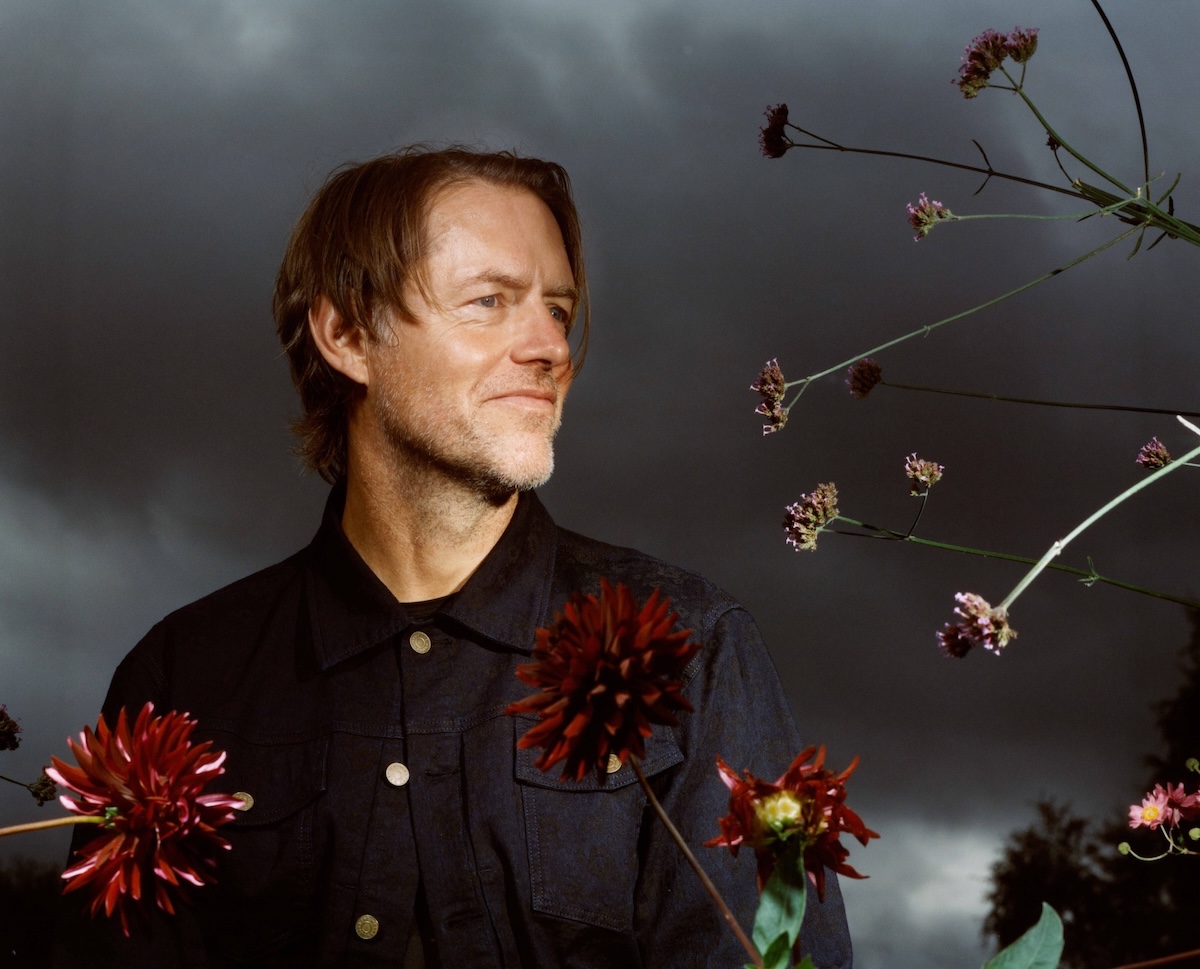
For guitarist Ed O’Brien, the long hiatus of his band Radiohead was a period of darkness and revelation.
The pandemic played a role, mostly as a way of forcing him to pause long enough to face the demons that had followed him from childhood. And his awakening emerged in the new music he has created on his second solo album, the gorgeous, meditative Blue Morpho.
In a video call from his home in Wales, O’Brien repeatedly describes the “dark night of the soul” he experienced under lockdown and after. The feelings of that time can be heard on the album’s opening track, the nearly eight-minute “Incantations,” as the song grows larger and deeper, layering guitars and beats, and O’Brien calmly sings: “Here comes the fear / And the ghosts of long ago / And all these years / I’m still running from it all … Falling deep into the hole.”
Recorded in London with producer Paul Epworth, Blue Morpho unfolds in layers, at times massive or understated. It’s a record of atmosphere and deep feeling, and is the kind of music that can be kept on endless repeat. While Radiohead returned to action after a seven-year hiatus in 2025, making his second solo album—following Earth in 2020—was all-encompassing in new ways.
“My role in Radiohead is to serve the song in a kind of a sonic way, but for my own record, it’s completely different,” he says, comparing his personal songs with the work he does in the acclaimed British group, which he co-founded at age 17. “On a Radiohead album, I traditionally get in the studio early and work on some sounds, and do a lot of R&D, if you like. I just don’t have time to do that on my record, because I’m playing, I’ve got to write this, I’ve got to write lyrics. I’m playing a lot more rhythm guitar, which actually I love.”
For inspiration, O’Brien turned to the work of artists from generations past who experienced their own transformations in the late-’60s and early-’70s. So he explored the moments when Miles Davis went electric, when Sly Stone and Nick Drake found their essential voices, when the Beatles evolved with Revolver.
“I’m a sound obsessive,” adds O’Brien, 58, of his growth through the creation of Blue Morpho. “When you go back into Radiohead world, it’s nice to have the luxury of just playing around with silly boxes and sounds for ages.”
Your first solo record, Earth, begins very electronic with the song “Shangri-La.” This new record is the opposite, opening with the sounds of an acoustic guitar. How does that reflect your state of mind?
It wasn’t a deliberate thing. It just comes out the way that it comes out. This record came from a dark place, and being in a dark night of the soul. The things that came out were written mainly acoustic, because I was in a room, and it was the second [COVID] lockdown, and we couldn’t go anywhere. What I love about the creative process that sometimes happens is that you write a musical motif, or something happens, and then you can kind of hear the whole song. You can imagine the possibility of that thing. It’s bizarre, because within that sound of the acoustic, that’s not the only sound that you’re hearing. It holds the potential of a musical universe in there.
There are songs on the album that are very meditative, and mantra-like.
The music that you make is obviously a direct expression of where you are in life, and it’s also often the kind of music that you want to hear. I’ve taught myself meditation over 20 years, so meditation has been a really important part of my life, and the spiritual aspect of my connection with spirit is very, very important. And what happened in that dark night of the soul is that I really connected on a far deeper place.
It’s interesting because the music that I could listen to in that time, there was a lot of silence in it—I’d listen to Fauré’s Requiem, or I’d listen to Talk Talk’s Spirit of Eden or I’d listen to [Miles Davis’s] In a Silent Way. All these records, there’s a stillness in there. And for me, when you achieve a certain stillness, that’s when spirit comes in, that’s when you feel connected. I feel the same thing with music.
It was to do with mantras and repetition, and these things are part of a spiritual discipline. I wasn’t trying to do it deliberately. I had a feeling that what I’m trying to do is, I’m trying to make sort of sacred music. I listen to a lot of Alice Coltrane, devotional music. I love it, but I don’t want to force it. It has to be a very natural thing, because I also like powerful music. When you hear a track like “Kashmir” by Led Zeppelin, there’s a power to it, there’s a sacredness to that music. I think Zeppelin touched those moments really brilliantly. I listened to [John Coltrane’s] A Love Supreme a lot, trying to understand the language of that, or just the feeling of that. I never force anything, it’s just what comes out, and it’s like feeling, okay, that feels right.
Being in a huge band like Radiohead, are there a lot of considerations when you make a solo record—what you aim for or avoid?
There were on the first record. I was just like, can I do this? I was almost at times paralyzed by the output of where I come from, Radiohead. This record was so far removed from Radiohead, I’d sort of forgotten about Radiohead in a way, and it was very liberating. The first record, I was fraught a lot of the time. I used up a ridiculous amount of nervous energy worrying about that. This one, I just didn’t worry. For me, this record is a co-creation with spirit. I’m literally letting go. There were no rules. I really embraced being in that really uncertain place.
It’s like a river, and just gently steering it, like, “Oh, look, this person came into my life, and he’s a composer called Tõnu Kõrvits from Estonia, and I’ve just heard his work for the first time. Well, we need a string arranger. Why don’t we ask if Tõnu can do it?” It’s that thing in life, when you sort of let go, you surrender. I love the challenge of it, and I love the not knowing and the uncertainty of it.
Your first solo record was made before COVID, and this one came after. How is the dark night of the soul you talk about connected with that period of time?
The only reason it’s connected to that is because it forced all of us to stop, and it forced me to stop. I’d been running from these ghosts of childhood forever. I didn’t realize it, by keeping busy, busy, busy, busy. And in that second lockdown, we couldn’t go anywhere. And it was just like, okay, now you’re gonna listen, and that’s when the depression set in, and I was very lucky. I didn’t have to work, I could be in it. My wife, who is a kinesiologist, was supremely helpful. I love the work of [physician and author] Gabor Maté. I read his book When the Body Says No, and that had a profound impact on me.
People said, oh, you must have been disappointed because your album was released in lockdown. No, a release of an album compared to what was going on in the world at the time was nothing. We had to adjust, but for me lockdown was brilliant, because it forced me to stop, and it forced me to deal with my demons. There was no running, there was no diversions. It was like, okay, you’ve got to walk through the fire, you’ve got to sit in the labyrinth. There’s nowhere to go.
That was what the first song, “Incantations,” is about—being in the labyrinth, and you have to get to a place where you actually see and feel the beauty in the darkness, because there is beauty there. But that means you have to face your fears. Because it’s a soul journey, it’s like Dante’s Inferno, it’s midway through life. I lost myself in the woods. This is the hero’s journey. This is what the sages, the poets, everybody’s written about for eons.
Is there anything you can say about what your demons were about?
The details aren’t important, because it’s not fair to those involved. But it’s like what Gabor Maté says—so much addiction and depression, the seeds of the stuff is all there in childhood. And what happens is you then react as a child and you create this framework in order to survive and deal with life, and then you think that’s how you carry on. That’s your modus operandi, and it stops serving you well after a certain time. They’re just adaptations that you made when you were a very small child in order to get through. So it’s incredibly liberating to go, oh, that’s not me. Then it’s like, who am I?
Are you the Blue Morpho?
Well, you know, it’s funny. I didn’t make that connection until Tõnu Kõrvits heard the album’s second track, and he said, “I love ‘Blue Morpho,’ and that’s obviously a great contender for the name of the album.” I was like, you’re right, but I didn’t think of it. It was right in front of me. Of course, it’s like the caterpillar going into the cocoon, in that place of darkness, and emerges with wings.
Did the words in the title song come right away, or after you’d been working on the album for a while?
Words have been the hardest thing for me. The music is the easier part. I enjoy the struggle of it, and I love words. I really appreciate words in a way. I always loved Thom [Yorke]’s lyrics—and obviously people like Lennon and Dylan and Leonard Cohen and Michael Stipe. But as a guitarist, my focus was always on guitars and melodies and the sound of a band, but what’s been so lovely is this shift to listening to lyrics and loving words. My notebooks are now full of words. I love the art of words and I love the process, but it’s quite challenging still.
That particular track, “Blue Morpho,” is very cinematic with the strings. It must have been quite an experience to record.
It was about letting go. I’d met Tõnu in Estonia at this music conference, and we’d been sat next to one another at a dinner—same age, and the same kind of very interesting reference points, but he’s a classical composer. I listened to his stuff, and it was beautiful. And about three months later, there were a couple of tracks that could benefit from strings. And rather than go to the usual very good string arrangers in London, I was like, I met this guy, and his music’s beautiful. So I emailed him. And I sent him “Blue Morpho” and “Sweet Spot.” And what came back was amazing. They’re like Scott Walker strings.
A very different track is “Teachers,” which has a very deep groove.
It’s very cinematic for me. “Teachers” is all about a psilocybin experience I had in the woods of Dartmoor, which is a very ancient place in Britain, very Celtic. Every year, me and some friends go out and camp next to this Iron Age fort in the woods, and we’ve been doing this for years. We have a fire, and some mushrooms. It’s a very beautiful and amazing experience. They’re always different, and one night, I went out for a walk, it was 1 o’clock in the morning, and these woods are ancient and magical. I was playing around with the chords and I suddenly was like, okay, this is what the song is. It’s about that night.
Radiohead drummer Philip Selway plays on a couple of tracks. It has been interesting seeing his solo stuff as well—to see Radiohead’s different members create by themselves, and then going in their own direction.
Philip has this incredible groove, and he has this weight to what he does. I’ve said this before: The two things that most identify Radiohead are Thom’s voice and Philip’s drums—the feel. Phil’s feel is extraordinary.
Most of the people on this record are not in Radiohead. How do you go about getting your players together?
For the other musicians, I basically went to [guitarist-bassist] Dave Okumu. Dave has his band, the 7 Generations, and I’d seen them live and said, “I think these guys will be the perfect fit for what I’m looking for.” He has created this community, this village of musicians. First and foremost, they are incredibly talented, but secondly, really good people, great souls.
[Flutist] Shabaka [Hutchings] was an amazing one. I saw him play at Glastonbury in 2023, and it was when he’d announced he was no longer going to play the sax. He wanted to immerse himself in the world of flutes. And I saw him do this beautiful set up on this hill at the Glastonbury Festival. My whole record’s recorded at 432 Hertz. It’s a really important frequency. And I said to him, “Are any of your flutes some 432 Hertz?” I had a stellar cast of beautiful souls and musicians.
It’s interesting you bring up that frequency. I recently talked with Ziggy Marley, and he’s now recording everything at that frequency.
Really? It’s huge, Steve. Everyone, including my own bandmates [in Radiohead], when I suggested it, thought I was fucking mad and thought I was a New Ager. For “Blue Morpho” and “Sweet Spot,” the players took about an hour to get used to going slightly flatter, because they’re not used to it, because their pitch is at 440, or concert pitch, which is 442.
I’m so pleased to hear that Ziggy Marley’s doing it. Ten years ago people laughed at me. I remember I put it on my Instagram or something, and people were like, “You aren’t into that hippie bollocks!” But so many people are embracing it now. It’s powerful stuff.
Ziggy made his new album, Brightside, that way and says he’s never going back.
Beautiful. No, me neither. I’m never going back. I started it on the previous record. I couldn’t do it [fully] because of pianos and keyboards, so I could only do the songs with just guitars. But I started on this journey in 2013, and on this record, I was just like, okay, I have to commit.
Are you still an outlier? Did you bring that up again to Radiohead?
It’s interesting, because…when I mentioned it for Moon Shaped Pool right at the beginning, in 2014, I was evangelical about it. They looked at me and were like, “We’re not going to do that.” But Thom said to me about three or four years later, “You know that thing you were talking about? Aphex Twin has been banging on about it.” There are a lot of people who feel it and who are curious. There feels like a groundswell, particularly in the last six years.
In one of your recent interviews, you were quoted as referring to Radiohead’s pause as having been a breakup. Was it an actual breakup or sort of an open-ended hiatus?
No! Someone must have misinterpreted me. It was never a breakup. It was a hiatus. We wouldn’t be that stupid. We just needed a break. I mean, it’s like family. Everybody needed to get out of the house. You need to leave home, right? And we come back every year for Christmas.
That was the end of a chapter. The bonds and the relationships, it’s family. Our kids love one another, they’re like cousins. They have this bond as the kids of guys in Radiohead, families in Radiohead. Only they know that experience. It’s this beautiful thing, so we would never split up. That would be crazy.
And Blue Morpho came out of that break for you?
Yeah, and what’s lovely is that Philip’s making records, Thom and Johnny [Greenwood], obviously, are hugely creative, and they’ve got Smile and soundtracks and all sorts of stuff. And Colin [Greenwood] is a Bad Seed, playing with Nick Cave, which is a beautiful fit. I’m doing my thing.
It was so lovely last year coming back together. In a way, I can feel more objective about Radiohead. I haven’t really thought about it for the last seven years, but now I think, “Wow, that’s pretty amazing—all members of the band are still being really creative and doing stuff.” It shows how much we love music, and it shows that Radiohead was like going to a good college. We’re still doing it for the right reasons. We’re doing it because we love it.